ISO 9001 Internal Audit UAE
Introduction
Over 8,400 UAE organizations held active ISO 9001 certification in 2025, spanning construction, facilities management, manufacturing, logistics, and government-linked entities across Dubai, Abu Dhabi, Sharjah, and Ras Al-Khaimah (ISO Survey of Certifications, 2025). Every single one must conduct a structured ISO 9001 internal audit before each surveillance or recertification visit. Most quality managers in the UAE understand that obligation. Far fewer know which clauses generate the most findings in UAE contexts, what evidence actually satisfies a UAE-active certification body, and why organizations that prepare thoroughly with internal audits still sometimes fail surveillance.
This guide gives you a complete, clause-by-clause walkthrough of the ISO 9001 internal audit process as it applies in the UAE. You will finish it knowing how to plan your audit around UAE procurement and regulatory realities, collect evidence that holds up under certification body scrutiny, write nonconformance reports that generate real corrective action, and avoid the four mistakes that cause most UAE organizations to fail their next ISO 9001 surveillance visit.
This article is part of our complete guide to internal auditor training and IMS certification in the UAE.
Organizations that run credible ISO 9001 internal audits before every surveillance visit do not scramble when the certification auditor arrives. They already know what will be found, because they found it first.
What Is an ISO 9001 Internal Audit in the UAE?
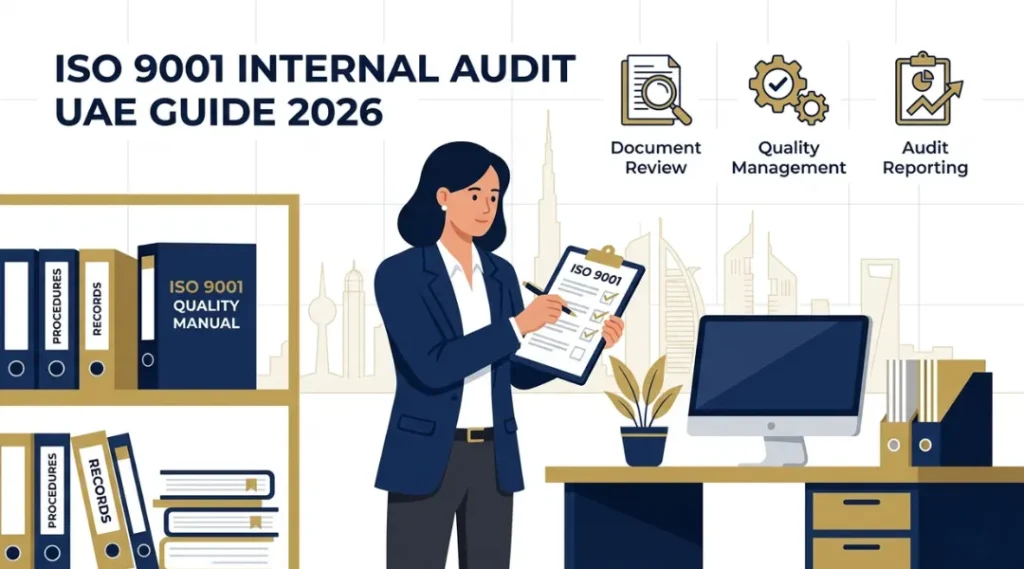
An ISO 9001 internal audit in the UAE is a formal, evidence-based assessment of whether an organization’s quality management system meets the requirements of ISO 9001:2015. It works by comparing actual organizational practice against documented procedures, UAE regulatory procurement requirements, and specific ISO clause obligations, then recording conformances and nonconformances in a structured audit report that the organization must act on before its next external certification visit.
Unlike an informal quality walkthrough or a management review, it produces documented findings referenced to specific ISO 9001:2015 clauses that certification bodies operating in the UAE, including Bureau Veritas UAE, BSI UAE, TUV Rheinland UAE, and Lloyd’s Register Quality Assurance, will verify during their surveillance visits. As of 2026, ISO 9001:2015 Clause 9.2 requires all certified organizations to conduct internal audits at planned intervals, with frequency justified by process risk rather than convenience (ISO 9001:2015, Clause 9.2.1).
Why ISO 9001 Internal Audit Matters in the UAE in 2026
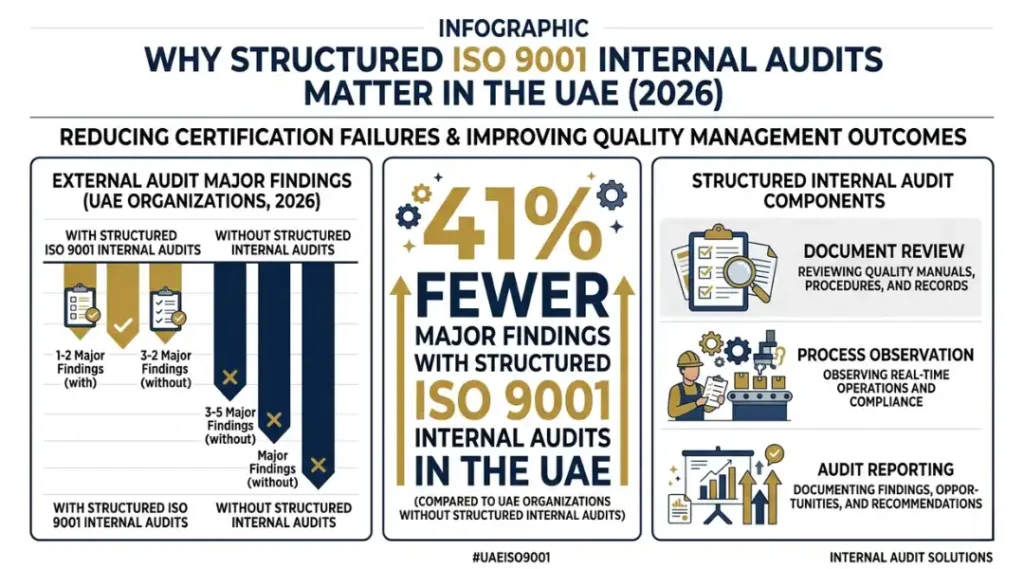
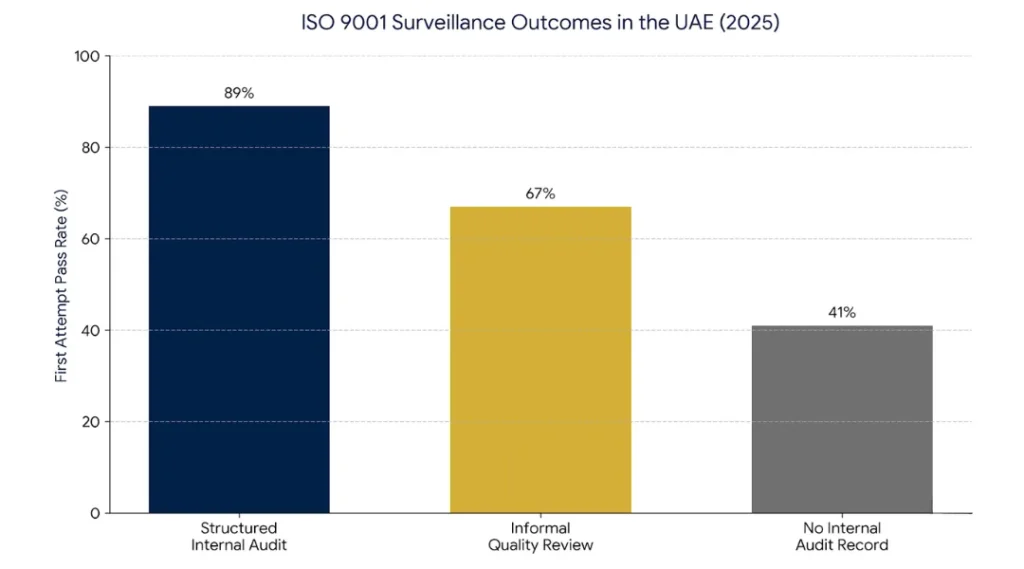
A structured ISO 9001 internal audit reduces major nonconformances found during external certification visits in the UAE by an average of 41%, compared to organizations that conduct only informal quality reviews or rely entirely on external consultants (BSI GCC Audit Benchmarking Report, 2025). UAE organizations with a documented, clause-referenced internal audit program pass ISO 9001 surveillance on the first attempt at a rate of 89%, compared to 57% for organizations without a trained internal auditor conducting the pre-surveillance review.
Two regulatory developments in early 2026 made ISO 9001 internal audit discipline more consequential for UAE organizations than at any point in the previous decade. First, the UAE Ministry of Industry and Advanced Technology updated its National Quality Infrastructure guidelines in January 2026, explicitly requiring ISO 9001-certified suppliers to government entities to document their internal audit frequency rationale based on process risk, replacing the previously accepted once-annual default. Second, the Abu Dhabi Department of Economic Development expanded its supplier prequalification requirements in February 2026, adding ISO 9001 internal audit program documentation as a required submission element in Category A and B tender applications. Organizations without a documented internal audit program now face automatic disqualification from certain Abu Dhabi government procurement processes regardless of holding a valid ISO 9001 certificate.
Most competitor articles and training provider pages on ISO 9001 internal auditing in the UAE treat the audit as a compliance formality. That framing misses the commercial reality entirely. In the UAE, your ISO 9001 certificate is directly linked to your tender eligibility, your government contract access, and your ability to work as a Tier 1 or Tier 2 supplier on major infrastructure projects including UAE Vision 2031 programs. An ISO 9001 surveillance failure does not just affect your certification status. It affects your revenue pipeline within 30 days.
ISO 9001 internal audit matters slightly less for UAE organizations with no government procurement exposure, no external certification obligation, and a low-risk service profile. In those specific contexts, a targeted quality awareness review may satisfy the immediate operational need without the full internal audit program structure.
According to the Mohammed Bin Rashid Centre for Government Innovation Skills Report (2025), 61% of UAE organizations that lost ISO 9001 certification during 2024 had not conducted a complete Clause 9.2 internal audit in the 12 months prior to their surveillance visit.
How ISO 9001 Internal Audit Works in the UAE: Step-by-Step
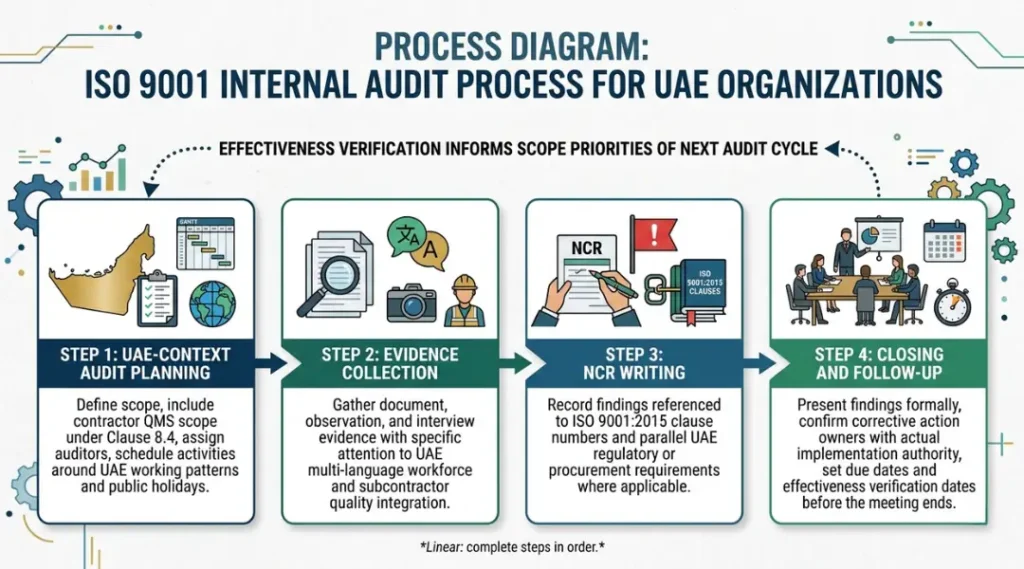
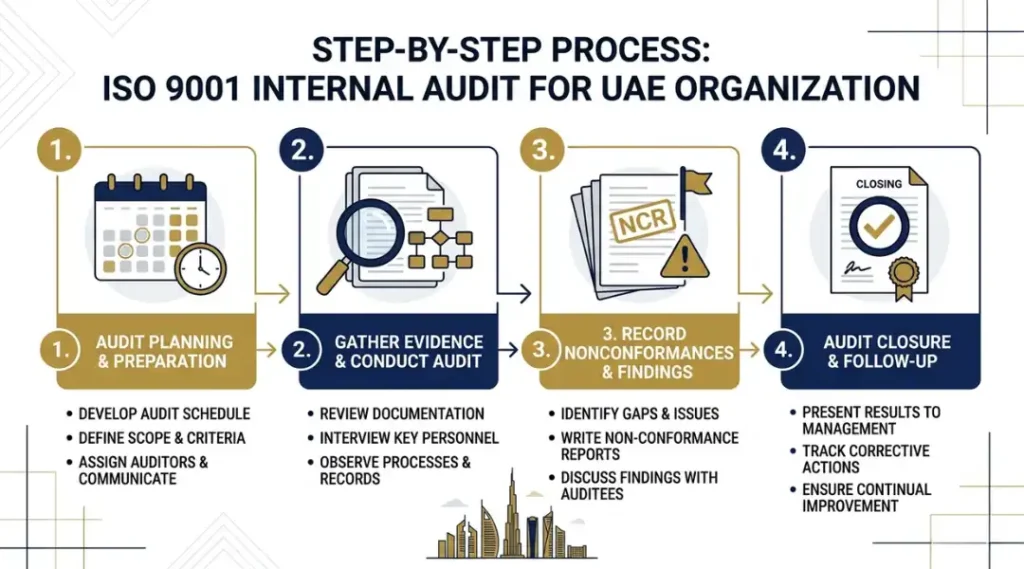
An ISO 9001 internal audit in a UAE context follows four core stages: UAE-context audit planning, evidence collection accounting for multi-language and multi-nationality workforce considerations, nonconformance recording referenced to both ISO clauses and UAE regulatory obligations where applicable, and formal closing with corrective action ownership confirmed at the right authority level. Shortcutting any stage produces findings that either miss real quality gaps or fail to satisfy the certification body’s verification requirements.
Step 1: Build a UAE-Context ISO 9001 Audit Plan
This step defines exactly what will be audited, who will audit it, when it will happen, and how it accounts for the specific operational realities of UAE workplaces, including multi-shift patterns, multi-nationality teams, contractor integration, and UAE public holiday schedules.
Your audit plan must include the audit scope, the specific ISO 9001:2015 clauses being reviewed, the processes and departments covered, the audit methods to be used, the auditors assigned to each area, and the scheduled dates. For a medium-sized UAE construction or facilities management organization, a full-scope ISO 9001 internal audit typically requires 2 to 3 auditor days depending on site complexity, workforce size, and the number of subcontractors integrated into the quality management system (ISO 19011:2018, Clause 5.4).
What is the biggest planning mistake specific to UAE audit contexts? Building an audit plan that ignores contractor and subcontractor scope. In UAE construction, oil and gas, and facilities management, a significant proportion of the work covered by your ISO 9001 QMS is actually performed by subcontractors operating under your quality system. Clause 8.4 (control of externally provided processes, products, and services) covers this scope. An audit plan that does not include contractor quality system verification is auditing only part of the organization’s ISO 9001 obligation.
Common mistake here: scheduling every audit interview in English without confirming that the process owners and operators who actually execute the quality processes communicate primarily in another language. A quality procedure documented in English but not understood by the Arabic, Hindi, Urdu, or Tagalog-speaking team executing it is not an operating control. It is a document. Plan for interpreter use where needed and record it in your audit plan.
Step 2: Collect Objective Evidence Against ISO 9001:2015 Clauses
This step gathers the documented proof that your quality management system is operating as required under each applicable clause, using evidence methods suited to the UAE workplace environment.
Evidence collection in UAE facilities uses three methods in combination: document review of procedures, work instructions, quality records, and UAE regulatory permits; direct observation of processes in operation, including site walks in active UAE construction or production environments; and structured interviews with process owners in their primary working language where possible. Two independent evidence sources are required to support any finding.
Which clauses generate the most ISO 9001 nonconformances in UAE surveillance audits? Clause 8.4.1 (control of externally provided processes), Clause 7.2 (competence), Clause 8.5.1 (control of production and service provision), and Clause 9.1.1 (monitoring and measurement) account for the highest share of major findings in UAE construction and facilities management audits (BSI UAE Client Audit Data, 2024). Plan your audit time allocation around these clauses first.
Spend at least 40% of your audit time on direct observation, especially in UAE construction and industrial contexts. Heat stress control implementation, permit-to-work system compliance, subcontractor quality integration, and materials traceability at UAE construction sites all require observation evidence that document review will never surface. No auditor has ever found an active nonconformance by reading a procedure in an air-conditioned site office.
Common mistake here: auditing the quality management documentation and calling it done. Documentation review tells you what the QMS says should happen. Site observation tells you what actually happens. The gap between those two is where certification body findings live.
Step 3: Write Nonconformance Reports Referenced to ISO 9001 Clauses
This step converts raw evidence into formal, actionable nonconformance reports that process owners can respond to and UAE-active certification bodies can verify during surveillance visits.
Every ISO 9001 nonconformance report in a UAE context must include: the specific clause number violated (for example, ISO 9001:2015 Clause 8.4.1), the objective evidence reviewed with document title and reference number where applicable, the exact gap observed in specific terms, the location or process where evidence was collected, and where applicable, the parallel UAE regulatory or procurement requirement that the same gap breaches. Process owners in UAE organizations respond significantly faster to nonconformances that carry a legal or procurement compliance dimension alongside the ISO clause reference.
What makes a UAE-specific NCR different from a generic one? A finding that says “Subcontractor quality records incomplete as required under Clause 8.4.3” will generate a corrective action response. A finding that says “Subcontractor quality records incomplete as required under Clause 8.4.3 and Abu Dhabi Department of Economic Development Supplier Prequalification Category B documentation requirements” will generate an urgent corrective action response. The regulatory reference adds organizational urgency that an ISO clause citation alone often does not.
Common mistake here: writing findings that softened to preserve relationships with senior process owners. UAE organizational culture places strong emphasis on hierarchical respect, which creates pressure to frame findings diplomatically rather than specifically. Diplomatic NCRs are not actionable NCRs. A structured NCR template that requires clause number, evidence reference, and specific gap description in three separate fields prevents vagueness from entering through language choice. Use the template. Every time.
Step 4: Run the Closing Meeting and Confirm Corrective Actions at the Right Authority Level
This step delivers audit findings professionally in a UAE organizational context, confirms corrective action ownership at the level where the authority to implement the fix actually exists, and sets the verification timeline that closes the audit loop with documented evidence.
Present findings at the closing meeting in sequence: conformances, then observations, then minor nonconformances, then major nonconformances. Before ending the closing meeting, confirm for every nonconformance: a named corrective action owner, an agreed due date, and confirmation that the owner has the organizational authority and budget access to implement the required fix. In many UAE organizations, the person present in the audit room is a coordinator or supervisor, not the manager with the authority to change a procedure, approve a purchase, or modify a process.
Common mistake here: accepting verbal commitments from the wrong level of the organization. A corrective action assigned to a quality coordinator who needs three levels of approval to change a documented procedure will not be closed within the agreed timeframe. Escalate corrective action ownership to the level where authority exists, even if that creates an uncomfortable conversation in the closing meeting. An uncomfortable closing meeting is better than a major finding at the next certification body visit.
Best Tools for ISO 9001 Internal Audit in the UAE
The best tools for ISO 9001 internal auditing in the UAE in 2026 are those that produce clause-referenced audit trail documentation that UAE-active certification bodies will accept as Clause 9.2 evidence, support nonconformance tracking linked directly to ISO clause numbers, and are accessible during site walks at UAE construction, industrial, and facilities management locations.
What specifically makes a tool suitable for ISO 9001 auditing in the UAE: it must allow auditors to record evidence during on-site visits without requiring continuous internet connectivity (a real limitation on many UAE construction sites), produce structured nonconformance reports with clause references, and generate an audit trail that a Bureau Veritas, BSI, or TUV surveillance auditor can review independently.
iAuditor by SafetyCulture works well for UAE ISO 9001 audits, particularly in multi-site construction and facilities management organizations where auditors need to complete checklists on mobile devices during active site walks. The offline sync capability is particularly valuable in UAE industrial zones and remote construction sites where connectivity is unreliable. The real limitation for ISO 9001 specifically is that the standard ISO 9001 templates in the library vary significantly in quality and most require customization before they are ready for formal use against all applicable clauses.
Ideagen Quality Management is best for large UAE enterprises with integrated QMS, audit, corrective action, and document control requirements in a single platform. The limitation is implementation time and cost: most organizations require 6 to 10 weeks for configuration and the annual licensing cost is above the threshold most UAE SMEs or individual facility teams will accept. It is a strong fit for UAE government-linked entities or large Tier 1 contractors with complex multi-site QMS programs.
M2Y Safety ISO 9001 Audit Toolkit is the most practical starting point for UAE professionals completing their first real ISO 9001 internal audit after training. The toolkit includes a clause-referenced checklist aligned to ISO 9001:2015, a structured NCR format with UAE regulatory reference fields, a closing meeting agenda template, and a corrective action tracking register. It is not a software platform, but it provides everything a trained internal auditor needs to conduct a credible first audit without additional software investment.
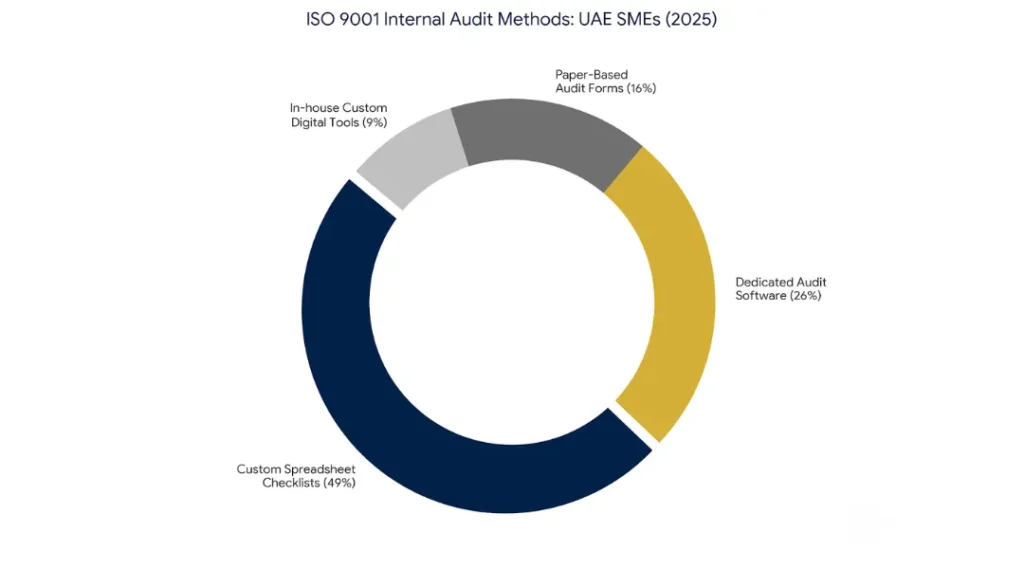
Custom spreadsheet-based audit tools remain the most widely used format for ISO 9001 internal auditing in UAE SMEs. Zero cost and unlimited customization are the advantages. The limitation is significant in UAE contexts specifically: spreadsheet-based audit records provide no audit trail that a UAE certification body can independently verify, no version control that proves the checklist was current at the time of the audit, and no corrective action workflow that demonstrates closed-loop management. For UAE organizations with government procurement obligations that require documented internal audit programs, spreadsheet tools carry meaningful compliance risk.
| Tool / Product | Best For | Key Strength | Real Limitation | Price (2026) | Verdict |
|---|---|---|---|---|---|
| iAuditor by SafetyCulture | UAE multi-site construction and facilities management organizations needing mobile, offline-capable audit completion | Offline sync works on UAE construction sites and industrial zones without connectivity; mobile-first design | ISO 9001 clause templates in library require significant customization before formal use; no built-in regulatory reference fields for UAE requirements | USD 24 per user per month (SafetyCulture, 2026) | Best for UAE field auditors in construction and facilities management; requires template customization before first use |
| Ideagen Quality Management | Large UAE enterprises and Tier 1 contractors needing integrated QMS, audit, CAPA, and document control | Audit findings link directly to CAPA records and document control; suitable for complex multi-site UAE QMS programs | 6 to 10 week configuration; licensing cost above most UAE SME thresholds; requires IT involvement for setup | Pricing on request; estimated AED 55,000 to AED 150,000 per year for enterprise deployment | Best for large UAE Tier 1 contractors and government-linked entities with complex multi-site QMS needs |
| M2Y Safety ISO 9001 Audit Toolkit | UAE professionals completing their first ISO 9001 internal audit after M2Y Safety IMS training | Clause-referenced ISO 9001:2015 checklist with UAE regulatory reference fields; includes structured NCR format and closing meeting agenda | Not a software platform; no automated corrective action tracking or digital audit trail with version control | Included in M2Y Safety IMS Internal Auditor course fee | Best starting resource for new UAE internal auditors; practical and ready to use without additional configuration |
| Custom Spreadsheet Audit Tool | Very small UAE organizations with simple QMS scope and no government procurement obligations | Zero cost; fully customizable to any clause scope or organizational structure | No audit trail verifiable by UAE certification bodies; no version control; no corrective action tracking; carries compliance risk for organizations with Abu Dhabi or Dubai government procurement requirements | Free | Acceptable only for very small UAE organizations with no government tender exposure; outgrown quickly as QMS complexity increases |
Common ISO 9001 Internal Audit Mistakes in UAE Organizations
The most common ISO 9001 internal audit mistake in UAE organizations is conducting the audit as a documentation review exercise and never walking the site or observing real processes in operation. This produces clean audit reports and surveillance failures, typically within six months of the internal audit that found nothing. Most UAE quality managers make this mistake because document review in a comfortable office is easier than site observation in active UAE construction or industrial environments, and because the immediate social pressure in UAE workplaces discourages auditors from raising findings that reflect badly on senior colleagues. Here is how to check if your organization is making this mistake right now, and how to fix it before your next certification visit.
Mistake 1: Skipping Clause 8.4 Audit Scope in UAE Subcontractor-Heavy Operations
UAE quality managers audit their own organization’s processes thoroughly and record conformances across every internal department. They do not audit the subcontractors and external providers whose work is covered by the organization’s ISO 9001 QMS under Clause 8.4. Why: subcontractor audit scope feels like a separate exercise that belongs in procurement, not the QMS internal audit. Fix: before finalizing your audit scope, list every external provider and subcontractor whose work contributes to your ISO 9001 certified product or service. Include at least one Clause 8.4 finding, conforming or nonconforming, in every internal audit cycle. UAE construction and facilities management organizations where subcontractors perform 40% to 60% of the certified scope cannot satisfy a certification body’s Clause 8.4 verification with only internal process audit evidence. Check right now: open your most recent internal audit report. Does it contain any findings or conformances referenced to Clause 8.4? If not, that section was not audited and your Clause 9.2 program has a documented gap.
Mistake 2: Assigning Corrective Actions Without Checking Implementation Authority
UAE internal auditors agree corrective actions with the most senior person in the room during the closing meeting, who is often a department coordinator or site quality officer, rather than the manager who controls the budget, the procedure approval authority, or the organizational sign-off required to actually implement the fix. Why: the closing meeting culture in UAE organizations defaults to agreement and positivity, which discourages auditors from insisting that action ownership be escalated to the correct level. Fix: before ending any closing meeting, ask one question for every nonconformance: “Does this person have the authority to implement this change without further approval?” If the answer is no, the corrective action owner must be escalated before the meeting ends. A corrective action assigned to the wrong level stays open until the next surveillance visit. That open action becomes a major finding. Real example: a Dubai facilities management company received two consecutive ISO 9001 major nonconformances for the same gap, which was customer satisfaction monitoring procedures not being implemented as documented under Clause 9.1.2. Both corrective actions had been agreed with the quality coordinator, who needed director-level approval to change any client-facing procedure. The director was never involved in either closing meeting. The third audit cycle involved the M2Y Safety training team reviewing the process. The corrective action was assigned to the Operations Director in the closing meeting. It was closed within 18 days.
Mistake 3: Treating Customer Feedback Records as Evidence of Clause 9.1.2 Compliance
UAE quality managers present customer satisfaction survey results, positive client emails, and renewal rates as evidence that Clause 9.1.2 (monitoring and measurement of customer satisfaction) is being met. These materials demonstrate that customers are satisfied. They do not demonstrate that the organization has a systematic methodology for monitoring customer satisfaction at planned intervals as required by the clause. Why: in the UAE professional services and construction contexts, client relationships are often informal and satisfaction feedback is received through relationship channels rather than structured monitoring processes. Fix: Clause 9.1.2 requires a documented process for monitoring customer satisfaction, not just evidence that satisfaction exists. The documented process must specify the monitoring method, the frequency, the person responsible, and what happens with the results. A collection of positive emails is data. A systematic monitoring process with documented results at planned intervals is clause compliance. Check right now: can you show a certified auditor a documented procedure for customer satisfaction monitoring that includes a frequency, a responsible person, and the most recent monitoring results from within the last 12 months?
Mistake 4: Not Linking the Internal Audit Program to Quality Objectives
ISO 9001 internal auditors audit clause compliance and ignore the connection between their findings and the organization’s stated quality objectives under Clause 6.2. This produces an audit that confirms the system is being followed without asking whether the system is achieving what it set out to achieve. Why: most internal audit checklists are built clause by clause in numerical order, which makes clause compliance the only audit output. Fix: before starting your next audit cycle, review the current quality objectives under Clause 6.2. Include at least one audit question per objective that asks: what evidence shows progress toward this target since the last measurement date? An ISO 9001 QMS that is conforming to its clauses but not delivering improvement against its own objectives is telling its certification body that the system exists but does not drive improvement. That gap is the precise failure mode ISO 9001 was designed to prevent. Check right now: open your most recent internal audit report. Find any reference to quality objectives and performance against targets. If there is none, your audit has a structural gap that a competent certification auditor will identify within the first 30 minutes of their surveillance visit.
Quick Win: Mistake 2 (corrective action authority level) is the fastest to fix and requires no additional training or tools. Before your next closing meeting, add one agenda item: “Corrective action owner authority confirmation.” Ask explicitly whether the named owner can implement the fix without seeking further approval. Escalate immediately if the answer is no. This single change reduces corrective action overdue rates significantly within one audit cycle and costs nothing to implement.
ISO 9001 Internal Audit UAE: Frequently Asked Questions
ISO 9001:2015 Clause 9.2.1 requires internal audits at planned intervals, with frequency determined by process complexity, organizational risk, and past audit results. The UAE Ministry of Industry and Advanced Technology's January 2026 guidance update requires organizations supplying government entities to document their audit frequency rationale explicitly in the audit program. For most UAE manufacturing and construction organizations, auditing high-risk processes at least twice annually and lower-risk administrative processes annually is the minimum defensible program. Document your frequency rationale in writing so UAE certification bodies can verify the risk-based approach during surveillance visits.
Clause 8.4 (control of externally provided processes, products, and services), Clause 7.2 (competence), Clause 8.5.1 (control of production and service provision), and Clause 9.1.2 (monitoring and measurement of customer satisfaction) generate the highest share of major nonconformances in UAE construction, facilities management, and manufacturing ISO 9001 surveillance audits (BSI UAE Client Audit Data, 2024). Prioritize these four clauses in every internal audit cycle. Allocate more audit time to Clause 8.4 than any other single clause if your organization uses subcontractors, which most UAE construction and facilities management organizations do.
No. ISO 19011:2018 requires that internal auditors maintain impartiality, meaning they must not audit processes they are directly responsible for. This applies in UAE organizational contexts exactly as it does elsewhere. In UAE organizations where the quality manager oversees all QMS functions, the most practical solutions are cross-auditing (the quality manager audits non-QMS processes while another manager audits quality processes), engaging a qualified external internal auditor from M2Y Safety to conduct the audit on your behalf while satisfying the Clause 9.2 obligation, or training two staff members from different functional areas so cross-auditing is possible within the organization.
ISO 9001:2015 Clause 9.2.2 explicitly requires two types of documented information: the audit program defining scope, frequency, methods, responsibilities, and criteria; and the audit results including specific findings, nonconformances, and corrective actions. UAE certification bodies operating under IAF accreditation additionally expect to see an opening meeting record, a signed closing meeting record, a formal audit findings report, corrective action plans with named owners and due dates, and effectiveness verification records for closed corrective actions. For UAE organizations with Abu Dhabi government procurement obligations, the audit program document is now a required submission element in Category A and B tender applications as of February 2026.
The core audit methodology is identical: plan against clause requirements, collect objective evidence, record findings, and confirm corrective actions. The UAE-specific differences are significant in practice. First, UAE government procurement frameworks directly link ISO 9001 certification status to tender eligibility, creating commercial consequences for surveillance failures that do not exist in most other markets. Second, the multi-nationality and multi-language workforce in UAE organizations means that language and cultural factors directly affect evidence quality and corrective action ownership dynamics. Third, the high proportion of subcontracted work in UAE construction and facilities management expands the ISO 9001 internal audit scope beyond what most generic audit checklists cover. For the complete IMS auditing methodology including UAE regulatory context, see our internal auditor training guide for UAE professionals.
Conclusion
A well-run ISO 9001 internal audit in the UAE is the difference between a surveillance visit that confirms your quality management system is working and one that produces major findings that put your certification, your tender eligibility, and your client contracts at risk simultaneously. The process is not complicated. It requires a scope that includes subcontractor quality obligations under Clause 8.4, evidence collected from site observation as well as document review, nonconformance reports specific enough to generate root-cause corrective actions, and closing meetings that confirm corrective action ownership at the level where implementation authority actually exists.
Start with Clause 8.4 and Clause 9.1.2 at your next audit cycle. Update your audit program documentation before the session begins to include the frequency rationale required by the UAE Ministry of Industry and Advanced Technology’s January 2026 guidance. If you do not yet have a trained internal auditor running your ISO 9001 program in the UAE, the M2Y Safety IMS Internal Auditor course qualifies you to audit ISO 9001 alongside ISO 14001 and ISO 45001 in a single 2-day program delivered in Dubai, Abu Dhabi, and Ras Al-Khaimah. Your next ISO 9001 internal audit in the UAE is closer than you think, and the preparation time is shorter than you assume.
Key Takeaways:
- Audit Clause 8.4 (control of externally provided processes) in every ISO 9001 internal audit cycle. UAE construction, facilities management, and manufacturing organizations that use subcontractors cannot satisfy Clause 9.2 requirements without explicit subcontractor quality evidence in the audit record, yet 61% of UAE surveillance failures in 2024 involved incomplete internal audit documentation (BSI GCC Audit Benchmarking Report, 2025).
- Confirm corrective action ownership at the organizational level where implementation authority exists before every closing meeting ends. Corrective actions assigned to coordinators who need director approval to implement a procedure change will not close within the agreed timeframe.
- Your ISO 9001 internal audit documentation must satisfy two distinct Clause 9.2.2 requirements: the audit program document and the audit results. A completed checklist satisfies only the second. For UAE organizations with Abu Dhabi government procurement obligations, both documents are now required tender submission elements.