ISO 45001 Certification in UAE
Why ISO 45001 Certification Is Your Competitive Edge in UAE's Safety-Conscious Market
A multinational corporation is selecting contractors for a AED 50 million project in Dubai. Three qualified bidders make the final round. Two have strong safety records. But only one holds ISO 45001 certification—internationally recognized proof of systematic occupational health and safety management.
Guess who wins the contract?
In today’s UAE business environment, ISO 45001 certification isn’t just a nice-to-have credential—it’s increasingly the price of entry for major projects, international clients, and government contracts.
According to the International Organization for Standardization, over 190,000 organizations in 127 countries have adopted ISO 45001 since its release in 2018. In the UAE, where workplace safety regulations continue tightening and major contractors demand supply chain safety excellence, ISO 45001 certification represents a strategic business advantage.
But ISO 45001 delivers more than marketing benefits. Organizations implementing this standard experience:
- 35-40% reduction in workplace incidents (ISO survey data)
- 20-30% decrease in workers’ compensation costs
- 15-25% improvement in employee productivity and morale
- 10-20% reduction in insurance premiums
Whether you’re:
- A business owner seeking competitive differentiation
- A safety professional advancing your expertise
- An auditor building consulting credentials
- A project manager meeting client requirements
Understanding ISO 45001 certification and training pathways is essential for success in UAE’s evolving safety landscape.
This comprehensive guide explains what ISO 45001 is, its benefits, implementation requirements, training options (including lead auditor certification), and how to achieve certification in the UAE.

What Is ISO 45001?
ISO 45001:2018 Occupational Health and Safety Management Systems is the international standard specifying requirements for implementing, maintaining, and continually improving occupational health and safety (OH&S) management systems.
Released in March 2018, ISO 45001 replaced the previous OHSAS 18001 standard, providing a globally unified framework for managing workplace health and safety risks.
The standard helps organizations:
- Proactively prevent work-related injuries, ill health, and fatalities
- Provide safe and healthy workplaces
- Continually improve OH&S performance
- Meet legal and regulatory requirements
- Achieve strategic OH&S objectives
ISO 45001 applies to any organization regardless of size, industry, or geographic location. From small businesses to multinational corporations, construction companies to healthcare facilities, manufacturing plants to service providers—any organization with employees can benefit from ISO 45001 certification.
ISO 45001 vs. Other Safety Standards
ISO 45001 vs. OHSAS 18001:
- OHSAS 18001 was the predecessor British Standard (now withdrawn)
- ISO 45001 is the international replacement with enhanced requirements
- Organizations certified to OHSAS 18001 transitioned to ISO 45001 by March 2021
- ISO 45001 emphasizes leadership involvement and worker participation more strongly
ISO 45001 vs. UAE OH&S Regulations:
- UAE regulations (Cabinet Resolution 37/2018) establish minimum legal requirements
- ISO 45001 provides systematic framework exceeding minimum compliance
- ISO 45001 certification demonstrates compliance with UAE law plus international best practices
- Many UAE entities require contractors to hold ISO 45001
ISO 45001 vs. OSHAD (Abu Dhabi):
- OSHAD is Abu Dhabi’s specific OH&S framework
- ISO 45001 is internationally recognized
- Many organizations implement both (OSHAD for Abu Dhabi operations, ISO 45001 for broader recognition)
- OSHAD certification can complement ISO 45001
The Business Case for ISO 45001 in UAE
Regulatory Alignment: UAE federal and emirate-level OH&S regulations increasingly expect systematic safety management. ISO 45001 provides proven framework meeting and exceeding these requirements.
Client Requirements: Major UAE and international clients often mandate ISO 45001 certification for contractors and suppliers, particularly in construction, oil and gas, manufacturing, and facilities management.
Insurance Benefits: Insurance providers offer premium reductions (typically 10-20%) for ISO 45001 certified organizations due to demonstrated risk management.
Tender Advantages: Government and private sector tenders frequently award evaluation points for ISO certifications, directly improving bid competitiveness.
International Credibility: ISO 45001 is recognized globally, facilitating international business expansion and demonstrating commitment to world-class safety standards.
Legal Protection: Systematic OH&S management provides documentation demonstrating due diligence, valuable in legal proceedings following incidents.
Talent Attraction: Top professionals seek employers genuinely committed to safety. ISO 45001 certification signals this commitment credibly.
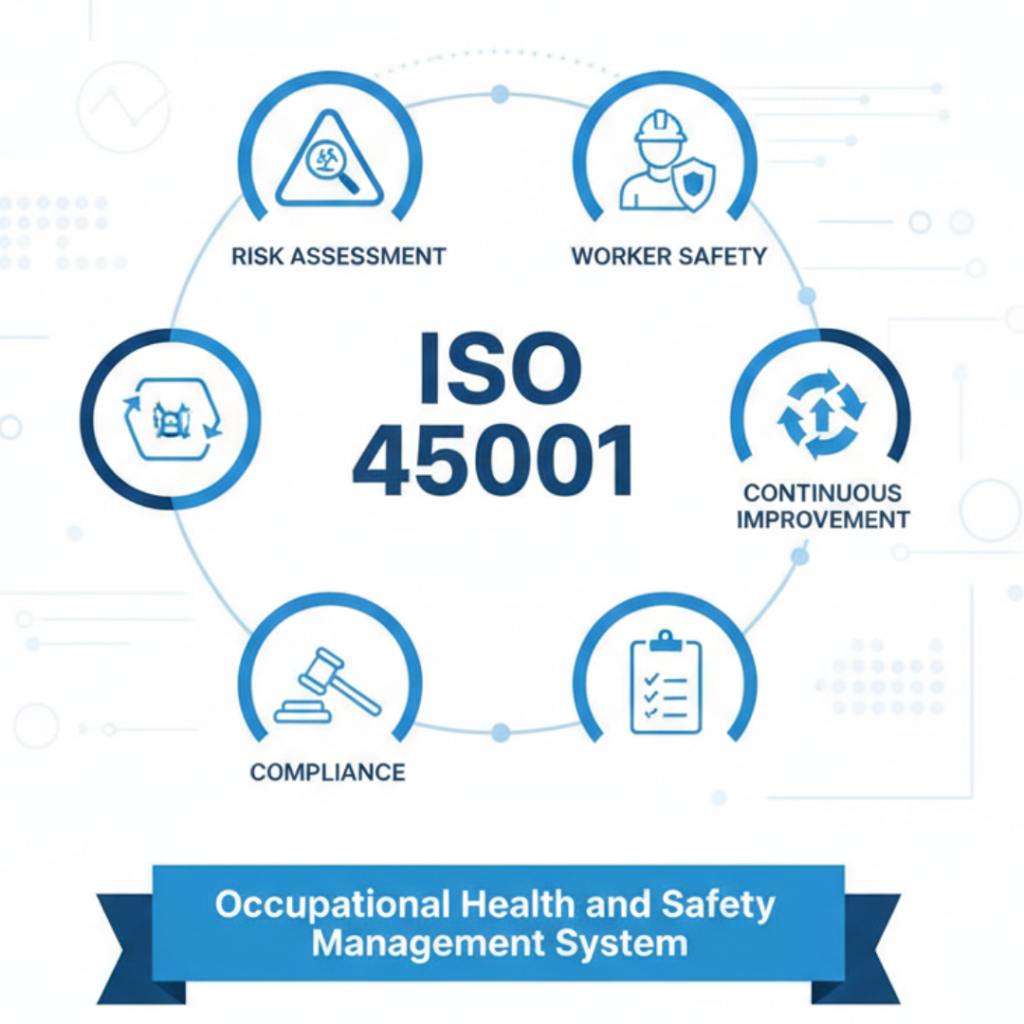
Understanding ISO 45001: Key Requirements
ISO 45001 follows the High-Level Structure (HLS) common to all ISO management system standards, facilitating integration with quality (ISO 9001) and environmental (ISO 14001) systems.
The 10 Clauses of ISO 45001
Clauses 1-3: Introduction, Scope, Terms
- Standard introduction and definitions
- Not auditable requirements
Clause 4: Context of the Organization
Organizations must understand:
- Internal and external issues affecting OH&S management system
- Interested parties (employees, regulators, clients, community)
- OH&S management system scope (what’s included/excluded)
Practical application:
- SWOT analysis identifying OH&S factors
- Stakeholder mapping and needs assessment
- Documented scope statement
Clause 5: Leadership and Worker Participation
Top management must:
- Demonstrate commitment and accountability
- Establish OH&S policy
- Assign roles, responsibilities, and authorities
- Ensure consultation and participation of workers
Worker participation requirements:
- Access to necessary information
- Opportunity to participate in safety decisions
- Mechanisms for reporting hazards and making suggestions
- No barriers or retaliation for participation
This is a game-changer: Unlike older standards, ISO 45001 requires active worker involvement, not just management-driven safety programs.
Clause 6: Planning
Organizations must address:
Risks and Opportunities:
- Identify hazards systematically
- Assess OH&S risks
- Determine legal and other requirements
- Plan actions to address risks/opportunities
OH&S Objectives:
- Measurable objectives at relevant levels
- Action plans to achieve objectives
- Resource allocation
- Timelines and responsibilities
- Evaluation methods
Clause 7: Support
Resource requirements:
- Competent personnel
- Adequate infrastructure
- Technology and information systems
- Funding
Competence:
- Determine necessary competencies
- Provide training or take action to acquire competence
- Evaluate effectiveness
- Retain documented information
Awareness:
- Ensure workers understand OH&S policy, risks, and their roles
Communication:
- Internal and external communication processes
- What, when, to whom, and how to communicate
Documented Information:
- Create and maintain required documents and records
- Control documents (versions, access, retention)
Clause 8: Operation
Operational planning and control:
- Establish processes to meet OH&S requirements
- Control outsourced processes
- Procurement controls
- Contractor management
- Eliminate hazards and reduce risks
Emergency preparedness:
- Plan response to potential emergencies
- Provide training and drills
- Evaluate and improve emergency plans
Clause 9: Performance Evaluation
Monitoring and measurement:
- Determine what to monitor (legal compliance, incident rates, near-misses, etc.)
- Establish methods and frequency
- Calibrate/verify monitoring equipment
- Analyze and evaluate results
Internal audit:
- Conduct regular audits of OH&S management system
- Ensure auditor competence and objectivity
- Report results to management
- Take corrective actions for nonconformities
Management review:
- Top management reviews system at planned intervals
- Consider audit results, performance data, incidents, legal changes
- Make decisions on improvements
Clause 10: Improvement
Incident investigation:
- Investigate incidents, nonconformities, near-misses
- Determine root causes
- Take corrective action
Continual improvement:
- Continuously enhance OH&S performance
- Enhance suitability, adequacy, and effectiveness of system
- Promote proactive improvement culture
Key Differences from Previous Standards
Enhanced leadership emphasis: ISO 45001 places greater responsibility on top management, requiring active involvement rather than delegation.
Worker participation mandate: More extensive requirements for worker consultation and participation throughout the system.
Risk-based thinking: Broader focus on opportunities for improvement, not just hazard control.
Organizational context: Must consider internal/external factors affecting OH&S, including supply chain and contractors.
Performance evaluation: More robust requirements for monitoring, measuring, and analyzing OH&S performance.
ISO 45001 Training Options in UAE
Various training courses support different roles in ISO 45001 implementation and auditing.
ISO 45001 Awareness Training
Duration: 1 day
Ideal for: All employees, managers, safety committee members
Cost: AED 200 – AED 400
Prerequisites: None
This introductory course provides overview of ISO 45001 standard for personnel who will work within certified systems.
Curriculum:
- ISO 45001 background and benefits
- High-Level Structure overview
- Key requirements summary
- Roles and responsibilities
- Worker participation importance
- How system applies to daily work
Who should attend: Any employee in organization pursuing or holding ISO 45001 certification.
ISO 45001 Implementation / Internal Auditor Training
Duration: 2-3 days
Ideal for: Safety officers, managers, implementation team members
Cost: AED 1,000 – AED 1,800
Prerequisites: Basic OH&S knowledge recommended
This course prepares professionals to implement ISO 45001 systems and conduct internal audits.
Curriculum:
Implementation Focus:
- Detailed review of all ISO 45001 requirements
- Gap analysis techniques
- Documentation development
- Process mapping
- Implementation planning
- Integration with existing systems
Internal Auditing:
- Audit principles and types
- Planning and preparing audits
- Conducting audit interviews
- Documenting findings
- Reporting and follow-up
- Corrective action verification
Practical Exercises:
- Mock audits
- Nonconformity writing
- Documentation review
- Case studies
Assessment:
- Written examination
- Practical audit exercise
Certification: Internal Auditor Certificate (organization-specific, not third-party certification)
M2Y Safety Consultancy delivers implementation training with UAE-specific examples covering construction, facilities management, manufacturing, and service sectors common in Emirates.
ISO 45001 Lead Auditor Training
Duration: 5 days intensive
Ideal for: Auditors, consultants, senior safety professionals
Cost: AED 3,500 – AED 6,000
Prerequisites: Understanding of ISO 45001 requirements; auditing experience advantageous
This comprehensive course prepares professionals to lead third-party certification audits and consultant roles.
Curriculum:
Day 1: ISO 45001 Requirements Deep Dive
- Detailed clause-by-clause analysis
- Interpretation of requirements
- Common implementation challenges
- Best practices
Day 2: Audit Principles and Process
- ISO 19011 auditing guidelines
- Audit types (first, second, third-party)
- Audit planning and preparation
- Risk-based audit approaches
- Sampling methodologies
Day 3: Conducting Audits
- Opening meetings
- Audit questioning techniques
- Evidence gathering
- Objective observation
- Managing audit challenges
- Time management
- Auditor behavior and ethics
Day 4: Audit Reporting and Follow-Up
- Nonconformity classification (major vs. minor)
- Writing clear, actionable findings
- Audit report structures
- Closing meetings
- Corrective action evaluation
- Follow-up audits
Day 5: Examination
- Written examination (3 hours)
- Practical audit role-play
- Case study analysis
Assessment:
- Written exam (typically 100 questions)
- Practical audit demonstration
- Passing score: 70% minimum
Certification: ISO 45001 Lead Auditor Certificate (internationally recognized if from accredited training provider like IRCA-approved courses)
M2Y Safety Consultancy offers IRCA-approved lead auditor training ensuring international recognition for graduates seeking consulting or auditing careers globally.
ISO 45001 Lead Implementer Training
Duration: 5 days intensive
Ideal for: Safety managers implementing systems, consultants
Cost: AED 3,500 – AED 6,000
Prerequisites: OH&S management experience recommended
Focused on implementation rather than auditing, this course prepares professionals to lead ISO 45001 deployment.
Curriculum:
- Implementation methodology
- Change management strategies
- Documentation architecture
- Legal requirements integration (UAE-specific)
- Integration with ISO 9001/14001
- Management system maturity models
- Implementation project management
- Certification process preparation
Assessment:
- Implementation project plan
- Written examination
- Case study presentation
ISO 45001 Training Comparison Table
| Training Course | Duration | Investment (AED) | Prerequisites | Certification | Career Path |
|---|---|---|---|---|---|
| Awareness | 1 day | 200 – 400 | None | Awareness Certificate | All employees |
| Internal Auditor | 2-3 days | 1,000 – 1,800 | Basic OH&S knowledge | Internal Auditor | Safety officers, coordinators |
| Lead Auditor | 5 days | 3,500 – 6,000 | ISO 45001 understanding | Lead Auditor (IRCA) | Consultants, third-party auditors |
| Lead Implementer | 5 days | 3,500 – 6,000 | OH&S management experience | Lead Implementer | Implementation specialists |
| Refresher/CPD | 1 day | 500 – 1,000 | Existing certification | Updates certificate | Maintaining credentials |
How to Achieve ISO 45001 Certification in UAE
Step 1: Management Commitment
ISO 45001 implementation fails without genuine top management commitment.
Secure leadership buy-in:
- Present business case (cost savings, competitive advantage, legal protection)
- Demonstrate client/regulatory expectations
- Establish budget and resource allocation
- Appoint management representative
Step 2: Gap Analysis
Assess current OH&S practices against ISO 45001 requirements.
Conduct gap analysis:
- Review existing safety policies and procedures
- Identify missing elements
- Evaluate documentation adequacy
- Assess worker participation mechanisms
- Review incident reporting and investigation processes
Option: Engage consultants like M2Y Safety Consultancy for objective gap assessment and implementation roadmap.
Step 3: Implementation Planning
Develop detailed implementation plan with timelines, responsibilities, and resources.
Key planning elements:
- Project team formation
- Implementation phases
- Documentation development schedule
- Training requirements
- Resource allocation
- Target certification date
Typical timeline: 6-12 months depending on organization size and complexity
Step 4: Training
Train personnel on ISO 45001 requirements and their roles.
Training needs:
- Top management: Awareness training on leadership requirements
- Implementation team: Internal auditor or lead implementer training
- Safety personnel: Detailed requirements training
- All employees: Awareness of system, policies, participation mechanisms
Step 5: Documentation Development
Create documented information required by ISO 45001.
Required documentation:
Policies:
- OH&S policy statement
Procedures:
- Hazard identification and risk assessment
- Legal requirements identification
- Incident investigation
- Emergency preparedness
- Internal audit
- Management review
- Corrective action
Operational Controls:
- Safe work procedures
- Permits to work
- Contractor management
- Equipment inspection
- Personal protective equipment
Records:
- Risk assessments
- Training records
- Inspection reports
- Incident reports
- Audit reports
- Management review minutes
- Legal register
Documentation tips:
- Keep it practical and usable, not just compliance documents
- Involve workers in procedure development
- Use flowcharts and visuals
- Ensure accessibility
- Regular review and update
Step 6: Implementation
Deploy the documented OH&S management system.
Implementation activities:
- Communicate policies and procedures
- Conduct training
- Implement operational controls
- Begin monitoring and measurement
- Establish worker participation mechanisms
- Track legal compliance
Common challenges:
- Resistance to change
- Documentation bureaucracy
- Inadequate resources
- Poor communication
- Lack of worker engagement
Success factors:
- Visible leadership commitment
- Clear communication of benefits
- Worker involvement from start
- Adequate training
- Realistic expectations
Step 7: Internal Audits
Conduct internal audits to verify system conformance before certification audit.
Audit planning:
- Develop audit program covering all processes
- Select competent auditors (internal auditor training)
- Schedule audits with adequate notice
- Prepare checklists and plans
Conducting audits:
- Review documentation
- Interview personnel
- Observe operations
- Identify nonconformities
- Document findings
Follow-up:
- Implement corrective actions
- Verify effectiveness
- Update system as needed
Recommendation: Conduct at least 2 rounds of internal audits before certification audit, allowing time to address findings and demonstrate system stability.
Step 8: Management Review
Top management reviews OH&S management system performance.
Review inputs:
- Audit results
- OH&S performance data
- Incident trends
- Legal compliance status
- Worker feedback
- External party feedback
Review outputs:
- Decisions on continual improvement
- Resource allocation
- System changes
Step 9: Certification Audit
Select certification body and undergo third-party audit.
Choosing certification body:
UAE-recognized certification bodies:
- Bureau Veritas
- SGS
- TÜV
- BSI
- DNV
- Intertek
- Others accredited by UAE or international accreditation bodies
Selection criteria:
- Accreditation (UKAS, ANAB, JAS-ANZ, etc.)
- Industry expertise
- Local presence in UAE
- Reputation
- Cost
- Auditor competence
Two-stage audit process:
Stage 1 (Documentation Review):
- Auditor reviews documented information
- Assesses system readiness
- Identifies gaps requiring correction
- Typically 1-2 days depending on organization size
- Can be conducted remotely or on-site
Stage 2 (Implementation Audit):
- Conducted on-site
- Auditor evaluates implementation effectiveness
- Interviews employees at all levels
- Observes operations
- Reviews records
- Identifies nonconformities
- Duration: 2-5 days depending on organization size and complexity
Possible outcomes:
- Certification recommended: Minor or no findings
- Certification pending: Major nonconformities require correction before certificate issuance
- Certification not recommended: Significant system failures (rare if proper preparation)
Corrective action:
- Address nonconformities identified
- Provide evidence to certification body
- Certification body verifies correction
Step 10: Certificate Issuance
Upon successful audit, certification body issues ISO 45001 certificate.
Certificate details:
- Valid for 3 years
- Subject to annual surveillance audits
- Specifies scope (activities/locations covered)
- Certificate number for verification
Ongoing Maintenance
ISO 45001 certification requires continuous maintenance.
Surveillance audits:
- Annual audits by certification body
- Verify system continues functioning
- Check corrective actions implemented
- Assess continual improvement
- Duration: 1-2 days typically
Recertification:
- Every 3 years
- More comprehensive audit similar to initial Stage 2
- Demonstrates sustained conformance and improvement
Continual improvement:
- Regular internal audits
- Management reviews
- Performance monitoring
- System updates
- Training
ISO 45001 Certification Costs in UAE
Training costs:
- Awareness training: AED 200-400 per person
- Internal auditor training: AED 1,000-1,800 per person
- Lead auditor/implementer training: AED 3,500-6,000 per person
Consulting support (optional):
- Gap analysis: AED 5,000-15,000
- Full implementation support: AED 25,000-100,000+ depending on organization size
Certification body fees:
- Application fee: AED 1,000-3,000
- Stage 1 audit: AED 5,000-15,000
- Stage 2 audit: AED 10,000-30,000
- Annual surveillance audits: AED 5,000-15,000 per year
- Recertification (every 3 years): Similar to Stage 2
Total first-year investment (medium organization ~100 employees): AED 50,000-150,000 including training, consulting, and certification
Ongoing annual costs: AED 10,000-20,000 for surveillance audits and system maintenance
ROI timeline: Most organizations recoup investment within 18-24 months through insurance savings, improved tender success, and incident reduction.
Benefits of ISO 45001 Lead Auditor Certification
Career Opportunities
ISO 45001 lead auditor certification opens diverse, high-paying career paths:
Third-Party Auditor:
- Work for certification bodies
- Conduct audits across various industries
- Travel to client sites
- Monthly salary: AED 10,000-18,000
- Project-based fees: AED 2,000-5,000 per audit day
OH&S Consultant:
- Independent consulting practice
- Help organizations implement ISO 45001
- Conduct gap analyses and readiness audits
- Monthly income potential: AED 15,000-30,000+
Internal Lead Auditor:
- Large organizations employ dedicated auditors
- Manage internal audit programs
- Support multiple facilities or business units
- Monthly salary: AED 12,000-20,000
Safety Management Roles:
- Lead auditor credential enhances HSE manager applications
- Demonstrates systematic approach competence
- Competitive advantage for senior positions
Professional Development
Skills gained:
- Systematic thinking and analysis
- Interview and questioning techniques
- Objective evidence evaluation
- Report writing
- Stakeholder management
- Problem-solving
- Regulatory interpretation
Industry recognition:
- Globally recognized credential
- Professional credibility
- Competitive differentiation
- Continued professional development (CPD) opportunities
Business Value
For consultants and safety professionals:
- Higher billing rates
- Expanded service offerings
- Client confidence
- Reduced liability (professional competence)
Why Choose M2Y Safety Consultancy for ISO 45001 Training
M2Y Safety Consultancy delivers comprehensive ISO 45001 training and implementation support across UAE, helping organizations achieve certification and safety professionals advance careers.
Our ISO 45001 Services
Training Programs:
- ISO 45001 awareness courses
- Internal auditor training
- IRCA-approved lead auditor courses
- Lead implementer training
- Customized corporate training
Implementation Support:
- Gap analysis and readiness assessment
- Documentation development
- System implementation guidance
- Internal audit support
- Pre-certification audit preparation
- Certification body liaison
Why M2Y?
Experienced Instructors: Our trainers are practicing lead auditors and consultants with extensive ISO 45001 implementation experience across construction, manufacturing, oil and gas, hospitality, and service sectors.
IRCA Accreditation: Our lead auditor training is IRCA-approved, ensuring international recognition for graduates pursuing consulting or certification body careers globally.
Practical Focus: We emphasize real-world application, not just standard interpretation. Our courses include UAE-specific examples, case studies from local industries, and practical exercises.
Post-Training Support: Graduates receive ongoing consultation support, access to updated materials, networking opportunities, and career guidance.
Integrated Approach: We help organizations integrate ISO 45001 with ISO 9001, ISO 14001, and UAE-specific requirements (OSHAD, Dubai Municipality, federal regulations).
Proven Track Record: We’ve supported dozens of UAE organizations achieving ISO 45001 certification, from small businesses to multinational corporations.
Flexible Delivery: Public courses, in-house corporate training, and blended learning options accommodate various needs and schedules.
Frequently Asked Questions About ISO 45001
ISO 45001:2018 is the international standard for occupational health and safety management systems. It provides a framework for organizations to proactively prevent work-related injuries, ill health, and fatalities while continually improving OH&S performance. It's important because it demonstrates systematic, auditable commitment to worker safety, often required by clients and regulators. Organizations with ISO 45001 experience 35-40% fewer workplace incidents, reduced insurance costs, improved competitive positioning for tenders, and enhanced reputation. In UAE's increasingly safety-conscious market, ISO 45001 is becoming essential for major projects and international business.
Typical timeline is 6-12 months from project start to certificate issuance. Small organizations with basic existing systems might achieve certification in 6 months, while larger, complex organizations may require 12+ months. The process includes: gap analysis (2-4 weeks), implementation planning (4-6 weeks), documentation development (8-12 weeks), system implementation (12-16 weeks), internal audits (4-6 weeks), management review (2 weeks), and certification audit (4-8 weeks including correction of findings). Organizations can expedite by dedicating resources, engaging consultants like M2Y Safety Consultancy, and implementing systems thoroughly the first time.
Internal auditor training (2-3 days, AED 1,000-1,800) prepares professionals to conduct audits within their own organization, focusing on implementation and basic auditing skills. Lead auditor training (5 days, AED 3,500-6,000) is more comprehensive, preparing professionals to lead third-party certification audits or work as consultants. Lead auditor courses cover advanced auditing techniques, managing audit teams, complex reporting, and certification body processes. Lead auditor certification (especially IRCA-approved) is recognized globally and enables consulting/certification body careers, while internal auditor certification is organization-specific.
Absolutely. While large organizations often pursue ISO 45001 for client requirements, small businesses gain significant advantages: competitive differentiation in tenders and proposals, access to contracts requiring ISO certification, reduced insurance premiums (10-20%), systematic approach preventing costly incidents, improved employee morale and retention, and enhanced credibility with clients. ISO 45001 is scalable—small businesses implement proportionate systems matching their risks and complexity. M2Y Safety Consultancy offers cost-effective implementation support for SMEs, and certification costs are lower for smaller organizations (AED 20,000-50,000 total first year).
Yes, especially if obtained from IRCA (International Register of Certified Auditors) approved training providers. IRCA is the world's leading professional body for management system auditors. IRCA-approved lead auditor certificates are recognized globally, enabling auditing careers with international certification bodies and multinational consultancies. M2Y Safety Consultancy offers IRCA-approved ISO 45001 lead auditor training, ensuring graduates hold internationally credible credentials. Non-IRCA certificates may be recognized regionally but lack the same global portability for professional auditing roles.
ISO 45001 certificates are valid 3 years with annual surveillance audits by the certification body. Organizations must continually operate their OH&S management system, conducting regular internal audits (recommended quarterly), management reviews (minimum annually), investigating incidents and implementing corrective actions, monitoring OH&S performance, ensuring legal compliance, and demonstrating continual improvement. Annual surveillance audits (1-2 days, AED 5,000-15,000) verify ongoing conformance. After 3 years, recertification audit (similar scope to initial Stage 2 audit) is required. Organizations failing surveillance audits risk certificate suspension or withdrawal.
Achieve World-Class Safety Management with ISO 45001
In UAE’s competitive, safety-conscious business environment, ISO 45001 certification demonstrates genuine commitment to protecting your most valuable asset—your people.
ISO 45001 delivers:
✅ Systematic safety management preventing incidents proactively
✅ Competitive advantage in tenders and client selection
✅ Regulatory compliance exceeding minimum legal requirements
✅ Cost savings through insurance reductions and incident prevention
✅ International credibility recognized in 127 countries
✅ Employee confidence in your commitment to their wellbeing
✅ Continuous improvement culture embedding safety in operations
Whether you’re pursuing organizational certification or advancing your professional credentials through lead auditor training, the time to start is now.
Your Next Steps
For Organizations Seeking Certification:
- Visit M2Y Safety Consultancy to schedule gap analysis
- Assess current OH&S practices against ISO 45001 requirements
- Develop implementation plan with realistic timeline and resources
- Engage M2Y for implementation support (documentation, training, audits)
- Select certification body and schedule certification audit
- Achieve certification and leverage for business growth
For Professionals Seeking Training:
- Visit M2Y Safety Consultancy to view training schedules
- Choose appropriate course (awareness, internal auditor, lead auditor)
- Enroll in training (public or corporate)
- Complete certification with internationally recognized credentials
- Advance your career in auditing, consulting, or safety management
The investment in ISO 45001—whether organizational certification or professional training—pays dividends for years through safer workplaces, competitive advantage, and career advancement.
Ready to Pursue ISO 45001?
📞 Call M2Y Safety Consultancy for consultation on certification or training
🌐 Visit https://m2ysafety.com/ for detailed information
📧 Email us about implementation support or course enrollment
Your journey to world-class safety management starts with one decision. Make it today.