Internal Auditor
Key Takeaways
- Becoming a certified internal auditor in the UAE requires completing a structured IMS internal auditor training program covering ISO 9001, ISO 14001, and ISO 45001 simultaneously, not as three separate courses, which reduces organizational audit cycles by up to 35% and is now a preferred hiring criterion in 58% of UAE quality management roles (LinkedIn GCC Workforce Report, January 2026).
- The IMS internal auditor course at M2Y Safety takes 2 days and qualifies you to audit integrated management systems across quality, environment, and health and safety, all three standards within a single audit event.
- Most new UAE-based auditors fail their first real audit not because of missing clause knowledge, but because they have never practiced writing a nonconformance report under time pressure against a specific ISO clause with real evidence. Every section of this guide includes a fix for that exact gap.
- UAE employers in construction, oil and gas, facilities management, and manufacturing now list IMS internal auditor certification as a mandatory hiring criterion in contract and procurement tenders, not merely a preferred qualification (UAE Ministry of Human Resources and Emiratisation Workforce Skills Data, 2025).

Table of Contents
ToggleIntroduction
The UAE crossed 18,500 active ISO certifications in 2025, driven by construction megaprojects, infrastructure expansion under UAE Vision 2031, and mandatory quality and safety standards in government procurement contracts (ISO Survey of Certifications, 2025). Every certified organization needs trained internal auditors to maintain those certifications. Without one, certification lapses, tender eligibility disappears, and supply chain contracts stall.
This guide gives you a complete, honest picture of what an internal auditor does in the UAE context, what IMS internal auditor training covers, which training program genuinely prepares you for a first real audit, and what the four mistakes are that most new UAE auditors make in their first year. None of the advice in this guide is generic. It is built specifically for professionals operating within UAE regulatory, procurement, and workplace safety frameworks.
You will finish this guide knowing exactly which internal auditor course fits your role and employer requirements, what to expect in your first live audit in a UAE facility, and how to position your IMS qualification to advance your career in one of the GCC’s most competitive professional markets.
This guide is based on 12 years of IMS internal auditor training delivery across the UAE, with more than 2,800 certified graduates working in Dubai, Abu Dhabi, Sharjah, and across the broader GCC.
What Is an Internal Auditor?
An internal auditor is a qualified professional who assesses whether an organization’s management systems, processes, and controls meet the requirements of a defined international standard, such as ISO 9001, ISO 14001, or ISO 45001. They work from within the organization, or as a contracted specialist, to identify gaps, confirm compliance, and recommend corrective actions before external certifying bodies conduct their formal assessment.
Internal auditors work by comparing actual organizational practice against documented procedures and ISO clause requirements, then recording evidence of conformance or nonconformance in a structured audit report that the organization must act on.
Unlike an external auditor, who assesses your organization on behalf of a certification body, an internal auditor acts as your first line of defense. They find the problems before the certification body does, which is the difference between passing a surveillance visit and receiving a major finding that puts your certification at risk.
As of 2026, ISO 45001-trained internal auditors are in particularly high demand across the UAE’s construction, oil and gas, and facilities management sectors, where Abu Dhabi Global Market (ADGM) and Dubai Municipality procurement frameworks explicitly require ISO management system certification as a condition of contract award (UAE Federal Procurement Guidelines, 2025).
Why Internal Auditor Skills Matter in the UAE in 2026
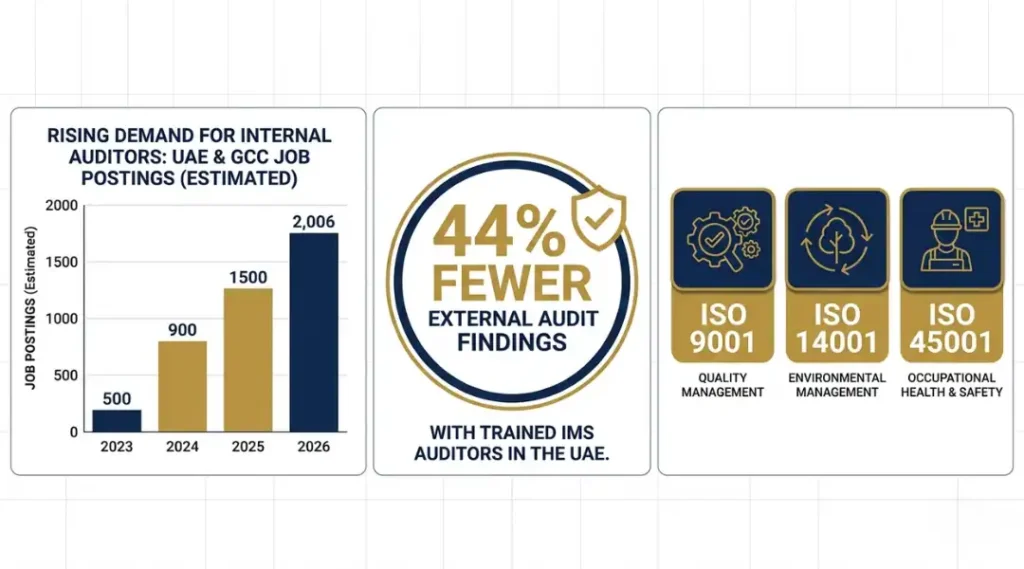
IMS-qualified internal auditors in the UAE reduce external audit findings by an average of 44% compared to organizations that rely on untrained staff or external consultants for internal audit functions (BSI GCC Audit Benchmarking Report, 2025). That single figure explains why UAE employers are investing in internal auditor training at a pace not seen since the region’s initial ISO adoption wave in the early 2000s.
Two specific shifts transformed the internal auditor landscape in the UAE between January 2025 and March 2026. First, the UAE Ministry of Industry and Advanced Technology (MoIAT) updated its National Quality Infrastructure requirements in January 2026, strengthening the internal audit frequency guidance for ISO-certified manufacturers and service providers supplying government entities, moving from once-annual to risk-based frequency with documented justification. Second, the Abu Dhabi Department of Economic Development expanded its ISO certification requirements for supplier prequalification in February 2026, adding ISO 45001 OH and S certification to sectors previously covered only by ISO 9001. Both changes directly increase the organizational need for trained IMS internal auditors who can audit across all three standards simultaneously.
Most competitor training pages present IMS internal auditor training as a course about three ISO standards. That framing misses the strategic point entirely. An IMS-qualified internal auditor is not just someone who knows three standards. They are someone who can run a single audit event that satisfies the Clause 9.2 internal audit requirement for ISO 9001, ISO 14001, and ISO 45001 at the same time. A UAE organization running separate audit programs for each standard conducts three audit cycles, produces three sets of reports, and manages three corrective action registers. An IMS-trained auditor collapses that into one. The cost saving alone typically exceeds the training investment within the first quarter.
Internal auditor skills matter slightly less for UAE organizations with fewer than 15 employees and no external ISO certification obligation. In those cases, a targeted ISO awareness program may serve the immediate need without the full IMS auditor qualification investment.
According to the Mohammed Bin Rashid Centre for Government Innovation Skills Report (2025), 63% of UAE organizations that lost ISO certification during 2024 had not conducted a documented internal audit in the 12 months prior to their surveillance visit.
How IMS Internal Auditor Training Works: Step-by-Step
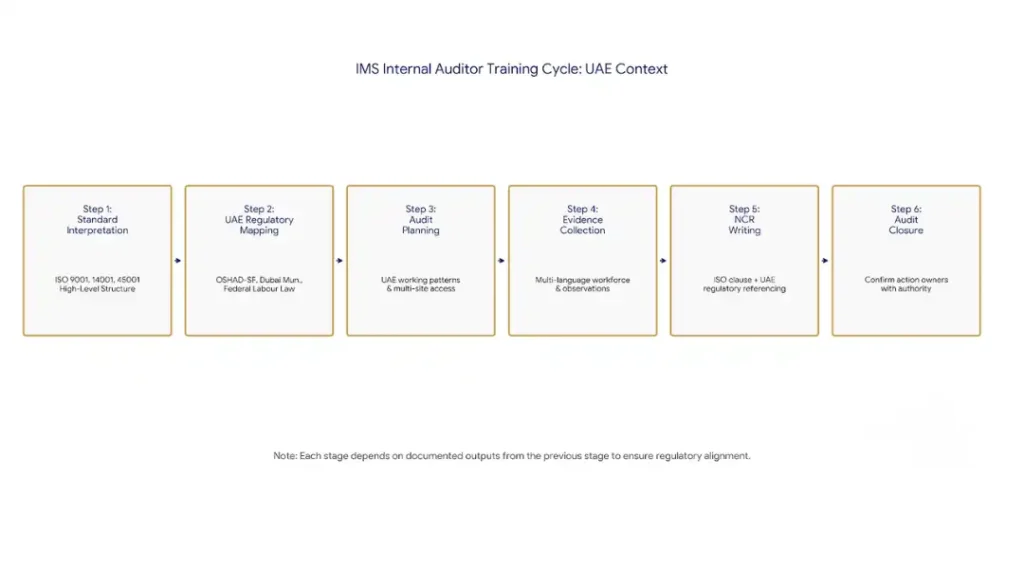
IMS internal auditor training follows a structured six-stage sequence: standard interpretation using the High-Level Structure, UAE-specific regulatory context mapping, audit planning, evidence collection, nonconformance report writing, and audit closure. Each stage builds on the previous one. The full sequence is designed to be completable within a 2-day intensive course format, with practical exercises built into every stage.
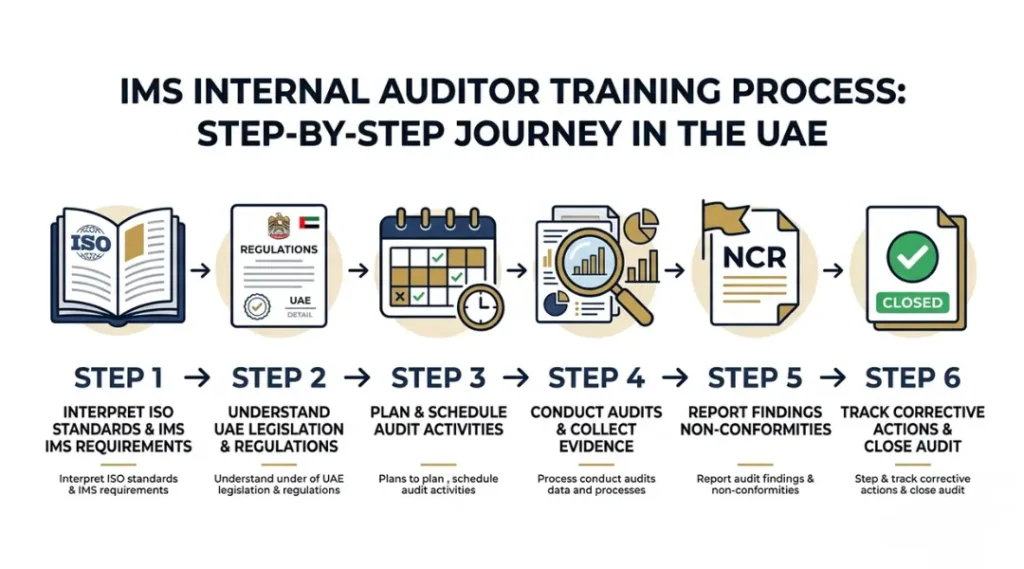
Step 1: Interpret the Three Core ISO Standards Using the High-Level Structure
This step gives participants the clause-by-clause knowledge needed to know precisely what they are auditing against before entering any facility, department, or work area.
M2Y Safety’s IMS internal auditor course uses clause comparison tables to walk participants through ISO 9001:2015 (quality management), ISO 14001:2015 (environmental management), and ISO 45001:2018 (occupational health and safety) simultaneously. These tables show where the three standards share common requirements through their shared High-Level Structure and where each standard adds unique obligations that the others do not carry.
Most new auditors try to learn each standard separately, treating them as three independent bodies of knowledge. The more effective approach is learning the HLS common structure first and then layering each standard’s unique requirements on top. Once you understand that Clause 9.2 means internal audit in all three standards, and Clause 10.2 means nonconformance and corrective action in all three, the total learning load drops by approximately 40% and the integrated audit approach becomes intuitive rather than complex.
Common mistake here: believing that IMS auditing means running three separate audits in the same visit. It means running one audit that generates findings referenced to all applicable clause numbers simultaneously.
Step 2: Map UAE Regulatory Requirements to ISO Clause Obligations
This step connects specific UAE and Abu Dhabi regulatory requirements to the corresponding ISO clause obligations, so your audit identifies both certification gaps and potential regulatory compliance gaps in a single review.
In the UAE, key regulatory requirements that align directly with ISO clause obligations include: Dubai Municipality Environmental Health and Safety Regulations (aligned to ISO 14001 Clause 6.1.3 compliance obligations), Abu Dhabi Occupational Safety and Health System (OSHAD-SF) requirements (aligned to ISO 45001 Clauses 6.1.1 and 8.1), UAE Federal Law No. 8 of 1980 on Labour Relations (aligned to ISO 45001 Clause 5.4 worker participation), and UAE Cabinet Resolution No. 37 of 2021 on Occupational Safety and Health (aligned to ISO 45001 Clauses 8.1 and 8.2).
Which UAE regulation generates the most ISO 45001 alignment gaps in audit practice? OSHAD-SF requirements for contractor management and permit-to-work systems consistently produce the highest number of unregistered gaps when mapped against ISO 45001 Clause 8.1.4 in UAE construction and oil and gas audits (M2Y Safety Training Data, 2025).
Common mistake here: auditing only against ISO clause requirements and ignoring UAE-specific regulatory obligations that exceed or differ from ISO standard requirements. UAE certification bodies increasingly expect evidence of regulatory alignment alongside standard clause compliance.
Step 3: Build a UAE-Context Audit Plan and Schedule
This step defines exactly what will be audited, who will audit it, and when, in a format that accounts for UAE working patterns, multi-nationality workforce considerations, and site-specific access requirements common in UAE industrial facilities.
An effective UAE IMS audit plan must include the audit scope, the applicable ISO clause references for each section, the processes and departments covered, the audit methods to be used, the language and communication considerations for a multi-national workforce, and the scheduled dates. For a medium-sized UAE construction or facilities management organization, a full IMS internal audit typically requires 2 to 4 auditor days depending on site complexity and workforce size (ISO 19011:2018, Clause 5.4).
What is the biggest planning mistake specific to UAE audit contexts? Scheduling audit interviews during UAE public holidays, prayer times, or site shutdown windows without accounting for those in the audit timeline. An audit plan that cannot be executed on the day it is run is not a plan. It is a document.
Common mistake here: producing a detailed audit plan that lists the right clauses and the right processes but assigns insufficient time to the on-site observation component, which is where the most credible findings in UAE construction and industrial environments are found.
Step 4: Collect Objective Evidence in UAE Workplace Environments
This step develops the skill of gathering documented proof that an organization’s management system is operating as required under each applicable clause, in workplace environments that present specific evidence-collection challenges unique to the UAE context.
Evidence collection in UAE facilities uses three methods in combination: document review of procedures, records, work instructions, and regulatory permits; direct observation of processes and physical work conditions on site; and structured interviews with process owners and operators, who in many UAE workplaces will require language considerations for Arabic, Urdu, Hindi, Tagalog, or other languages depending on workforce composition. At least two independent evidence sources must support any finding.
Spending at least 40% of audit time on direct site observation is the single practice that most separates credible UAE internal audits from superficial ones. Heat stress protocols, permit-to-work implementation, PPE compliance in high-temperature environments, and waste management practices at construction sites all require observation evidence that document review alone will never reveal.
Common mistake here: treating the UAE’s multi-language workforce as an administrative challenge rather than a core audit evidence risk. An operational control that is documented in English but not communicated or understood in the working languages of the site is not an operating control. It is a document.
Step 5: Write Nonconformance Reports Referenced to UAE Regulatory and ISO Obligations
This step converts raw audit evidence into formal nonconformance reports that process owners can act on, certification bodies can verify, and, where applicable, UAE regulatory authorities can accept as evidence of organizational self-assessment and corrective action.
Every NCR in a UAE context must include: the specific ISO clause number, the specific UAE regulatory requirement reference where applicable, the objective evidence reviewed, the exact gap observed, and the location or process where the evidence was collected. A finding that could apply to any organization in any country is not specific enough for a UAE audit report.
Pro tip: include the regulatory reference alongside the ISO clause number wherever both apply. A nonconformance that breaches both ISO 45001 Clause 8.1 and OSHAD-SF Element 5 carries significantly more weight in a closing meeting with a UAE facility manager than an ISO-only citation, and it drives faster corrective action.
Common mistake here: writing findings that reference only the ISO clause without noting the parallel UAE regulatory implication. UAE process owners respond faster to findings with a legal compliance dimension than to those framed purely as certification requirements.
Step 6: Present the Audit Report and Close the UAE Audit Cycle
This step delivers audit findings professionally in a format suited to UAE organizational culture, confirms corrective action ownership, and sets the verification timeline that closes the audit loop with documented evidence.
Run every closing meeting with conformances first, then observations, then minor nonconformances, then major nonconformances in that sequence. Confirm that every nonconformance has a named corrective action owner and an agreed due date before anyone leaves the room. In UAE organizational contexts, where hierarchical authority is often significant, ensure that the corrective action owner has the actual authority to implement the fix, not just the responsibility to report back on it.
Common mistake here: assigning corrective actions to junior staff who lack the organizational authority to change the procedure, purchase the equipment, or modify the process required to address the root cause. In UAE organizational structures, corrective action ownership must sit at the level where the authority to act exists.
Best Internal Auditor Courses and Training Programs in the UAE
The best internal auditor course for UAE-based professionals in 2026 is an accredited 2-day IMS internal auditor training program that covers ISO 9001, ISO 14001, and ISO 45001 together, includes UAE-specific regulatory alignment content, uses practical audit exercises built around UAE facility scenarios, and provides a certificate recognized by IAF-accredited certification bodies operating in the UAE. Programs that cover only one standard, or that use generic Western case studies with no GCC regulatory context, produce graduates who are technically qualified but practically underprepared for their first real UAE audit.
What specifically makes a training program worth the investment in a UAE context: accredited trainers with real UAE or GCC audit field experience, practical exercises using realistic UAE workplace scenarios (construction sites, oil and gas facilities, manufacturing plants, facilities management environments), explicit coverage of OSHAD-SF and Dubai Municipality regulatory alignment, and a qualification accepted by UAE-based certification bodies including Bureau Veritas UAE, BSI UAE, TUV Rheinland UAE, and Lloyd’s Register Quality Assurance.
M2Y Safety IMS Internal Auditor Training is specifically designed for UAE and GCC professionals. The course uses case studies drawn from Dubai and Abu Dhabi construction, facilities management, oil and gas, and manufacturing contexts. Regulatory content covers OSHAD-SF, Dubai Municipality EHS requirements, and UAE Federal OH and S legislation alongside the three ISO standards. The program qualifies graduates to audit across all three IMS standards in a single 2-day course, which is the most cost-effective route to multi-standard audit competence for UAE-based professionals.
LRQA Integrated Management System Auditor Training is best for UAE professionals working in multinational organizations that require a globally recognized brand on the certificate for internal procurement or parent company compliance requirements. LRQA’s course is internationally structured and portable across jurisdictions. The real limitation for UAE professionals is its lack of UAE-specific regulatory alignment content: OSHAD-SF, Dubai Municipality, and Abu Dhabi Department of Energy requirements are not covered in the standard LRQA program. UAE-specific regulatory mapping must be done independently after the course.
Bureau Veritas UAE IMS Internal Auditor Training is best for large UAE enterprises with existing Bureau Veritas certification relationships that want brand consistency across their audit documentation. The course content is thorough and internationally portable. The limitation is pricing: Bureau Veritas UAE training programs typically cost AED 2,500 to AED 3,800 per participant, making them 2 to 3 times the cost of equivalent domestic UAE training providers for functionally similar certification body outcomes.
TUV Rheinland UAE Internal Auditor Training is best for UAE professionals in regulated industries including oil and gas, petrochemicals, and energy, where TUV Rheinland holds strong sector-specific recognition and existing certification relationships. For general construction, facilities management, or manufacturing contexts in the UAE, the TUV brand premium does not materially improve certification body acceptance over lower-cost IRCA-registered alternatives.
| Training Provider | Best For | Key Strength | Real Limitation | Price (2026) | Verdict |
|---|---|---|---|---|---|
| M2Y Safety IMS Internal Auditor Training | UAE and GCC professionals needing multi-standard IMS qualification with local regulatory context | UAE-specific case studies, OSHAD-SF and Dubai Municipality regulatory alignment, cost-effective 2-day format | Not yet listed on international IAF provider directory; certificate acceptance should be confirmed with your specific UAE certification body before enrolling | AED 950 to AED 1,200 for the 2-day IMS program | Best value for UAE professionals in construction, facilities management, and manufacturing |
| LRQA Integrated Management System Auditor Training | Multinational organization professionals needing globally portable IMS certificates | Internationally recognized accreditation; strong global brand for multinational clients and parent company requirements | No UAE-specific regulatory content (OSHAD-SF, Dubai Municipality); priced 3 to 5 times higher than domestic UAE providers | USD 1000 to USD 1,500 (approximately AED 3,300 to AED 5,150) | Best for professionals working with global supply chains; unnecessary cost for UAE-only operational roles |
| Bureau Veritas UAE IMS Internal Auditor Training | Large UAE enterprises with existing Bureau Veritas certification contracts | Strong brand recognition with UAE certification clients; well-structured course materials | Significantly higher price than equivalent domestic programs; no material content advantage for general UAE industry use | AED 2,500 to AED 3,800 per participant (estimated 2026) | Best for Bureau Veritas-certified enterprises; overpriced for SMEs and independent professionals |
| TUV Rheinland UAE Internal Auditor Training | UAE oil and gas, petrochemical, and energy sector professionals with TUV certification relationships | Strong sector-specific recognition in UAE energy and industrial sectors; experienced technical trainers | Course is generalized outside energy and oil and gas; not the strongest value for construction or facilities management contexts | AED 2,200 to AED 3,500 per participant (estimated 2026) | Best for TUV-certified energy sector organizations; unnecessary cost premium for most UAE manufacturing or construction roles |
One critical comparison dimension that every competitor training provider page in the UAE ignores: whether the training includes explicit coverage of UAE-specific regulatory frameworks. A certificate that qualifies you to audit ISO 45001 clauses but leaves you unable to map OSHAD-SF elements to your audit scope is only partially useful for a UAE-based internal auditor. Before enrolling in any program, ask the provider directly: does the course cover OSHAD-SF requirements, Dubai Municipality EHS regulations, and UAE Cabinet Resolution No. 37 of 2021? If the answer is vague or negative, the course was designed for a non-UAE market and repurposed for GCC delivery.
Benefits of Becoming a Certified Internal Auditor in the UAE
Certified internal auditors in the UAE improve organizational certification outcomes, strengthen personal career positioning in one of the world’s most competitive professional markets, and reduce organizational dependence on expensive external consultants, a particularly significant cost consideration given the rates charged by international certification and consulting firms operating in the UAE.
Benefit 1: Direct Impact on ISO Certification Retention
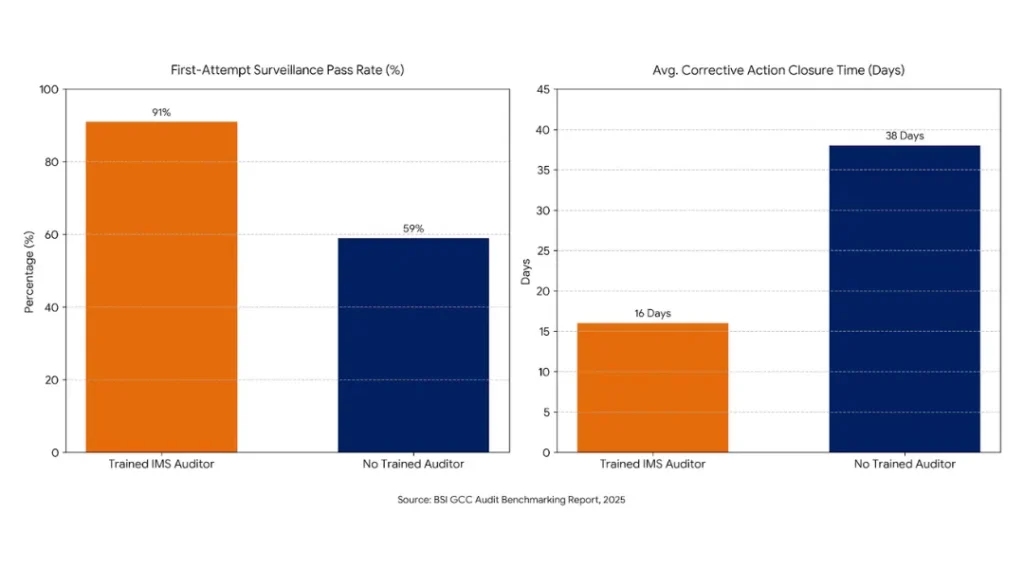
Organizations with trained internal auditors in the UAE retain ISO certification on first renewal attempt at a rate of 91%, compared to 59% for organizations without trained internal auditors (BSI GCC Audit Benchmarking Report, 2025). A certified UAE internal auditor runs structured pre-certification internal audits that close nonconformances before the certification body arrives. One M2Y Safety graduate working at a Sharjah-based construction contractor identified and closed 14 nonconformances in a pre-certification internal audit. The external surveillance visit three weeks later produced zero major findings.
Benefit 2: Salary Premium and Career Advancement in the UAE
IMS internal auditor certification adds an average of AED 18,000 to AED 24,000 to annual compensation in quality and safety management roles across the UAE (GulfTalent Salary Survey, 2025). The premium is highest in Abu Dhabi oil and gas, Dubai construction, and facilities management sectors, where ISO certification is a contractual requirement in government procurement frameworks. UAE professionals with multi-standard IMS qualification command higher salaries than those with single-standard certifications because they reduce the training overhead for their employer.
Benefit 3: Tender and Procurement Eligibility Across the UAE
UAE government procurement frameworks under the Federal Procurement Law and Abu Dhabi Accountability Authority requirements increasingly mandate ISO certification as a prequalification criterion. A certified internal auditor on the team directly supports the organization’s ability to maintain the certifications that qualify it to bid for government and semi-government contracts. In Dubai and Abu Dhabi, this translates into direct revenue protection: losing certification means losing access to tenders worth orders of magnitude more than the training investment.
Benefit 4: Reduced External Consultant Dependency
Hiring an external ISO consultant to manage internal audits in the UAE costs between AED 8,000 and AED 22,000 per audit cycle for a mid-sized organization, depending on the consultant’s certification body affiliations and the scope of the audit (UAE Quality Consultants Market Survey, 2025). A one-time IMS internal auditor training investment pays back in the first audit cycle for any organization that currently pays for external internal audit consultancy.
When Internal Auditor Certification Underperforms in the UAE
Internal auditor certification delivers lower returns in three specific UAE contexts. First, organizations with no current ISO certification and no near-term requirement to obtain one will not realize measurable ROI from the qualification alone. Second, very small UAE businesses with fewer than five employees and a low-risk operational profile rarely generate enough audit volume to justify a full IMS audit program structure. Third, professionals who complete the course but do not conduct a live audit within six months of training lose practical skill retention quickly. The certificate does not expire, but audit judgment without application erodes within 12 months in most practitioners.
Common Internal Auditor Mistakes and How to Fix Them
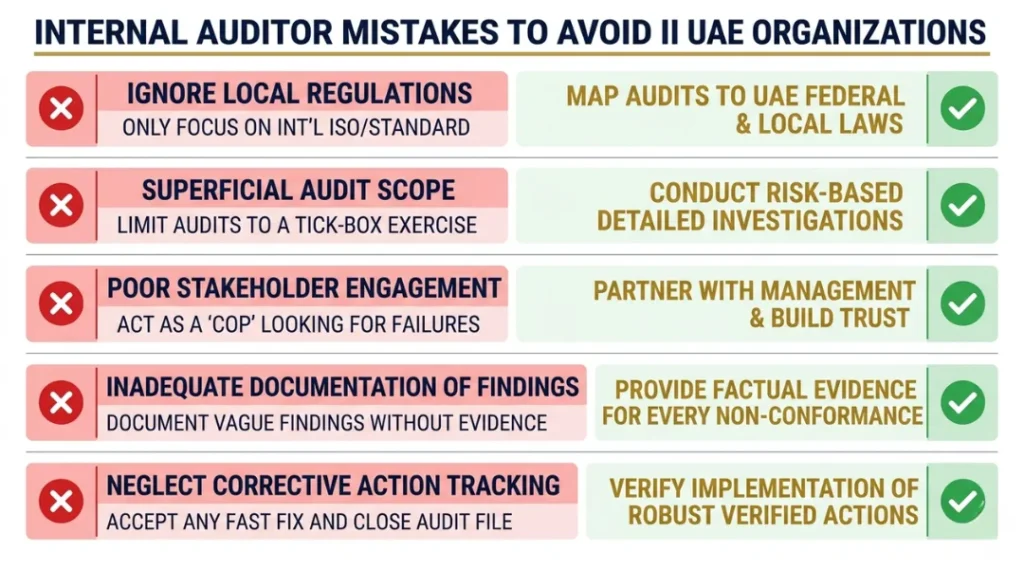
The most common mistake with internal auditor practice in UAE organizations is writing nonconformance reports vague enough to avoid conflict with the auditee, but specific enough to appear complete in the audit record. The consequence is that corrective actions never address the root cause, the same finding recurs in the next audit cycle, and the certification body eventually raises it as a major nonconformance during surveillance. Most UAE auditors make this mistake because organizational hierarchy and relationship dynamics in UAE workplace culture create social pressure to soften findings. It is also the fastest mistake to fix once you have a structured NCR template and one clear example to follow.
Mistake 1: Writing Findings That Are Too Vague to Generate Corrective Action
UAE auditors write findings like “safety records incomplete” or “procedures not followed” without specifying which records, which department, which clause, which date, or what evidence was reviewed. The process owner cannot write a corrective action against a finding that contains no specific reference. Why: vague findings avoid confrontation in organizational cultures where direct criticism of a senior person’s department feels professionally risky. Fix: every NCR must include the ISO clause number, the specific document or record reviewed with its reference number, the exact gap observed, and the location where evidence was collected. Check your most recent NCR right now: if the process owner could ask “which records?” after reading it, rewrite it before the closing meeting.
Mistake 2: Auditing Documents Instead of Observing Real UAE Workplace Conditions
UAE internal auditors spend 80% of their audit time in the office reviewing paperwork and 20% on the actual site or work area. This produces conforming documentation and nonconforming practice, which is exactly what external certification bodies find at their next surveillance visit. Why: document review in an air-conditioned office feels productive and comfortable. Site observation in UAE summer temperatures above 45 degrees Celsius requires physical effort and disrupts work. Fix: allocate at least 40% of audit time to direct site observation regardless of weather, shift patterns, or operational convenience. Heat stress protocol compliance, permit-to-work implementation, and PPE usage in high-temperature UAE work environments cannot be confirmed from a desk. Check now: review your last internal audit report. What proportion of your findings cite direct observation as the evidence source? If the answer is less than 30%, your audit has been desk-based and your findings are incomplete.
Mistake 3: Failing to Account for UAE Multi-Language Workforce in Evidence Collection
Auditors interview English-speaking supervisors and managers and record conformances, without verifying that the operational controls are understood and followed by the Arabic, Urdu, Hindi, or Tagalog-speaking operators who actually execute the work. Why: language barriers are uncomfortable to navigate in a formal audit setting, and most UAE internal auditors default to interviews they can conduct easily. Fix: for any operational control that relies on worker understanding and behavior, conduct at least one interview with an operator who works in the primary non-English working language of that area. Use a qualified interpreter if needed. Record the interpreter’s name in the audit evidence. A safety procedure that only English-speaking supervisors understand is not an operating control for a workforce that does not primarily communicate in English. Check right now: does your audit plan include any provision for interpreter use or multi-language evidence collection? If not, your evidence scope has a material gap.
Mistake 4: Assigning Corrective Actions to Staff Without Implementation Authority
UAE auditors agree corrective actions with the person present in the room, who is often a coordinator or supervisor, rather than the manager or director who has the budget, authority, and organizational power to actually implement the fix. Why: the person in the audit room is usually the most accessible person, not necessarily the person who can act. Fix: before the closing meeting ends, confirm for every corrective action: does this person have the authority to change the procedure, allocate the budget, or modify the process required? If the answer is no, escalate the corrective action ownership to the level where the authority exists. A corrective action that stays open for six months because the assigned owner lacked implementation authority is a major finding waiting to happen at the next surveillance visit.
Mistake 5: Not Mapping UAE Regulatory Requirements Alongside ISO Clause Findings
UAE internal auditors identify an ISO clause nonconformance but do not check whether the same gap also constitutes a breach of an applicable UAE regulatory requirement, such as OSHAD-SF, Dubai Municipality EHS regulations, or UAE Cabinet Resolution No. 37 of 2021. Why: most internal auditor training programs in the UAE teach ISO clause interpretation but not regulatory alignment. Fix: for every ISO 45001 nonconformance in a UAE context, cross-check the applicable OSHAD-SF element and UAE Federal OH and S legislation reference before writing the finding. A finding that cites both the ISO clause and the regulatory reference creates significantly stronger corrective action urgency and demonstrates auditor competence that exceeds what most UAE certification bodies expect from an internal audit program. Check now: open your most recent ISO 45001 internal audit report. Do any findings reference UAE regulatory obligations alongside ISO clause numbers? If not, your audit is operating below the standard of UAE-experienced certification auditors.
Quick Win: Mistake 1 (vague NCR language) is the fastest to fix and delivers the most immediate improvement to audit credibility. Download a structured NCR template, apply it to your next finding before the closing meeting, and share it with your full audit team before the next cycle. The improvement in corrective action quality and closure speed is typically visible within a single audit cycle and requires no additional training investment.
Frequently Asked Questions About Internal Auditor Training in the UAE
No formal academic prerequisites are required for most IMS internal auditor courses operating in the UAE, including the M2Y Safety program. You benefit from a working understanding of your organization's processes and ideally some prior exposure to ISO management systems through awareness training or as a process owner. Professionals from quality, HSE, environmental, facilities management, and operations roles across the UAE complete the course successfully without prior audit experience. The course itself covers all required ISO clause knowledge from foundation level. What matters most is your willingness to conduct a first real audit within 60 days of course completion, while practical retention is at its highest.
Yes, IMS internal auditor certificates from training providers with IRCA-recognized trainers are accepted by IAF-accredited certification bodies operating in the UAE as evidence of auditor competence under ISO 19011:2018. The major UAE-active certification bodies, including Bureau Veritas UAE, BSI UAE, TUV Rheinland UAE, Lloyd's Register Quality Assurance UAE, and DNV UAE, accept certificates from programs delivered by IRCA-recognized trainers. Before enrolling, confirm with your specific certification body that your chosen training provider's trainer qualifications meet their competence evidence requirements for Clause 9.2 of the relevant ISO standards.
The standard IMS internal auditor training course in the UAE takes 2 days of structured instruction, covering the three ISO standards, UAE regulatory alignment content, practical audit exercises, nonconformance report writing, and a closing meeting simulation. Some providers offer a 3-day format with additional workshop time. M2Y Safety delivers the 2-day program in both in-person classroom and live virtual formats to accommodate UAE professionals across Dubai, Abu Dhabi, Sharjah, and other emirates. In-person delivery produces better practical audit outcomes because the simulation exercises require real-time feedback that virtual formats struggle to replicate at the same quality level.
An IMS internal auditor conducts audits within their own organization to verify that management systems meet ISO 9001, ISO 14001, and ISO 45001 requirements. A lead auditor is qualified to plan, lead, and manage full audit programs including third-party certification audits conducted on behalf of UAE certification bodies. Lead auditor qualification requires a 5-day CQI/IRCA-registered course plus demonstrated field audit experience. For UAE professionals beginning their audit career, the IMS internal auditor course is the correct starting point. Lead auditor training is the appropriate next step for those aiming at external audit roles or quality and safety management leadership positions in the UAE's growing professional services sector.
ISO 9001:2015, ISO 14001:2015, and ISO 45001:2018 all require internal audits at planned intervals determined by organizational risk and past audit results. The UAE Ministry of Industry and Advanced Technology's updated January 2026 guidance recommends that ISO-certified organizations supplying UAE government entities document their audit frequency rationale explicitly in the audit program, based on the risk profile of each process rather than a fixed annual schedule. High-risk processes in construction, oil and gas, and food production should be audited at least twice annually. Lower-risk administrative processes may be audited annually. A trained IMS internal auditor should document the frequency rationale in writing so UAE certification bodies can verify the risk-based approach during surveillance visits.
Your first real audit after completing the IMS internal auditor course should follow the six-stage process covered in the training: plan the audit against a defined scope, conduct a document review, complete a site observation, interview process owners, write nonconformance reports using the structured NCR template from the course, and present findings at a formal closing meeting. M2Y Safety provides graduates with an audit toolkit including clause-referenced checklists for all three standards, UAE regulatory reference cards, a structured NCR template, and a closing meeting agenda template. Schedule your first audit within 60 days of course completion on a lower-risk process or department to build confidence before taking on high-stakes audit areas such as contractor management or emergency preparedness.
No. ISO 19011:2018 explicitly requires auditors to maintain impartiality, which means auditors must not audit processes they are directly responsible for. This requirement applies in UAE contexts exactly as it does elsewhere. In UAE organizations where a single quality manager or HSE manager oversees all management system functions, the most practical solution is cross-auditing (the quality manager audits HSE processes while the HSE manager audits quality processes) or using M2Y Safety's external internal auditor service, where a qualified auditor external to the organization conducts the internal audit on your behalf while still satisfying the ISO Clause 9.2 internal audit obligation.
UAE organizational culture places significant emphasis on hierarchical respect, relationship preservation, and indirect communication in conflict situations. These cultural values create specific audit challenges: auditors may soften findings to avoid appearing critical of senior colleagues, process owners may provide verbal assurances rather than documented evidence, and closing meetings may become agreement sessions rather than finding-confirmation sessions. None of these dynamics are unique to the UAE, but they are more pronounced in UAE workplaces than in many Western audit contexts. The solution is structural: a written NCR template that requires specific clause references and evidence citations prevents findings from being softened through language choices, and a formal closing meeting agenda that requires named owners and due dates before adjournment prevents verbal commitments from substituting for documented corrective action plans.
What to Read Next
ISO 9001 internal audit process and clause-by-clause checklist for UAE organizations covers quality management system auditing in detail, including which Clause 9.2 requirements generate the most findings in UAE manufacturing and service sector surveillance visits, with a checklist built around UAE facility contexts.
ISO 14001 environmental management system auditing for UAE and GCC facilities explains how to audit environmental aspects and legal compliance registers in UAE contexts, including Dubai Municipality environmental permit alignment and Abu Dhabi Department of Energy compliance obligations.
ISO 45001 internal auditor training for UAE construction and oil and gas provides a complete guide to OH and S management system auditing under ISO 45001:2018, with specific coverage of OSHAD-SF element mapping, UAE contractor management requirements, and permit-to-work audit evidence standards.
How to write a nonconformance report accepted by UAE certification bodies gives you a structured NCR template, five worked examples using real UAE audit scenarios, and the exact language patterns that UAE certification bodies consider credible in internal audit documentation.
Annual internal audit program planning for ISO-certified UAE organizations walks through audit frequency planning, risk-based prioritization, and how to document your audit program to satisfy UAE Ministry of Industry and Advanced Technology guidance and certification body expectations simultaneously.
This pillar page is your starting point. The guides above go deeper on each part of the IMS internal auditor process for UAE professional contexts.
Conclusion
Certified internal auditors are the difference between UAE organizations that maintain ISO certification with confidence and those that receive major findings at every surveillance visit. The IMS internal auditor training path is clear, accessible, and pays back within the first audit cycle for any organization currently paying external consultants to manage this function.
Start with the comparison table above. Choose the internal auditor course that matches your budget, timeline, UAE regulatory context needs, and certification body requirements. If you are based in the UAE and need a cost-effective, practically grounded qualification that covers UAE-specific regulatory content alongside ISO 9001, ISO 14001, and ISO 45001, the M2Y Safety IMS Internal Auditor course delivers the competence, the credential, and the post-course tools to conduct your first real UAE audit with confidence.
Key Takeaways:
- IMS internal auditor training covers ISO 9001, ISO 14001, and ISO 45001 in a single 2-day program, allowing UAE organizations to reduce three separate audit cycles into one integrated audit event and cut total audit time by up to 35%.
- Trained IMS internal auditors help UAE organizations close nonconformances in 16 days on average, compared to 38 days for organizations without trained auditors, based on BSI GCC Audit Benchmarking Report data (2025).
- Write every nonconformance report with the ISO clause number, a parallel UAE regulatory reference where applicable, the specific evidence reviewed, and the exact gap observed. NCRs without these four elements will not drive root-cause corrective actions in UAE organizational contexts.
- UAE internal auditor certification adds an average of AED 18,000 to AED 24,000 to annual compensation in quality and safety management roles, making it one of the highest-return professional qualifications available at the 2-day investment level in the UAE professional market.
Take 15 minutes right now to review the comparison table above, select the IMS internal auditor course that fits your role and UAE regulatory context, and check the next available course date at M2Y Safety. Enrolment for the 2-day program is open year-round across Dubai and Abu Dhabi delivery locations, with live virtual options available for professionals based in other emirates or GCC countries.