Environmental Management
When Sarah walked into her Dubai office last summer, she noticed something troubling. The AC was running at full blast in empty conference rooms. Printer trays overflowed with single-sided documents. Nobody had thought twice about the daily plastic bottle pile-up in the breakroom.
Sound familiar?
You’re not alone. Across the UAE and globally, businesses are waking up to a harsh reality: environmental challenges aren’t just headlines anymore—they’re hitting our bottom lines, regulatory compliance, and corporate reputations. Whether you’re a facility manager overwhelmed by new sustainability regulations, an HSE professional expanding your expertise, or a business owner trying to future-proof your company, environmental management can feel like navigating a maze blindfolded.
But here’s the truth: effective environmental management isn’t about perfection. It’s about making informed, strategic decisions that protect our planet while strengthening your organization. And the good news? You don’t need to figure it all out alone.
What is Environmental Management and Why Does It Matter?
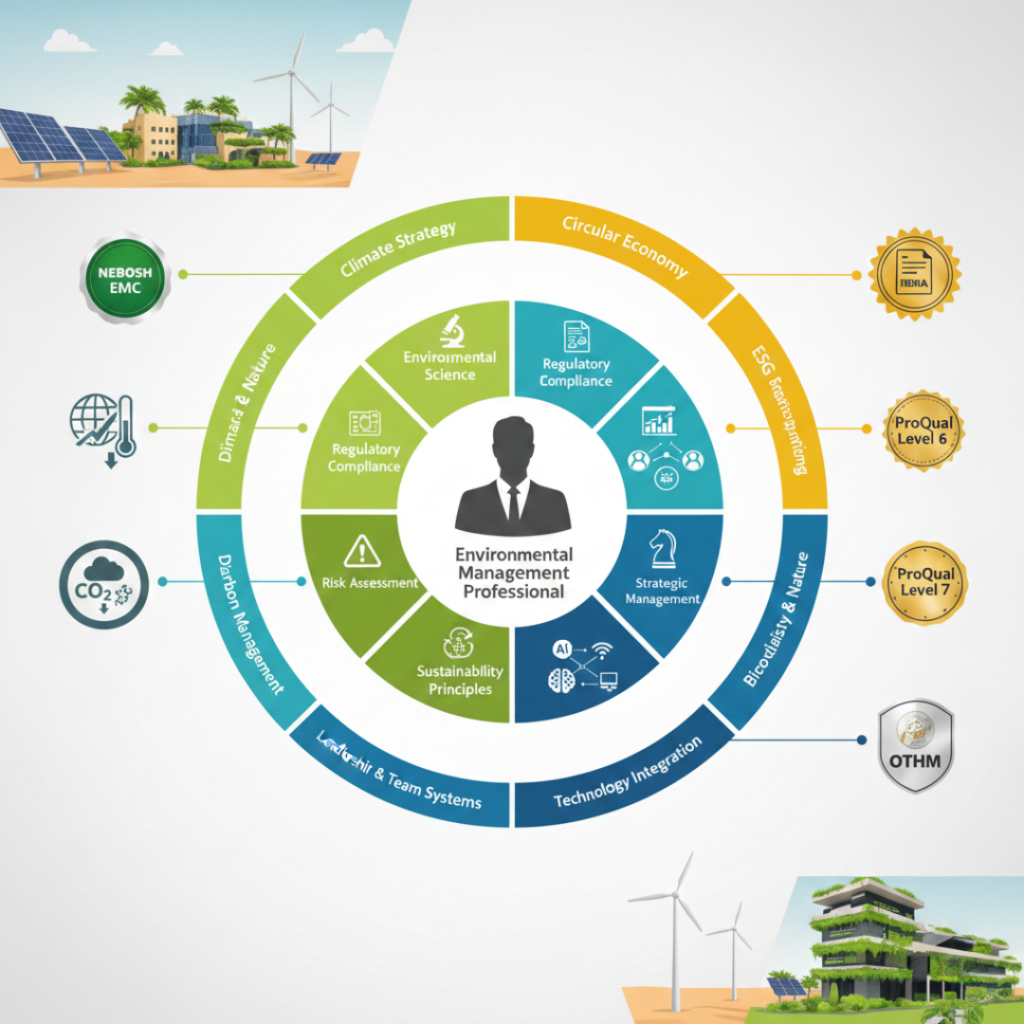
Environmental management is the systematic approach to planning, implementing, and monitoring activities that minimize an organization’s negative impact on the environment while maximizing resource efficiency and regulatory compliance.
Think of it as your organization’s roadmap for balancing operational needs with environmental responsibility.
In practical terms, this means:
- Reducing waste, emissions, and resource consumption
- Ensuring compliance with environmental laws and regulations
- Identifying and mitigating environmental risks
- Implementing sustainable practices across operations
- Monitoring and continuously improving environmental performance
The Real-World Impact: Why Organizations Can’t Afford to Ignore This
The numbers tell a compelling story. According to the International Organization for Standardization (ISO), over 400,000 organizations worldwide have adopted ISO 14001 environmental management standards. In the UAE specifically, environmental compliance has become non-negotiable following the country’s ambitious UAE Net Zero by 2050 Strategic Initiative.
Consider this: companies with robust environmental management systems report an average 20-30% reduction in energy costs within the first two years. That’s not just good for the planet—it’s smart business.
Understanding the Core Components of Environmental Management
Environmental management isn’t a one-size-fits-all solution. It’s a comprehensive framework built on several interconnected pillars.
1. Environmental Policy and Planning
Your environmental policy serves as your organization’s commitment statement. This isn’t corporate jargon—it’s your north star for decision-making.
Key elements include:
- Clear environmental objectives aligned with business goals
- Identification of environmental aspects and impacts
- Legal and regulatory compliance requirements
- Resource allocation and responsibility assignment
2. Implementation and Operation
This is where strategy meets action. You’ll need practical systems for:
- Training and competency development – Your team needs to understand not just what to do, but why it matters
- Operational controls – Standard procedures that prevent environmental incidents
- Emergency preparedness – Response plans for environmental risks
- Communication protocols – Both internal awareness and external stakeholder engagement
3. Monitoring, Measurement, and Analysis
You can’t manage what you don’t measure. Effective environmental management requires:
- Regular environmental audits and inspections
- Performance indicators tracking (energy use, waste generation, emissions)
- Compliance verification and documentation
- Data analysis for continuous improvement
4. Management Review and Continuous Improvement
The most successful organizations treat environmental management as an ongoing journey, not a destination. This means regular leadership reviews, corrective actions when needed, and commitment to raising the bar continuously.
Environmental Management Standards and Certifications That Matter
Professional credentials signal expertise and commitment. For organizations and individuals in the UAE and globally, several certifications stand out:
| Certification | Level | Best For | Key Focus Areas |
|---|---|---|---|
| ISEP/IEMA Foundation Certificate in Sustainability and Environmental Management | Senior-Level | Senior HSE Managers, Consultants, Environmental Specialists | Advanced sustainability principles, strategic environmental management, organizational integration |
| NEBOSH Environmental Management Certificate (EMC) | Intermediate | HSE professionals expanding into environmental management | Risk assessment, environmental law, management systems |
| ProQual Level 6 NVQ Diploma | Advanced | Practitioners with hands-on experience | Practical environmental management implementation |
| ProQual Level 7 Diploma | Expert | Senior managers and consultants | Strategic environmental leadership, policy development |
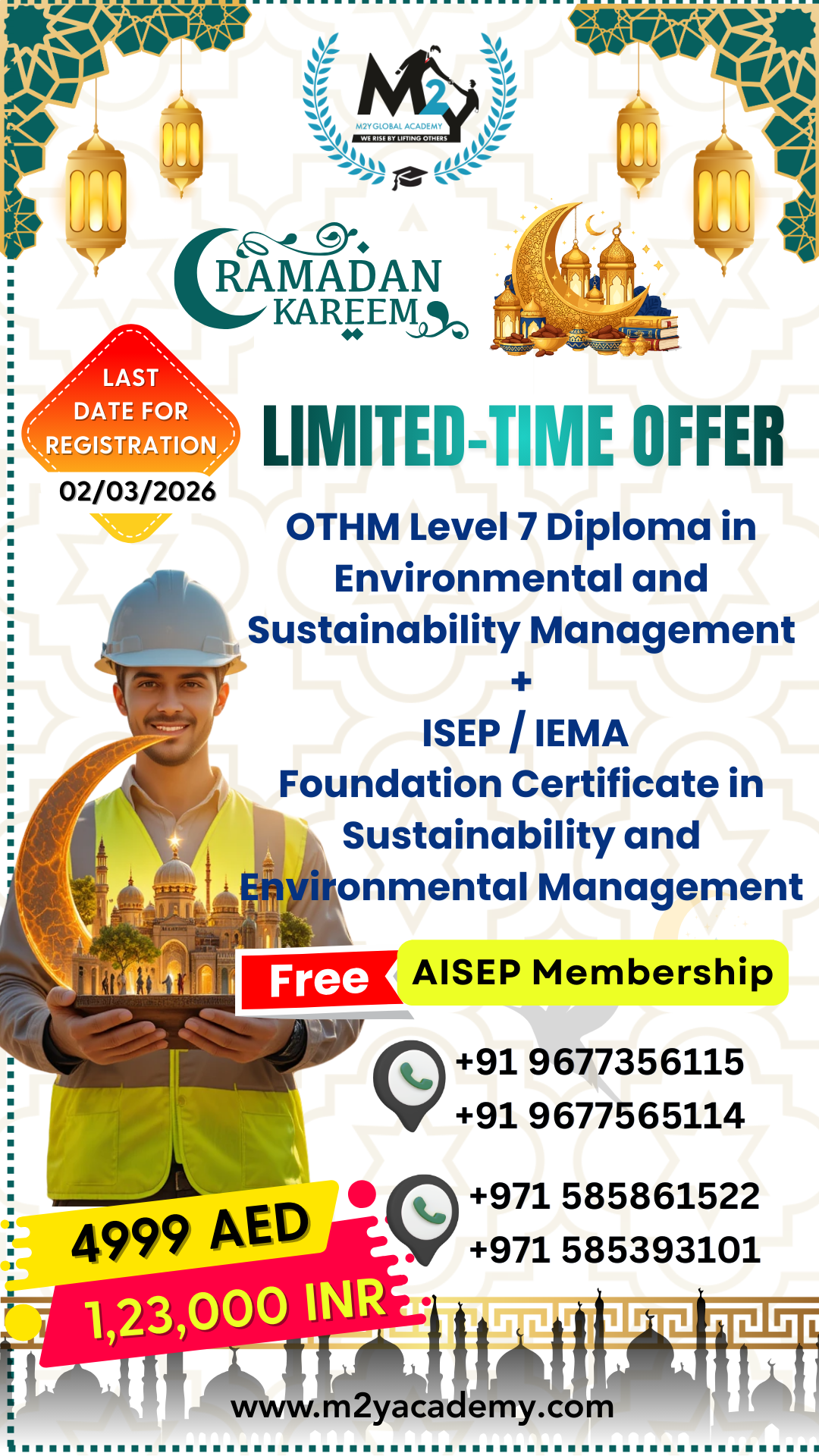
| OTHM Level 7 Diploma | Expert | Sustainability managers and directors | Integrated environmental and sustainability strategy |
The ISEP/IEMA Foundation Certificate in Sustainability and Environmental Management is designed for senior-level professionals including Senior HSE Managers, Consultants, and Environmental Specialists. Delivered by M2Y Global Academy with flexible virtual live training and self-paced learning options, this qualification typically takes 5-10 days to complete and is assessed through online examination and project evaluation.
Meanwhile, the NEBOSH Environmental Management Certificate digs deeper into risk assessment methodologies and legal frameworks, making it invaluable for those responsible for maintaining compliance across complex operations.
For those seeking advanced credentials, the ProQual Level 6 NVQ Diploma in Environmental and Sustainability Management validates practical, hands-on experience in implementing environmental systems. The ProQual Level 7 Diploma in Environmental Management and OTHM Level 7 Diploma in Environmental and Sustainability Management represent expert-level qualifications for senior managers developing strategic environmental policies and leading organizational transformation.
Sustainability in UAE: A Regional Perspective with Global Implications
The UAE has positioned itself as a regional leader in environmental stewardship. This isn’t just political posturing—it’s backed by substantial investment and policy changes that are reshaping how businesses operate.
Current Environmental Priorities in the UAE
Energy transition: The UAE is investing heavily in renewable energy, with projects like the Mohammed bin Rashid Al Maktoum Solar Park in Dubai, one of the world’s largest solar energy projects. The country aims to generate 50% of its energy from clean sources by 2050.
Circular economy initiatives: The UAE Circular Economy Policy 2021-2031 aims to redirect 75% of municipal solid waste from landfills, creating new opportunities for waste management professionals and innovative business models.
Green building requirements: Dubai’s Al Sa’fat Green Building System and Abu Dhabi’s Estidama Pearl Rating System have made sustainable construction practices mandatory for new developments, driving demand for environmental expertise in the construction sector.
Water conservation: Given the UAE’s arid climate, water management has become a critical environmental priority, with organizations required to demonstrate water efficiency improvements year-over-year.
Carbon neutrality targets: Major UAE cities have announced ambitious carbon neutrality goals, with Dubai targeting 2050 and Abu Dhabi pursuing similar timelines.
For professionals working in the region, understanding sustainability in UAE initiatives isn’t optional—it’s essential for career growth and organizational success. The government’s commitment to environmental protection creates abundant opportunities for qualified environmental management professionals.
Practical Steps to Implement Environmental Management in Your Organization
Let’s get tactical. Whether you’re starting from scratch or improving existing practices, here’s your roadmap:
Phase 1: Assessment and Gap Analysis (Weeks 1-4)
- Conduct an environmental review – Document current practices, identify environmental aspects, and assess legal compliance
- Benchmark against industry standards – Where do you stand compared to competitors and best practices?
- Identify quick wins – Look for low-hanging fruit that demonstrates immediate value
- Engage stakeholders – Get buy-in from leadership, employees, and key external partners
Phase 2: Planning and Framework Development (Weeks 5-12)
- Develop your environmental policy – Make it specific, measurable, and authentic to your organization
- Set SMART objectives – Specific, Measurable, Achievable, Relevant, Time-bound goals
- Create operational procedures – Document processes for waste management, energy efficiency, pollution prevention
- Establish metrics and KPIs – Determine how you’ll measure success
Phase 3: Implementation and Training (Months 4-6)
- Launch awareness campaigns – Help employees understand their role in environmental management
- Provide targeted training – Invest in professional development, including recognized certifications from providers like M2Y Safety Consultancy
- Implement operational controls – Put systems in place to manage day-to-day environmental impacts
- Begin data collection – Start tracking your baseline environmental performance
Phase 4: Monitoring and Improvement (Ongoing)
- Conduct regular audits – Both internal reviews and external verification
- Analyze performance data – Look for trends, identify problems, celebrate successes
- Implement corrective actions – Address non-conformances promptly
- Communicate results – Share progress with stakeholders transparently
Common Environmental Management Challenges (And How to Overcome Them)
After working with hundreds of organizations, the same obstacles appear repeatedly. The good news? They’re all solvable.
Challenge 1: “Environmental management is too expensive.”
Reality check: Initial investments pay for themselves through reduced energy costs, waste disposal savings, and avoided regulatory penalties. Start with no-cost or low-cost initiatives like behavioral changes and process optimization before major capital investments.
Challenge 2: “We don’t have the expertise in-house.”
Solution: This is exactly why professional training and certifications matter. Investing in employee development through programs like the NEBOSH EMC, ISEP/IEMA certifications, or ProQual diplomas builds internal capacity. M2Y Safety Consultancy offers comprehensive training programs designed specifically for UAE-based organizations, with both virtual live training and self-paced learning options.
Challenge 3: “Employee engagement is low.”
The fix: Connect environmental initiatives to values people care about—health, cost savings, community pride. Make participation visible and rewarding. Gamification and recognition programs work remarkably well.
Challenge 4: “Regulatory requirements keep changing.”
Your approach: Build flexibility into your management system. Subscribe to regulatory update services, join professional networks, and consider hiring or training compliance specialists. In the UAE, the Ministry of Climate Change and Environment provides regular updates on environmental legislation.
Challenge 5: “Measuring environmental performance is too complex.”
Simplify it: Start with 3-5 key metrics that matter most to your operations. You can always expand your measurement program later. Focus on utility bills (energy, water), waste disposal records, and regulatory inspection results as starting points.
The Business Case: ROI of Environmental Management
Let’s talk money, because that’s often what gets leadership approval.
Organizations with mature environmental management systems consistently report:
- 15-30% reduction in energy consumption – Through efficiency improvements and behavioral changes
- 20-40% decrease in waste disposal costs – Via waste reduction and recycling programs
- Improved employee retention – Studies show 40% of millennials consider environmental values when choosing employers
- Enhanced brand reputation – Increasingly important for customer loyalty and market differentiation
- Reduced regulatory risk – Fewer fines, penalties, and legal complications
- Better access to capital – ESG (Environmental, Social, Governance) criteria now influence lending and investment decisions
A 2023 study by the UN Environment Programme found that companies with strong environmental practices achieved 18% higher profitability over five-year periods compared to industry peers.
In the UAE context, organizations with ISO 14001 certification or equivalent environmental management systems often gain preferential treatment in government procurement processes and major project tenders.
Building Your Environmental Management Career
The demand for qualified environmental management professionals is growing exponentially—both in the UAE and globally. The region’s commitment to sustainability in UAE initiatives creates exceptional career opportunities.
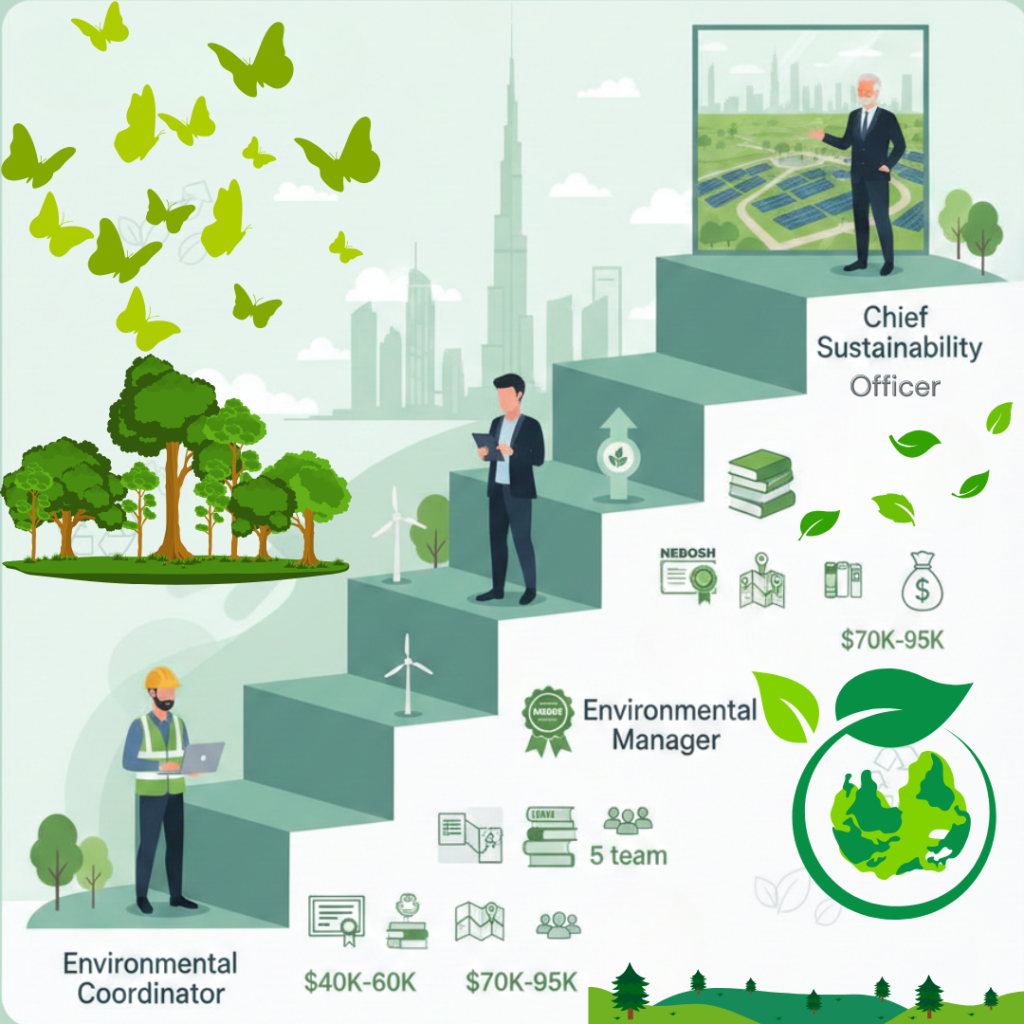
Career Pathways and Opportunities
Entry-level positions:
- Environmental Coordinator
- Sustainability Assistant
- Environmental Health and Safety (EHS) Coordinator
- Compliance Officer
Mid-level roles:
- Environmental Manager
- Sustainability Manager
- EHS Manager
- Environmental Consultant
Senior positions:
- Head of Sustainability
- Environmental Director
- Chief Sustainability Officer (CSO)
- Environmental Management Consultant
Skills That Set You Apart
Technical knowledge alone won’t cut it. The most successful environmental management professionals combine:
- Technical competence – Understanding environmental science, regulations, and management systems
- Business acumen – Connecting environmental initiatives to organizational strategy and financial performance
- Communication skills – Translating technical concepts for diverse audiences
- Project management – Implementing initiatives on time and within budget
- Data analysis – Interpreting metrics and driving evidence-based decisions
- Stakeholder engagement – Building coalitions and influencing organizational culture
Professional certifications provide structured development of these competencies, giving you credibility in a competitive job market. M2Y Safety Consultancy’s comprehensive course portfolio—from NEBOSH EMC to advanced Level 7 diplomas—ensures professionals at every career stage can access the training they need.
The Future of Environmental Management: Trends to Watch
Environmental management is evolving rapidly. Staying current isn’t optional—it’s essential for professional relevance.
Emerging Priorities
Climate risk assessment and adaptation: Organizations are moving beyond mitigation (reducing emissions) to adaptation (preparing for climate impacts). This requires new skills in risk modeling and scenario planning.
Circular economy implementation: Linear “take-make-dispose” models are being replaced by circular approaches that eliminate waste through design, reuse, and regeneration. The UAE’s circular economy policy is driving this transformation across industries.
Digital environmental management: IoT sensors, AI analytics, and digital twins are transforming how organizations monitor and optimize environmental performance. Smart buildings in Dubai and Abu Dhabi showcase these technologies in action.
Biodiversity and nature-based solutions: Following the 2022 UN Biodiversity Conference (COP15), organizations are increasingly accountable for impacts on ecosystems and natural capital.
Integrated reporting: Environmental performance is being integrated into mainstream financial reporting through frameworks like the Task Force on Climate-related Financial Disclosures (TCFD) and the Global Reporting Initiative (GRI).
Scope 3 emissions management: Companies are extending environmental responsibility beyond direct operations to entire value chains—including suppliers, products, and end-of-life impacts.
For professionals in the UAE, these trends create exceptional opportunities. The region’s commitment to economic diversification and sustainability leadership means early adopters of these competencies will be highly valued.
How M2Y Safety Consultancy Supports Your Environmental Management Journey
Whether you’re an individual professional looking to advance your career or an organization seeking to build internal environmental management capacity, structured training makes the difference between good intentions and real results.
M2Y Safety Consultancy offers a complete suite of internationally recognized environmental management courses designed specifically for the UAE market and global professionals:
Course Offerings
ISEP/IEMA Foundation Certificate in Sustainability and Environmental Management
- Senior-level qualification for experienced professionals
- Virtual live training and self-paced learning options
- 5-10 days duration with flexible scheduling
- Assessed through online examination and project evaluation
NEBOSH Environmental Management Certificate (NEBOSH EMC)
- Comprehensive coverage of environmental risk assessment and management
- Internationally recognized credential
- Ideal for HSE professionals expanding their expertise
ProQual Level 6 NVQ Diploma in Environmental and Sustainability Management
- Advanced qualification validating practical experience
- Portfolio-based assessment of real-world competence
- Perfect for practitioners seeking professional recognition
ProQual Level 7 Diploma in Environmental Management
- Expert-level strategic qualification
- Designed for senior managers and consultants
- Focus on policy development and organizational leadership
OTHM Level 7 Diploma in Environmental and Sustainability Management
- Integrated approach to environmental and sustainability strategy
- Ideal for sustainability directors and CSOs
- Covers cutting-edge topics including circular economy and climate adaptation
All courses are delivered by experienced instructors with real-world environmental management expertise and can be customized for in-house corporate training.
Visit M2Y Safety Consultancy to explore course details, schedules, and enrollment options.
Frequently Asked Questions About Environmental Management
Implementation timelines vary based on organization size and complexity. Small businesses can establish basic systems in 3-6 months, while larger organizations typically need 12-18 months for comprehensive implementation. However, you can start seeing benefits from quick-win initiatives within weeks. The key is starting now rather than waiting for perfect conditions. Organizations in the UAE often accelerate timelines when working toward ISO 14001 certification or compliance with specific regulatory requirements.
Absolutely not. Every organization—from offices to hospitals, hotels to logistics companies—has environmental impacts that need managing. Service sector organizations often find the greatest cost savings through energy efficiency and waste reduction programs. In Dubai and Abu Dhabi, commercial real estate, hospitality, and financial services sectors are increasingly prioritizing environmental management to meet green building requirements and ESG expectations.
Environmental management focuses specifically on minimizing negative environmental impacts through systematic processes and controls. Sustainability is broader, encompassing environmental, social, and economic dimensions (the "triple bottom line"). Environmental management is typically a component of a comprehensive sustainability strategy. In the UAE context, sustainability in UAE initiatives often integrate environmental management with social responsibility and economic development goals.
ISO 14001 certification is not legally required, but it provides a recognized framework and demonstrates credibility to stakeholders. Many organizations start by implementing environmental management practices informally, then pursue certification once systems mature. In the UAE, ISO 14001 certification can provide competitive advantages in government tenders and major contracts. The certification process typically takes 6-12 months after initial implementation.
Course costs vary by qualification level and delivery method. Foundation and intermediate certifications like NEBOSH EMC typically range from AED 1,000-3,000, while advanced diplomas may cost AED 6,000-8,000. However, the return on investment is substantial: professionals with recognized environmental management credentials earn 20-40% higher salaries on average, and organizations with trained staff avoid costly compliance violations and operational inefficiencies. M2Y Safety Consultancy offers flexible payment options and corporate packages for organizations training multiple employees.
Key UAE environmental regulations include Federal Law No. 24 of 1999 for the Protection and Development of the Environment, emirate-specific regulations (Dubai Municipality environmental regulations, Abu Dhabi Environment Agency requirements), waste management regulations, air quality standards, and water discharge permits. Requirements vary by industry and emirate. The UAE Ministry of Climate Change and Environment maintains updated regulatory information. Professional training programs like those offered by M2Y Safety Consultancy include comprehensive coverage of UAE-specific compliance requirements.
Taking Action: Your Next Steps Toward Environmental Excellence
Environmental management isn’t just about compliance or corporate responsibility anymore. It’s about building resilient organizations that thrive in a resource-constrained world. It’s about creating workplaces where people are proud to contribute. It’s about positioning yourself and your organization for long-term success.
The journey starts with a single step. Here’s what you can do today:
For individuals:
- Assess your current knowledge – Identify gaps in your environmental management expertise
- Choose the right qualification – Select training aligned with your career goals and experience level
- Enroll in professional training – Explore M2Y Safety Consultancy’s course offerings at https://m2ysafety.com/
- Join professional networks – Connect with environmental management professionals in your region
- Stay current – Subscribe to industry publications and regulatory update services
For organizations:
- Conduct an environmental review – Understand your current impacts and compliance status
- Set clear objectives – Define what environmental excellence means for your organization
- Invest in your team – Provide training and professional development opportunities
- Start with quick wins – Implement visible, low-cost improvements to build momentum
- Commit to continuous improvement – Make environmental management part of your organizational DNA
The UAE’s ambitious sustainability in UAE goals create unprecedented opportunities for professionals and organizations who invest in environmental management capabilities now. Whether you’re in Dubai, Abu Dhabi, or anywhere globally, the skills and knowledge you develop today will define your competitive advantage tomorrow.
Don’t wait for the perfect moment. The perfect moment is now.
Ready to advance your environmental management expertise? Visit M2Y Safety Consultancy to explore course options, download detailed syllabi, and speak with enrollment advisors who can help you choose the right path for your goals.
The future of business is sustainable. Make sure you’re prepared to lead it.