Diploma Courses
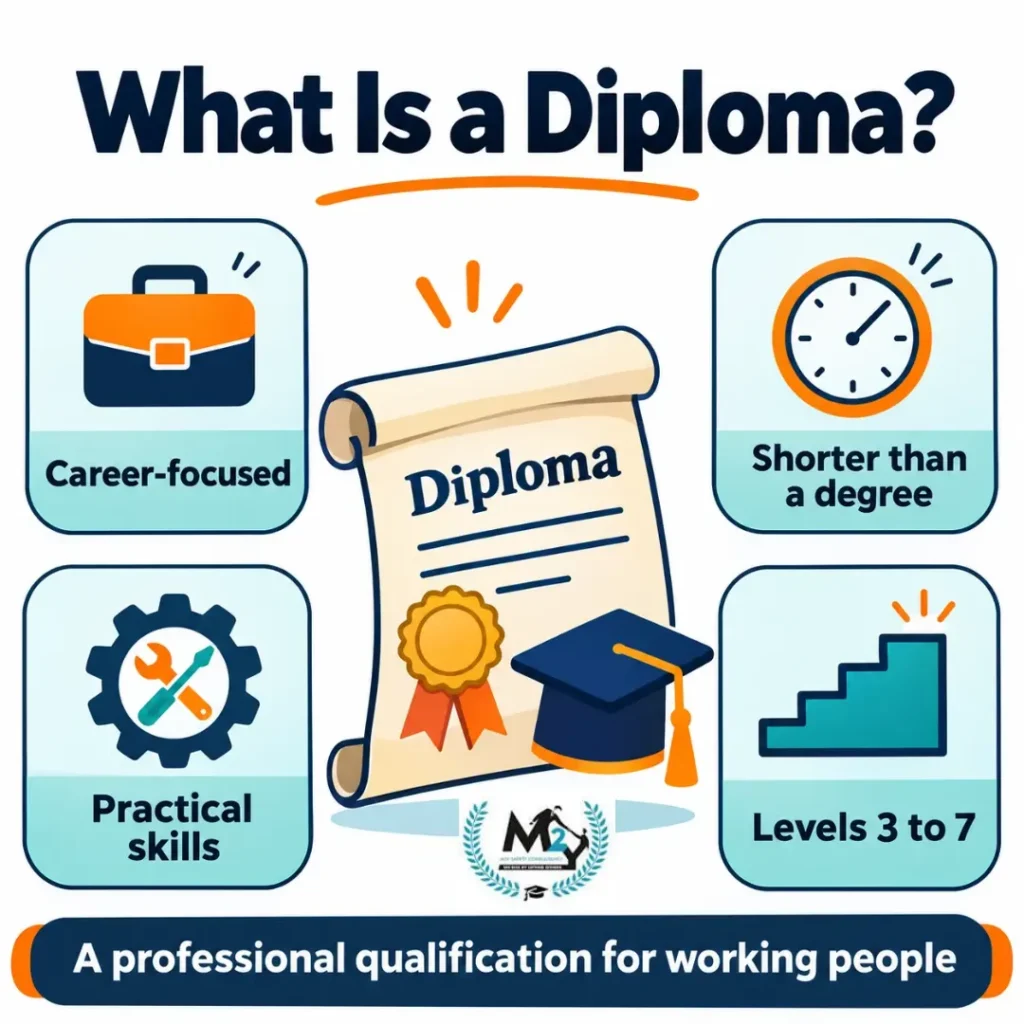
A diploma can move your career forward without a full degree: it is shorter, focused on a profession, and many employers across the Gulf treat higher-level diplomas as proof that you can take on more responsibility. The challenge is choosing well. There are many awarding bodies, levels and subjects, and not every course with “diploma” in its name carries the same weight.
M2Y Safety Consultancy supports professionals in the UAE, Saudi Arabia and the wider Middle East with professional diplomas in health and safety, environmental management, risk, strategic management, project management and logistics and supply chain. This guide explains how diploma levels work, compares the main options side by side, and shows how to choose the right one and check a provider before you pay.
Quick answer
- Looking for a recognised health and safety diploma? Compare the IOSH Level 6 Diploma, the OTHM Level 6 Diploma in Occupational Health and Safety and the ProQual Level 6 NVQ Diploma in the table below.
- Want a postgraduate-level (RQF Level 7) diploma? See the OTHM Level 7 Diploma in OHS Management and the other Level 7 options.
- Not sure which to pick? Message us on WhatsApp or call +971 585861522.
What Is a Diploma Course?
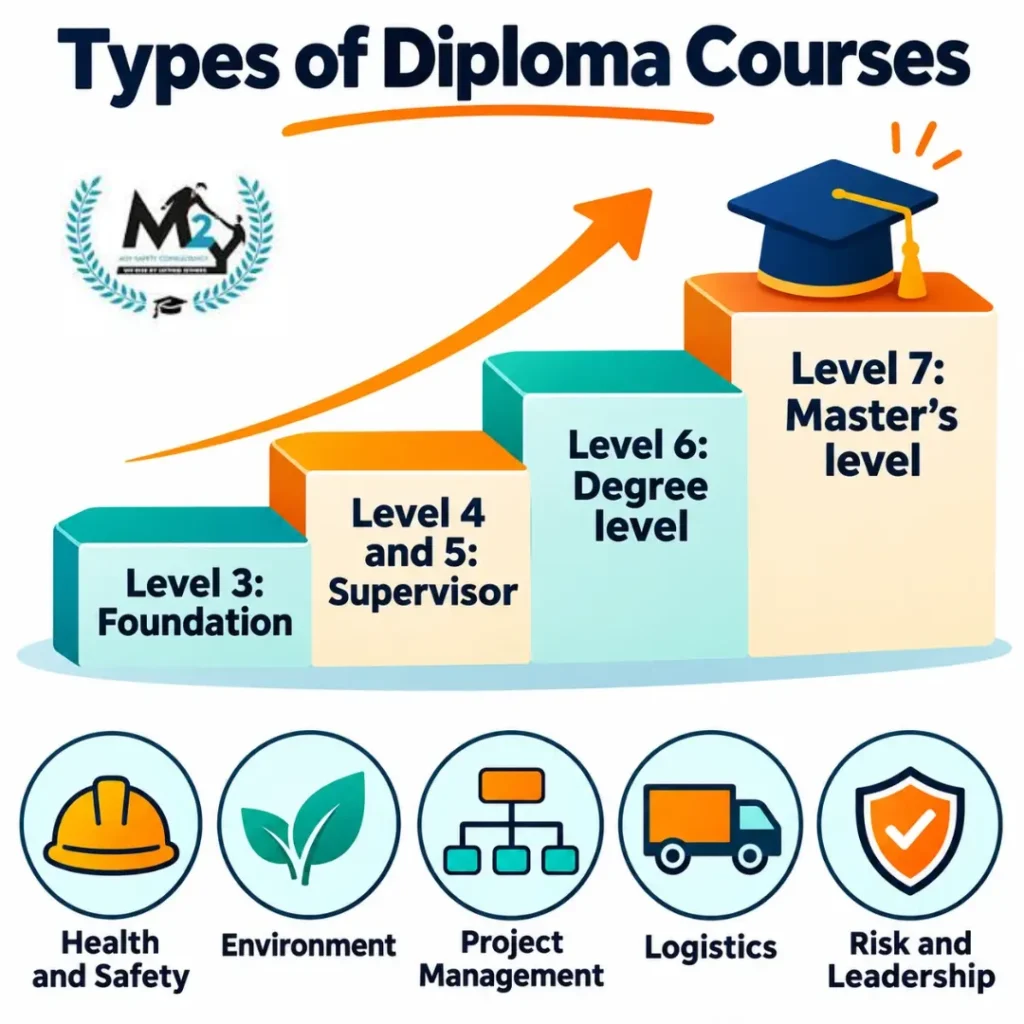
A diploma is a vocational or professional qualification that focuses on a specific field. In the UK qualification system, which many of the diplomas below follow, qualifications are placed on the Regulated Qualifications Framework (RQF) by level:
| RQF level | Roughly comparable to | Typical use |
|---|---|---|
| Level 3 | A level / upper secondary | Entry to a profession, foundation knowledge |
| Level 4 and 5 | First stages of higher education | Supervisory and junior management roles |
| Level 6 | Bachelor’s degree level | Professional and senior roles |
| Level 7 | Master’s degree level | Strategic, executive and postgraduate-pathway roles |
A diploma at Level 6 or 7 is not itself a degree. Level 7 diplomas are normally shorter than a full master’s, so a master’s usually needs a further dissertation stage with a university. You can check whether a qualification is regulated on the Ofqual Register of Regulated Qualifications.
Health and Safety Diplomas at Level 6: Compare Your Options
Level 6 health and safety diplomas are the most requested professional diplomas we are asked about. The right one depends on how you prefer to be assessed and which professional bodies you are aiming for.
| Diploma | Awarding body | Structure | How it is assessed | Best for |
|---|---|---|---|---|
| IOSH Level 6 Diploma in OSH Leadership and Management | IOSH (Ofqual-regulated awarding organisation) | 3 mandatory units | No written exams; one assignment per unit using reports and presentations based on your own workplace | Practitioners who want a leadership-focused qualification from IOSH itself |
| OTHM Level 6 Diploma in Occupational Health and Safety | OTHM (qualification number 603/5002/7) | 7 mandatory units, 60 credits | Internally assessed by the centre and externally verified by OTHM | Learners who prefer a structured, unit-by-unit programme |
| ProQual Level 6 NVQ Diploma in OHS Practice | ProQual | Competence-based units | Work-based evidence rather than exams | Experienced practitioners who can evidence their work |
| NEBOSH Level 6 International Diploma | NEBOSH (regulated by Ofqual) | 3 units (DI1 to DI3), 42 credits | Assignment for DI1 and case studies for DI2 and DI3 | Learners who want NEBOSH’s qualification; offered through our sister academy, M2Y Global Academy |
How to choose between them: think about the assessment style you can do well in, what your employer or target employer asks for, and whether you want to work towards IOSH Certified membership (CertIOSH). IOSH lists its own Level 6 Diploma as a degree-level qualification accepted for Certified membership, and OTHM states that its Level 6 diploma leads to CertIOSH eligibility. IOSH sets and may change its own membership rules, including experience requirements, so check its current criteria on the IOSH Certified membership page.
Sources: IOSH Level 6 Diploma, NEBOSH International Diploma guide (PDF) and M2Y course pages. Confirm unit details with each awarding body before enrolling.
Level 7 Diplomas: Postgraduate-Level Options
Level 7 diplomas suit senior professionals, managers and consultants who want strategic-level knowledge.
| Diploma | Focus | Page |
|---|---|---|
| OTHM Level 7 Diploma in Occupational Health and Safety Management | Six mandatory units, 120 credits; qualification number 603/7782/3. OTHM states that completers are eligible to apply for CertIOSH, and learners can progress to a master’s top-up at many universities | View course |
| ProQual Level 7 Diploma in Strategic Health and Safety Leadership and Management | Five mandatory units, portfolio-based assessment, for senior health and safety professionals | View course |
| ProQual Level 7 Diploma in Occupational Health and Safety Management | Level 7 health and safety management qualification | View course |
| OTHM Level 7 Diploma in Environmental and Sustainability Management | Environmental and sustainability leadership | View course |
| ProQual Level 7 NVQ Diploma in Environmental Management | Competence-based environmental management | View course |
| OTHM Level 7 Diploma in Risk Management | Strategic risk management | View course |
| OTHM Level 7 Diploma in Strategic Management and Leadership | Strategic management and leadership | View course |
| OTHM Level 7 Diploma in Project Management | Advanced project management | View course |
| OTHM Level 7 Diploma in Logistics and Supply Chain Management | Strategic logistics and supply chain | View course |
Entry requirements, units and assessment differ for each qualification. Ask us for the current details for the diploma you are considering.
Diploma Courses by Field
Health, safety and fire
Health and safety diplomas run from foundation to strategic level. For example, the OTHM Level 3 Technical Certificate in OHS and ProQual Level 3 NVQ Certificate in Occupational Health and Safety are earlier-stage options, the ProQual Level 5 NVQ Diploma in Fire Safety and Risk Management suits fire and risk specialists, and the Level 6 and 7 diplomas above are for senior professionals.
Environment and sustainability
- ProQual Level 6 NVQ Diploma in Environmental and Sustainability Management
- OTHM Level 7 Diploma in Environmental and Sustainability Management
- ProQual Level 7 NVQ Diploma in Environmental Management
- Related: ISEP / IEMA environmental sustainability courses
Project management
- OTHM Level 4 Diploma in Project Management
- OTHM Level 5 Diploma in Project Management
- OTHM Level 5 Extended Diploma in Project Management
- OTHM Level 7 Diploma in Project Management
Logistics and supply chain management
- OTHM Level 4 Diploma in Logistics and Supply Chain Management
- OTHM Level 5 Diploma in Logistics and Supply Chain Management
- OTHM Level 5 Extended Diploma in Logistics and Supply Chain Management
- OTHM Level 6 Diploma in Logistics and Supply Chain Management
- OTHM Level 7 Diploma in Logistics and Supply Chain Management
Strategic management and risk
How to Choose the Right Diploma
| If you want to… | Consider |
|---|---|
| Move from supervisor to HSE manager | OTHM Level 6 Diploma in OHS or IOSH Level 6 Diploma |
| Avoid written exams and use evidence from your job | ProQual Level 6 NVQ Diploma in OHS Practice |
| Reach senior, strategic or consultancy roles | OTHM Level 7 Diploma in OHS Management or ProQual Level 7 Strategic Health and Safety Leadership |
| Work towards IOSH Certified (CertIOSH) and then Chartered status | An accredited Level 6 or 7 diploma, then check IOSH’s requirements |
| Work towards the Certified Safety Professional (CSP) | A BCSP-qualified credential, a degree and experience; see our CSP page |
| Move into environmental or sustainability roles | OTHM Level 7 Diploma in Environmental and Sustainability Management |
| Manage projects or supply chains | The OTHM project management and logistics diplomas above |
Also consider shorter, more focused routes if a full diploma is more than you need: IOSH Managing Safely, OSHA 30-hour training, ISO Lead Auditor courses and the wider HSE training catalogue.
Diploma Courses in UAE, Saudi Arabia and the Middle East
Employers across the Gulf use diplomas in different ways. Some ask for a named qualification in job advertisements, some look for a level (for example “degree-level HSE qualification”), and some rely on professional-body membership. A few practical points:
- Check the job description first. Requirements vary by employer, sector and country, so look at what your target employers in the UAE, Saudi Arabia or elsewhere actually list.
- Check local compliance rules. Some roles carry local approvals in addition to a diploma. For example, see our pages on Dubai Municipality OHS Person in Charge (PIC) training and DM HSO officer approval.
- Compare levels, not just titles. A Level 6 diploma is bachelor’s degree level; a Level 7 diploma is master’s degree level.
- Verify the awarding body. Confirm the qualification is regulated, and check the exact title and awarding body that appear on the certificate.
- Remote and online study. M2Y delivers diploma programmes online to learners in Saudi Arabia and across the Middle East, with the delivery formats and time zones you support.
How Diploma Courses Are Assessed
Assessment differs between diplomas, so choose one that suits how you learn:
- Assignments and reports based on your own workplace (for example the IOSH Level 6 Diploma)
- Unit-based coursework assessed by the centre and externally verified by the awarding body (for example OTHM diplomas)
- Portfolio or competence-based evidence from your job (for example ProQual NVQ diplomas)
- Case studies (for example parts of the NEBOSH Level 6 International Diploma)
Most professional diplomas allow you to study while you work, and several have no written exam, but you should confirm the format for your chosen course before you enrol.
Entry Requirements
Entry requirements depend on the diploma and the awarding body. In general:
- Level 3 and 4 diplomas are suitable if you are starting out or moving into a new field
- Level 5 and 6 diplomas usually expect an earlier qualification or relevant experience (for example a Level 3 or 4 health and safety qualification for the OTHM Level 6 diploma)
- Level 7 diplomas usually expect a Level 6 qualification or substantial senior experience
- English language ability is needed because courses and assessments are in English
M2Y entry requirements: [Confirm the current entry criteria for each diploma you list.]
Not sure whether you qualify? Message us on WhatsApp with your qualifications and experience and we will advise you before you commit.
Progression After a Diploma
- Professional membership. IOSH lists accredited Level 6 or 7 qualifications (with the relevant experience) for Certified membership, which leads towards Chartered membership. See IOSH’s Certified and Chartered pages.
- Certified Safety Professional (CSP). BCSP requires a degree, four years of qualifying experience, a BCSP-qualified credential and a pass in the CSP exam. See our CSP page.
- Further study. Level 7 diplomas can lead to a master’s top-up at many universities, subject to each university’s requirements. For OTHM Level 7 qualifications, see OTHM’s university progression page.
- Specialist add-ons. Add audit skills with an ISO 45001 Lead Auditor course, or fire and risk skills with the ProQual Level 5 NVQ Diploma in Fire Safety and Risk Management.
How to Check a Diploma Provider
- Check the awarding body. Make sure the diploma comes from a named awarding body, and ask for its qualification number.
- Check regulation. Look the qualification up on the Ofqual Register or the awarding body’s own site.
- Ask exactly what you will receive, including the exact certificate title and who issues it.
- Ask how it is assessed and what support you get with assignments or portfolios.
- Ask what the fee includes, such as registration, assessment, resits and materials.
- Be wary of vague claims. “Internationally recognised” and “guaranteed job” are not proof. Ask for specifics.
- Ask about progression, for example which professional bodies or universities accept the diploma and under what conditions.
Fees, Dates and Booking
Diploma fees depend on the qualification, level, awarding body and what is included. We confirm current fees and start dates directly so that you get an accurate quote.
Contact us for current diploma fees and next start dates
- WhatsApp: Chat with M2Y Safety on WhatsApp
- Phone: +971 585861522
- Email: info@m2ysafety.com
- Contact page | Book a free demo | Special offers
What to tell us: the diploma you are considering (or your goal), your qualifications and experience, your country, and your preferred study mode and start date.
What your quote should confirm: which awarding body issues the diploma, whether registration and assessment fees are included, the study format, and what happens if you need extra time or a resit.
Frequently Asked Questions
Diploma courses are vocational or professional qualifications that focus on a specific field. In the UK system, higher-level diplomas sit at RQF Level 6 (bachelor's degree level) and Level 7 (master's degree level).
It depends on your field. In health and safety, popular routes include the IOSH Level 6 Diploma, the OTHM Level 6 and Level 7 diplomas and the ProQual NVQ diplomas. For management, project management, risk and logistics, OTHM offers diplomas from Level 4 to Level 7.
A Level 6 diploma is at the same RQF level as a bachelor's degree, but it is a professional diploma and not a degree. Level 7 diplomas are at the same level as a master's degree, but a full master's usually needs a further dissertation stage.
Contact us to check which diplomas and formats are available for your country.
Choose based on how you prefer to be assessed, what employers in your market ask for, and the professional bodies you are targeting. The IOSH Level 6 Diploma uses work-based assignments with no written exams, the OTHM Level 6 Diploma is a unit-based programme, and the ProQual NVQ Level 6 Diploma uses work-based evidence.
It varies. Some diplomas, such as the IOSH Level 6 Diploma, have no written exams and use assignments, while others use coursework, portfolios or case studies. Check the assessment format for your chosen diploma.
IOSH lists accredited Level 6 or Level 7 qualifications, plus the relevant experience, for Certified membership. IOSH sets and can change its requirements, so check its current criteria.
Level 7 diplomas can lead to a master's top-up at many universities, subject to each university's own entry requirements.
Confirm the awarding body and qualification number, and look the qualification up on the Ofqual Register or the awarding body's website. Ask your provider for the exact title that will appear on your certificate.
Fees vary by qualification, level and what is included. Contact M2Y Safety on WhatsApp or call +971 585861522 for current fees and start dates.
Yes, group and corporate arrangements are generally possible. Contact us with the diploma, number of participants and location for a tailored quote.