CSP Certification
If you’re scrolling through job postings and seeing “CSP required” or “CSP preferred,” you’re probably asking yourself: Is this certification really worth it? Will it boost my salary? Can I even qualify?
You’re not alone. Thousands of safety professionals face the same questions. You’ve worked hard—maybe earned your NEBOSH, gained years of experience, completed advanced qualifications. But something’s still missing. Promotions aren’t coming. Salary negotiations fall flat. Those dream jobs in Dubai or with multinational companies keep slipping away.
The truth? Certified Safety Professional (CSP) certification has become the key differentiator in today’s competitive safety landscape. This guide gives you everything you need to know—straight and simple.
CSP Certification | Info |
Last Date for Registration | 10 Mar 2026 |
What is CSP Certification?
CSP (Certified Safety Professional) is the gold standard credential in occupational safety, offered by the Board of Certified Safety Professionals (BCSP). It’s globally recognized and proves you have expert-level competence in safety management—not just theoretical knowledge.
Why CSP matters:
- ISO/IEC 17024 internationally accredited
- Recognized in 100+ countries
- Validates both knowledge AND experience
- Required for senior safety positions globally
Unlike basic safety courses, CSP proves you can integrate safety into business operations, manage complex safety systems, and deliver measurable results.
Is CSP Certification Worth It? The Real Numbers
Let’s talk money and career impact—what you really care about.
Salary Impact by Region
| Region | Average CSP Salary | Without CSP | Increase |
|---|---|---|---|
| UAE/Gulf | AED 18,000 – 30,000/month | AED 12,000 – 18,000 | 30-40% |
| India | ₹10 – 20 lakhs/year | ₹6 – 12 lakhs | 40-60% |
| UK | £50,000 – 75,000/year | £35,000 – 50,000 | 35-45% |
| Saudi Arabia | SAR 15,000 – 25,000/month | SAR 10,000 – 15,000 | 40-50% |
| USA | $85,000 – 130,000/year | $60,000 – 85,000 | 35-50% |
Real Career Impact:
- Access to senior management positions (Safety Manager, HSE Director)
- International job mobility without credential issues
- Premium consulting rates (if self-employed)
- Faster promotions and career progression
CSP is worth it if you:
- Have 4+ years of safety experience
- Target senior-level or management positions
- Want to work internationally (especially Gulf, UK, USA)
- Work in oil & gas, construction, manufacturing, petrochemicals
- Have reached a career plateau
Skip CSP (for now) if you:
- Have less than 3 years experience (you don’t qualify yet)
- Plan to stay in entry-level positions
- Only work in markets where local certifications dominate
Is CSP Certification Worth It? The Real Numbers
Main Pathways to CSP
| Pathway | Education | Experience | Total Time |
|---|---|---|---|
| Route 1 | Bachelor’s degree (any field) | 4 years safety work | ~4-5 years |
| Route 2 | Bachelor’s in safety/related | 4 years safety work | ~4-5 years |
| Route 3 | Master’s in safety/related | 3 years safety work | ~3-4 years |
| Route 4 | High school diploma | 8 years safety work | ~8+ years |
| NEBOSH Route | NEBOSH IDIP | 4 years safety work | ~4-5 years |
| IOSH Route | IOSH Level 6 Diploma | 4 years safety work | ~4-5 years |
What counts as “professional safety experience”?
- 50%+ of your time doing safety work
- Full-time safety officer, HSE coordinator, or safety manager roles count
- Must involve: hazard identification, risk assessment, safety program management
The NEBOSH/IOSH Advantage
This is huge for international professionals:
| Your Credential | CSP Benefit |
|---|---|
| NEBOSH International Diploma | Skip ASP level, go straight to CSP (with experience) |
| IOSH Level 6 Diploma | Skip ASP level, go straight to CSP (with experience) |
| NEBOSH IGC | Helps but doesn’t skip steps |
NEBOSH and IOSH credentials significantly accelerate your CSP pathway.
How Long Does It Take to Become a CSP?
Realistic Timeline
| Stage | Duration | Action |
|---|---|---|
| Build Experience | 4-8 years | Work in qualifying safety roles |
| Application | 1-2 months | Submit to BCSP with documents |
| Study | 3-6 months | 150-300 hours of preparation |
| Exam | 1 day | 4-hour computer exam |
| Results | 4-6 weeks | Pass/fail notification |
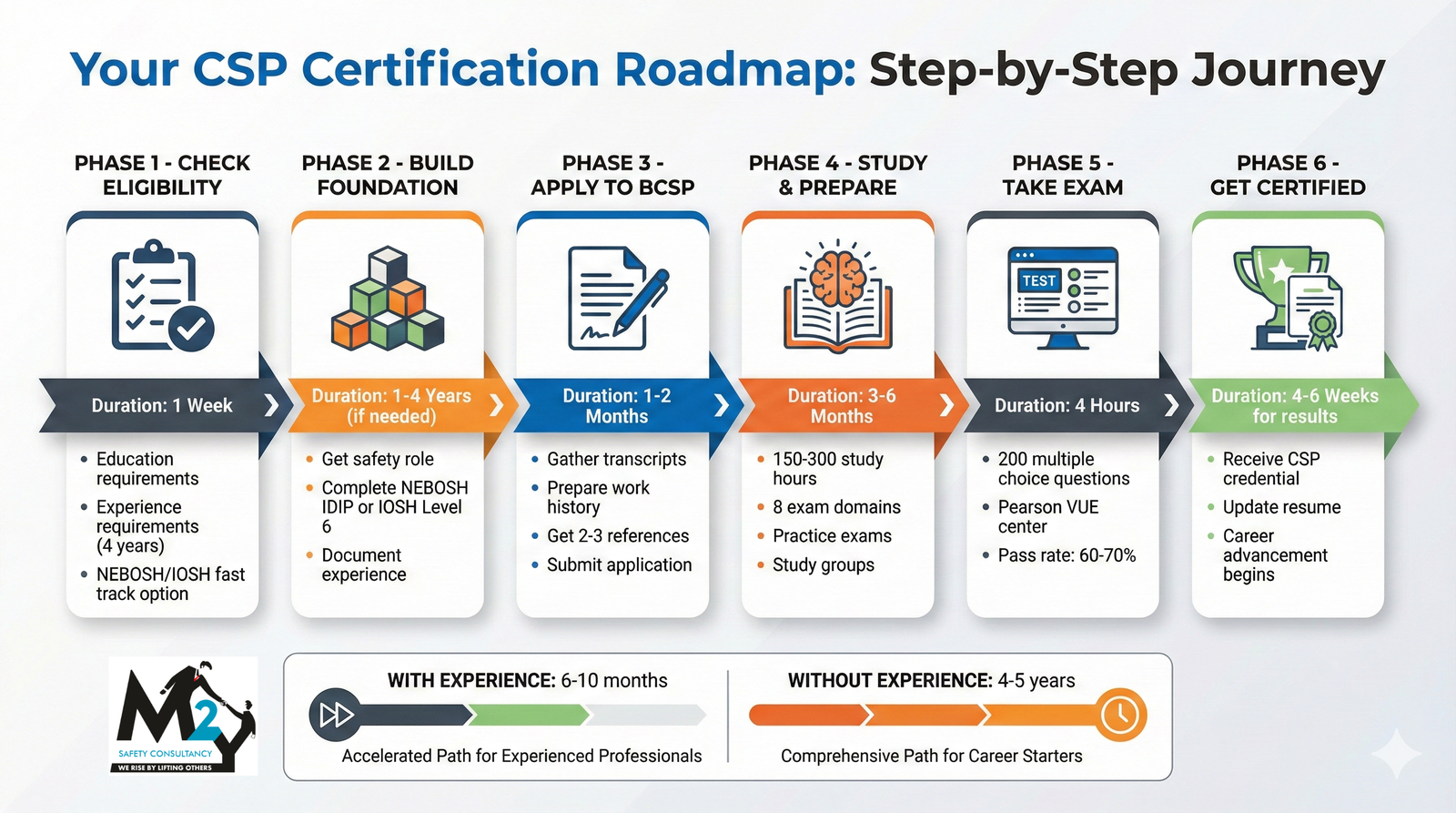
If you already have experience: 6-10 months from start to certification If starting fresh: 4-5 years minimum
Understanding the CSP Exam
Exam Quick Facts
| Detail | Specification |
|---|---|
| Format | Computer-based, multiple choice |
| Questions | 200 questions |
| Duration | 4 hours (no breaks) |
| Location | Pearson VUE centers worldwide |
| Cost | $350-450 (exam only) |
| Pass Rate | 60-70% (first attempt) |
| Preparation Time | 150-300 hours recommended |
8 CSP Exam Domains
| Domain | Weight | Key Topics |
|---|---|---|
| Management Systems | ~20% | Safety leadership, program management |
| Risk Management | ~15% | Risk assessment, hazard control |
| Industrial Hygiene | ~15% | Chemical hazards, exposure control |
| Advanced Sciences | ~15% | Physics, chemistry, statistics |
| Ergonomics | ~10% | Human factors, workplace design |
| Fire Prevention | ~10% | Fire safety, emergency response |
| Environmental | ~8% | Environmental compliance |
| Training & Communication | ~7% | Adult learning, safety culture |
CSP vs NEBOSH: Key Differences
| Aspect | CSP | NEBOSH |
|---|---|---|
| Type | Professional Certification | Educational Qualification |
| Experience Required | Yes (4+ years) | No |
| Best For | Senior/management roles | Building knowledge foundation |
| Time to Complete | Years (with experience) | Weeks to months |
| Recognition | USA, Gulf, global MNCs | UK, Middle East, Commonwealth |
| Cost | $2,000-5,000 total | Varies by course |
| Renewal | Every 5 years | No renewal needed |
Best Strategy: Use Both
Your Career Path:
- Years 1-3: Get NEBOSH IGC, then NEBOSH IDIP or IOSH Level 6
- Years 4-5: Build experience, then pursue CSP
- Years 5+: Maintain CSP, continue specialization
NEBOSH builds knowledge. CSP course proves professional competence. Together, they’re unbeatable.
Why Gulf Employers Love CSP
Top 5 Reasons:
- International standards: Gulf mega-projects need globally recognized credentials
- Regulatory compliance: Advanced safety laws require advanced professionals
- Competitive edge: CSP cuts through the noise in crowded job markets
- Salary justification: Employers know CSP holders command higher pay
- Long-term value: Ongoing CSP requirements prove continuous development
Gulf Market Reality:
- Oil & gas companies often require CSP for senior positions
- Construction megaprojects prefer CSP-certified safety managers
- International firms operating in Gulf default to CSP as standard
- Visa sponsorship stronger with internationally recognized credentials
Your Step-by-Step CSP Roadmap
Phase 1: Qualify (If You Don’t Already)
Check your eligibility:
- Education: Do you have a bachelor’s degree?
- Experience: Do you have 4+ years in safety?
- Documentation: Can you prove it?
If not ready:
- Get a full-time safety role
- Pursue NEBOSH IDIP or IOSH Level 6 at M2Y Academy
- Document everything you do
Phase 2: Apply to BCSP
Application requirements:
- Official transcripts
- Detailed job descriptions (not just titles)
- 2-3 professional references
- Proof of certifications
- Application fee (~$100)
Timeline: 1-2 months for approval
Phase 3: Study Smart
Study plan (3-6 months):
- Week 1-2: Assessment (take practice test, identify weak areas)
- Week 3-12: Deep study (focus on weak domains first)
- Week 13-16: Practice exams (multiple full-length tests)
- Week 17-20: Review and refinement
- Week 21-24: Final preparation
Essential resources:
- BCSP official study guide (mandatory)
- Practice exams (as many as possible)
- Study groups (online or local)
- Professional mentoring at M2Y Safety Consultancy
Study hours by week:
- Minimum: 10 hours/week
- Recommended: 15 hours/week
- Intensive: 20+ hours/week
Phase 4: Take the Exam
Exam day tips:
- Arrive 30 minutes early
- Bring two forms of ID
- Read each question carefully (they’re scenario-based)
- Manage your time (1.2 minutes per question)
- Flag difficult questions, come back later
- Don’t second-guess excessively
Phase 5: Maintain Your Certification
Ongoing requirements:
- 30 recertification points every 5 years
- Annual renewal fee (~$100)
- Continuing education through conferences, courses, publications
Practical Exam Preparation Tips
Top 10 Success Strategies:
- Start early: Don’t cram—CSP covers too much
- Focus on application: Practice scenario-based thinking
- Master the math: Statistics, exposure calculations, probability
- Know regulations: OSHA, ANSI, NFPA standards
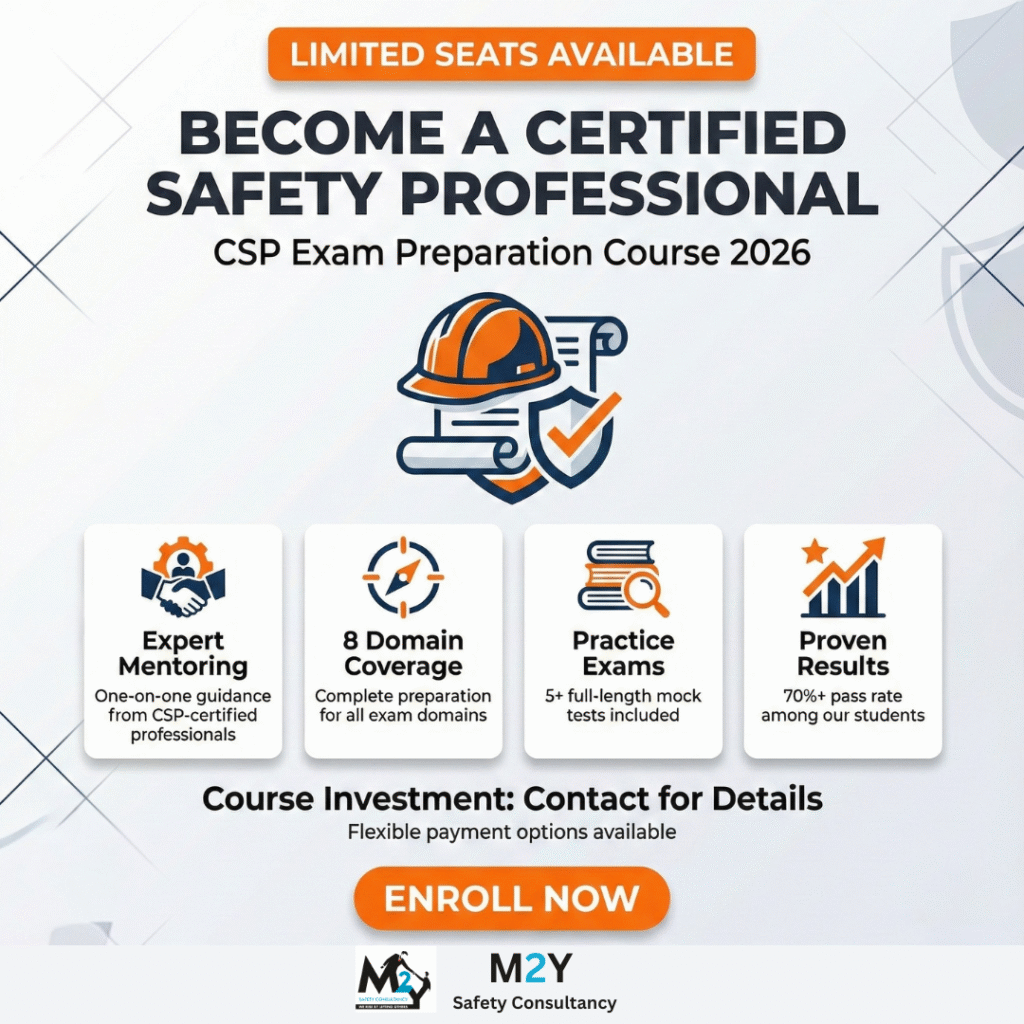
- Take practice exams: Minimum 5 full-length tests
- Join study groups: Learn from others’ perspectives
- Study weak areas first: Don’t avoid difficult topics
- Use flashcards: For regulations and definitions
- Teach others: Explaining concepts solidifies learning
- Get professional help: Consider mentoring at M2Y Safety Consultancy
Common mistakes to avoid:
- Relying only on work experience (exam tests book knowledge too)
- Ignoring math and statistics sections
- Using outdated study materials
- Not taking enough practice exams
- Studying everything equally (prioritize by exam weight)
M2Y Safety Consultancy: Your CSP Success Partner
We provide complete CSP support:
✅ Eligibility Assessment: We review your credentials and create your personalized pathway
✅ Application Support: We help prepare documentation and navigate BCSP requirements
✅ Exam Preparation: Structured mentoring covering all 8 domains with practice tests
✅ NEBOSH/IOSH Integration: We help leverage your existing credentials toward CSP
✅ Career Coaching: Resume optimization, interview prep, salary negotiation
✅ Gulf Market Expertise: Specialized guidance for UAE, Saudi, Qatar opportunities
Why M2Y?
- Experienced CSP-certified mentors
- Proven track record (dozens of successful CSP candidates)
- Flexible online and in-person options
- Comprehensive HSE training programs
- Post-certification career support
Start your CSP journey: Contact M2Y Safety Consultancy today
Frequently Asked Questions
Yes, absolutely. CSP is highly valued in UAE, Saudi Arabia, Qatar, Kuwait, and Oman. Major employers—especially in oil & gas, construction, and manufacturing—actively prefer CSP certification for senior positions.
Yes, but you need 8 years of professional safety experience (vs. 4 years with a bachelor's degree). This pathway takes longer but is definitely possible.
Yes. NEBOSH International Diploma can allow you to skip the ASP level and go directly to CSP eligibility (with required experience). This is a major advantage for international professionals.
No. CSP requires minimum 3-4 years of professional safety experience (depending on your degree). Fresh graduates should focus on getting safety experience and building foundational credentials like NEBOSH first.
Approximately $2,000-5,000 total including:
- Application fee: ~$100
- Exam fee: ~$350-450
- Study materials: $300-800
- Review courses (optional): $1,000-3,000
- Annual maintenance: ~$100/year
Approximately 60-70% pass on first attempt. With proper preparation (150-300 study hours), your chances improve significantly.
Yes, generally. CSP covers broader scope, emphasizes application over theory, and is a single 4-hour comprehensive exam. However, if you have strong experience and prepare properly, it's absolutely achievable.
CSP requires renewal every 5 years through continuing education (30 recertification points). You also pay an annual maintenance fee.
Yes. CSP is recognized globally and particularly valued in USA, Canada, Gulf countries, UK, and by multinational corporations worldwide.
They serve different purposes. NEBOSH builds knowledge (educational). CSP proves professional competence (certification). Best strategy: get NEBOSH first, then CSP later. Having both is ideal.
Your Next Steps: Start Your CSP Journey Today
Action Plan:
Immediate (This Week):
- Assess your eligibility using BCSP website
- Calculate your timeline to eligibility
- Set your CSP target date
Short-term (Next 3 Months):
- Complete any missing education (NEBOSH IDIP or IOSH Level 6)
- Document your safety experience in detail
- Gather transcripts and certificates
- Identify professional references
Medium-term (Next 6-12 Months):
- Submit BCSP application
- Begin structured exam preparation
- Join study groups or get professional mentoring
- Take practice exams regularly
Your Investment vs. Return:
| Investment | Return |
|---|---|
| $2,000-5,000 total cost | $5,000-15,000 annual salary increase |
| 150-300 hours study | Career advancement for 20-30 years |
| 3-6 months preparation | Professional credibility for life |
| ROI: 6-12 months | Lifetime value: $100,000+ |
Final Thoughts
CSP certification isn’t easy. It requires years of experience, months of preparation, and genuine commitment. But for safety professionals serious about career advancement, international opportunities, and financial growth, it’s one of the smartest investments you can make.
The difference between those who achieve CSP and those who don’t usually comes down to one thing: taking the first step.
Don’t spend another year wondering “what if.” The best time to start was yesterday. The second-best time is today.
Ready to begin?
👉 Contact M2Y Safety Consultancy for personalized CSP guidance
👉 Explore HSE training programs to build your foundation
👉 Check M2Y Global Academy for NEBOSH and IOSH courses
Your CSP credential—and the career transformation it brings—is waiting. Take action today.