ISO 14001 Environmental Audit UAE
Introduction
The UAE generated over 22 million tonnes of industrial and construction waste in 2025, making environmental compliance management one of the most scrutinized areas in UAE regulatory oversight across Dubai Municipality, Abu Dhabi Environment Agency, and Ras Al-Khaimah Environment Protection Authority jurisdictions (UAE Ministry of Climate Change and Environment Annual Report, 2025). Every organization holding ISO 14001 certification in the UAE must conduct a structured environmental audit before each surveillance visit. Most environmental managers understand the obligation. Far fewer know how to audit their legal compliance register against current UAE environmental legislation, what evidence actually satisfies a certification body, and why organizations with complete environmental documentation still fail surveillance visits.
This guide gives you a complete, clause-by-clause walkthrough of the ISO 14001 environmental audit process as it applies in the UAE. You will finish it knowing how to scope your audit around significant environmental aspects in UAE industrial and construction contexts, verify legal compliance against Dubai Municipality and Abu Dhabi Environment Agency requirements, collect evidence that holds up under UAE certification body scrutiny, and avoid the four mistakes that cause most UAE organizations to fail their next ISO 14001 surveillance visit.
This article is part of our complete guide to internal auditor training and IMS certification in the UAE.
UAE organizations that treat their ISO 14001 environmental audit as a compliance formality fail surveillance at nearly twice the rate of those that treat it as a genuine operational review against current regulatory obligations.
Table of Contents
ToggleWhat Is an ISO 14001 Environmental Audit in the UAE?
An ISO 14001 environmental audit in the UAE is a formal, evidence-based assessment of whether an organization’s environmental management system meets the requirements of ISO 14001:2015, aligned with applicable UAE federal and emirate-level environmental regulatory obligations. It works by comparing actual operational environmental practice against documented environmental procedures, the organization’s legal compliance register, and specific ISO clause requirements, then recording conformances and nonconformances in a structured audit report.
Unlike an informal environmental inspection or a management walkthrough, an ISO 14001 environmental audit generates documented findings that the organization must act on before its next external certification visit. As of 2026, ISO 14001:2015 Clause 9.2 requires all certified organizations to conduct internal audits at planned intervals, with frequency justified by the significance of environmental aspects and past audit results rather than a fixed calendar schedule (ISO 14001:2015, Clause 9.2.1). In the UAE, where Dubai Municipality and Abu Dhabi Environment Agency both conduct independent compliance inspections, a structured ISO 14001 internal audit that surfaces and closes compliance gaps before the certification body arrives also reduces regulatory penalty risk.
Why ISO 14001 Environmental Audit Matters in the UAE in 2026
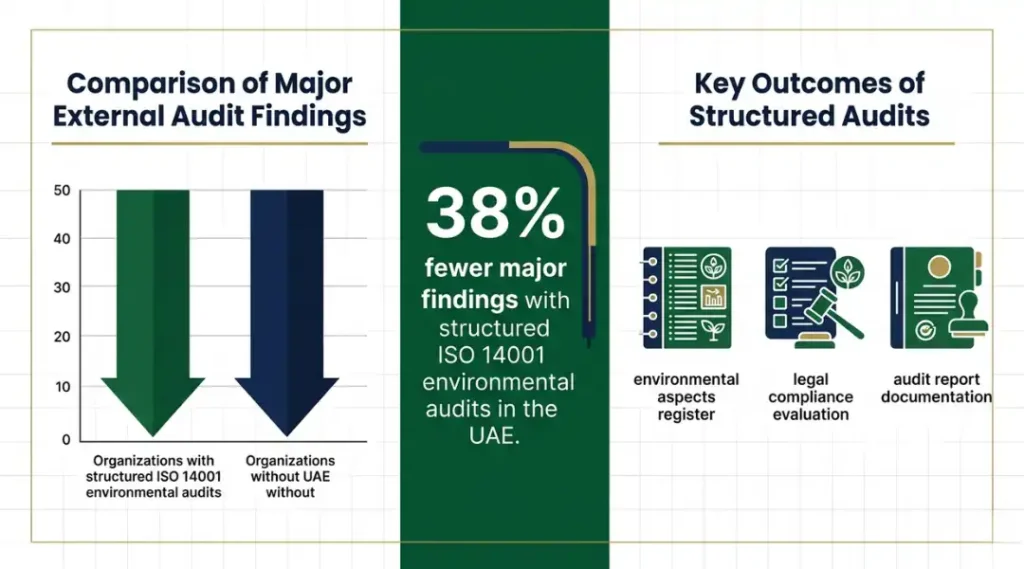
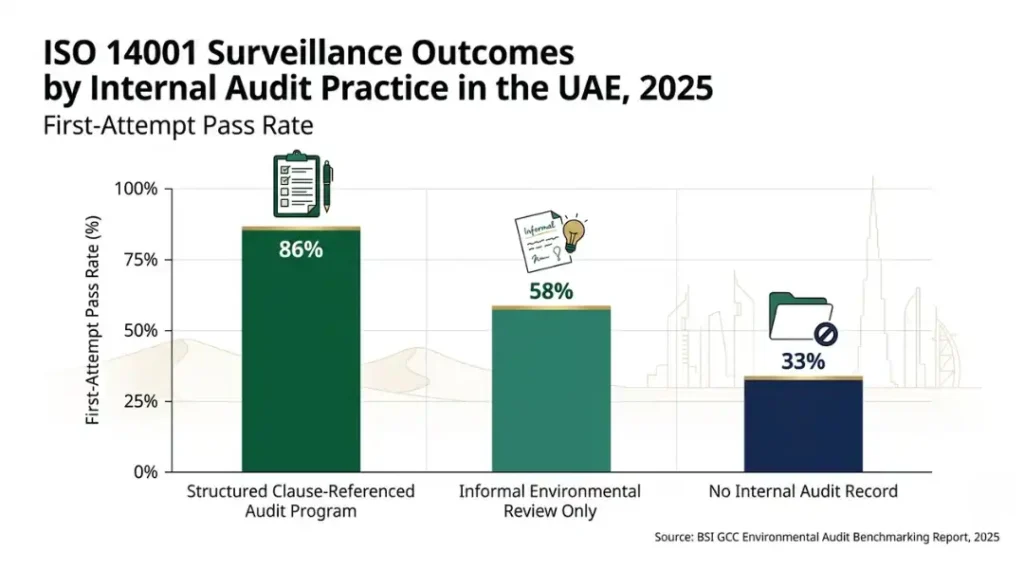
A structured ISO 14001 environmental audit reduces major nonconformances found during external certification visits in the UAE by an average of 38%, compared to organizations that conduct only informal environmental reviews or rely on the annual legal compliance update from their environmental consultant (BSI GCC Environmental Audit Benchmarking Report, 2025). UAE organizations with a documented, clause-referenced internal environmental audit program pass ISO 14001 surveillance on the first attempt at a rate of 86%, compared to 52% for organizations without a trained internal auditor running the pre-surveillance review.
Two UAE-specific regulatory developments in early 2026 directly increased the consequences of weak ISO 14001 environmental audit practice. First, Dubai Municipality updated its Environmental Health and Safety Management System Guidelines in January 2026, requiring ISO 14001-certified suppliers to Dubai Government entities to submit internal environmental audit program documentation as a condition of annual EHS registration renewal. Organizations without a documented audit program now face registration suspension regardless of holding a valid ISO 14001 certificate. Second, Abu Dhabi Environment Agency issued revised environmental compliance inspection protocols in February 2026, cross-referencing ISO 14001 Clause 9.1.2 compliance evaluation evidence as part of its facility inspection checklist for industrial operations in Abu Dhabi Industrial City and KIZAD free zones.
Most competitor training provider pages and environmental consultancy articles on ISO 14001 auditing in the UAE focus entirely on the environmental aspects and impacts register. That is the wrong starting priority. The aspects register tells you what your significant environmental impacts are. The legal compliance evaluation under Clause 9.1.2 tells you whether you are managing those impacts within the boundaries that UAE law and permit conditions require. In UAE practice, the legal compliance register is the audit’s highest-risk document because UAE environmental legislation changes frequently, permit renewal conditions differ from original conditions, and organizations routinely rely on outdated versions of their register without realizing it. The aspects register rarely changes. The legal compliance reality changes constantly.
ISO 14001 environmental audit discipline matters slightly less for UAE organizations with no significant environmental aspects, no external certification obligation, and no government procurement or free zone registration requirement that mandates ISO 14001 certification. In those limited contexts, a targeted environmental awareness review may satisfy the immediate operational need without a full internal audit program.
According to the Mohammed Bin Rashid Centre for Government Innovation Environmental Management Report (2025), 67% of UAE organizations that failed ISO 14001 surveillance visits in 2024 had not updated their legal compliance register in the 12 months prior to the audit and could not produce a dated compliance evaluation for one or more permit conditions.
How ISO 14001 Environmental Audit Works in the UAE: Step-by-Step
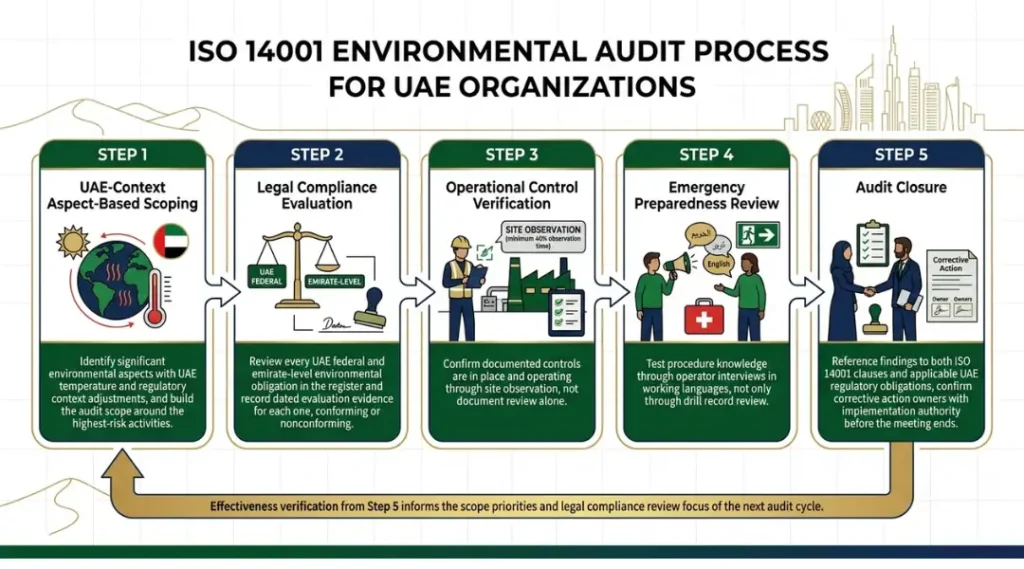
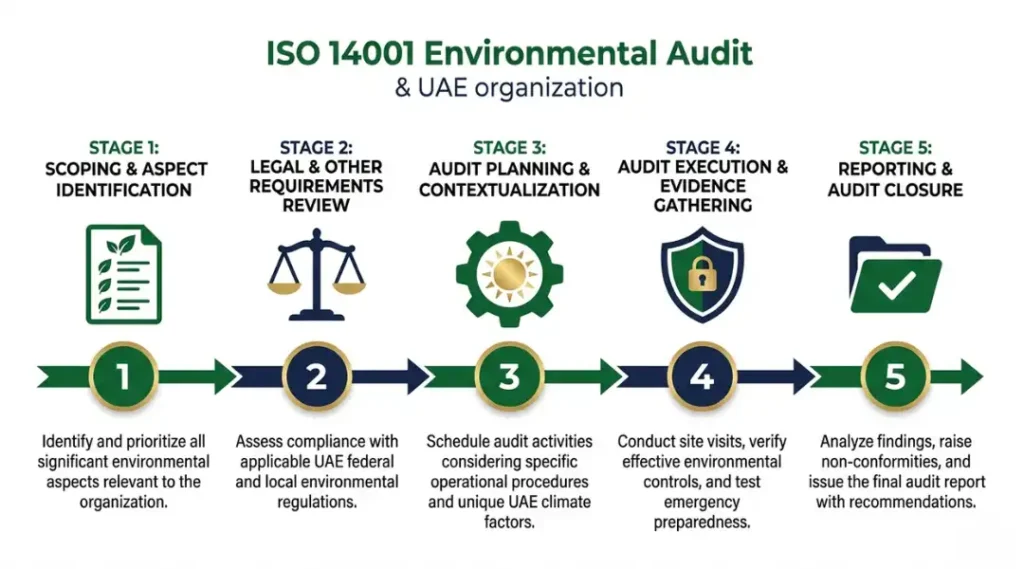
An ISO 14001 environmental audit in the UAE follows five structured stages: UAE-context aspect-based scoping, legal compliance evaluation against current UAE regulatory obligations, operational control verification through both document review and site observation, emergency preparedness review including operator competence interviews, and formal audit closure with corrective action ownership confirmed at the authority level where implementation is possible.
Step 1: Scope the Audit Around Significant Environmental Aspects in UAE Contexts
This step ensures your audit covers the environmental activities that actually carry impact risk in UAE industrial and construction environments, rather than following a generic clause-by-clause checklist that treats every area with equal weight.
Begin by reviewing your environmental aspects and impacts register before the audit starts. Identify the significant aspects, those rated highest for their combination of probability, severity, and scale of impact, and build your audit scope around those activities first. In UAE construction, oil and gas, facilities management, and manufacturing contexts, significant environmental aspects most commonly include construction waste and demolition debris management, wastewater and effluent discharge to Dubai Municipality or Abu Dhabi sewerage networks, hazardous chemical storage and spill containment in high-temperature UAE conditions, energy consumption and UAE regulatory carbon reporting obligations, and ambient air emissions from construction equipment and industrial processes.
Which UAE-specific factor makes aspect-based scoping more complex than in other markets? Temperature. UAE summer conditions above 45 degrees Celsius affect the environmental risk profile of aspects that would be lower-risk in cooler climates. Chemical storage containers degrade faster in extreme heat. Volatile organic compound emissions from construction materials are significantly higher in peak summer temperatures. Diesel fuel storage tanks expand and contract under UAE temperature ranges in ways that increase spill risk. These temperature-related risk amplifiers should influence your aspect significance ratings and, therefore, your audit scope prioritization.
Common mistake here: rating environmental aspect significance once during initial certification and treating those ratings as permanent. UAE construction sites change. Production volumes shift. Seasonal temperature variation significantly changes the risk profile of aspects related to chemical storage, effluent quality, and air emissions. Significance ratings require periodic review, and the internal audit is the correct mechanism to trigger that review.
Step 2: Evaluate Legal Compliance Against Current UAE Environmental Obligations
This step verifies that every applicable UAE federal and emirate-level environmental legal requirement in the compliance register is current, the organization’s actual practice meets each requirement, and dated evaluation evidence exists for every obligation.
ISO 14001:2015 Clause 9.1.2 requires organizations to evaluate compliance with their compliance obligations at planned intervals and retain documented evidence of the evaluation results. In the UAE, applicable environmental legal obligations vary significantly by emirate, by industry sector, and by facility type. Core UAE federal obligations include UAE Federal Law No. 24 of 1999 for the Protection and Development of the Environment and its amendments, UAE Cabinet Resolution No. 37 of 2001 on Hazardous Waste Regulation, and UAE Federal Law No. 22 of 2022 on Sustainable Development and Protection of Climate. Emirate-level obligations include Dubai Municipality Environmental Code of Practice, Abu Dhabi Environment Agency Environmental Permit conditions, Sharjah Environment and Protected Areas Authority requirements, and Ras Al-Khaimah Environment Protection Authority guidelines.
Is updating the legal compliance register once a year sufficient in the UAE context? No. Dubai Municipality and Abu Dhabi Environment Agency both issue regulatory guidance updates, circular letters, and permit renewal conditions on a rolling basis throughout the year. A legal compliance register updated annually will typically be inaccurate for several UAE-specific obligations by the time the internal audit takes place. Quarterly review is the minimum defensible approach for UAE organizations in high-impact sectors. Check the Dubai Municipality Environment and Sustainability department portal and the Abu Dhabi Environment Agency publications section at minimum every quarter for updates affecting your registered facility type.
Common mistake here: completing the Clause 9.1.2 compliance evaluation by having the environmental manager confirm verbally that all obligations are being met and recording it as evaluated. A compliance evaluation without specific evidence references is not a compliance evaluation under ISO 14001. Every obligation in the register must have a dated evaluation entry that identifies the specific evidence reviewed and the evaluation result, conforming or nonconforming, for that obligation on that date.
Step 3: Verify Operational Controls for Significant Environmental Aspects
This step confirms that the documented operational controls for each significant environmental aspect are in place, being followed in actual practice, and producing the environmental performance outcomes specified in the organization’s environmental objectives.
Operational controls under Clause 8.1 include documented procedures, work instructions, training records, monitoring frequency requirements, and response criteria for deviations from acceptable environmental performance levels. For each significant aspect in the audit scope, review the documented control, then observe the actual practice. The gap between documented procedure and actual site practice is where ISO 14001 nonconformances live in UAE operational environments.
Which UAE-specific operational control gaps appear most frequently in environmental audit evidence? Hazardous waste segregation at UAE construction sites, where multiple subcontractor teams work simultaneously and waste is often mixed rather than segregated at source. Wastewater pre-treatment system maintenance records at manufacturing and food processing facilities, where the gap between required monitoring frequency and actual monitoring practice is often significant. Chemical secondary containment integrity at outdoor storage areas, where UAE summer heat causes seal degradation that is often not recorded in maintenance logs.
Common mistake here: confirming operational controls exist by reviewing the written procedure and recording a conformance. A procedure documents what should happen. Direct observation of the process documents what actually happens. UAE certification auditors weight observation evidence significantly above documentary evidence in environmental operational control verification. Spend at least 40% of your total audit time on direct site observation regardless of weather conditions or operational convenience.
Step 4: Audit Emergency Preparedness and Response for UAE Environmental Scenarios
This step verifies that the organization’s environmental emergency response arrangements under Clause 8.2 are current, tested under UAE operating conditions, and understood by the people who would actually implement them during a spill, release, or environmental incident.
Review documented emergency response procedures for each identified potential environmental emergency. In UAE contexts, common environmental emergency scenarios include hydrocarbon spill from construction or maintenance equipment in extreme heat conditions, chemical container failure at outdoor storage areas during summer temperature peaks, sewage or wastewater overflow at construction sites in urban Dubai or Abu Dhabi environments, and hazardous waste release during transportation between UAE locations. Confirm that drill records exist for each scenario at the required testing frequency and that the outcomes of drills were reviewed and used to update procedures where gaps were identified.
Conduct structured interviews with at least two operators responsible for environmental emergency response in each area. Ask them to describe the first three steps they would take in response to the most likely environmental emergency for their work area. A significant gap between their described response and the documented procedure is a nonconformance under Clause 8.2 regardless of how thorough the written procedure appears.
One UAE-specific consideration competitors consistently miss: emergency response arrangements must account for the communication channel limitations of UAE multi-nationality workforces. An operator who would respond to an environmental emergency but cannot read the emergency response procedure in English, and for whom no Arabic, Hindi, Urdu, or Tagalog version of the procedure exists, is an environmental emergency risk that your Clause 8.2 audit evidence will not surface through document review alone. Only operator interviews reveal this gap.
Common mistake here: confirming that emergency response drill records exist and calling Clause 8.2 complete. Drill records prove that a drill happened. They do not prove that operators can execute the procedure correctly under real emergency conditions. Operator interviews are the only evidence source that tests procedural competence rather than administrative compliance.
Step 5: Report Environmental Audit Findings and Close the UAE Audit Cycle
This step delivers environmental audit findings professionally in a UAE organizational context, confirms corrective action ownership at the level where implementation authority exists, and sets the documentation trail that satisfies both ISO 14001 Clause 9.2.2 requirements and, where applicable, Dubai Municipality or Abu Dhabi Environment Agency audit record requirements.
Present findings in sequence: environmental conformances, observations, minor nonconformances, major nonconformances. Reference every nonconformance to both the ISO 14001 clause and the applicable UAE regulatory obligation where relevant. For example, a finding that cites both “ISO 14001:2015 Clause 9.1.2 evaluation of compliance” and “Dubai Municipality Environmental Code of Practice Requirement 4.3.2” carries significantly more organizational urgency than an ISO-only citation, particularly when the facility holds a Dubai Municipality EHS registration that requires demonstrated regulatory compliance.
Common mistake here: ending the closing meeting without confirming that every named corrective action owner has the authority to implement the fix without further approval. In UAE organizational structures, environmental corrective actions often require procurement approval, facilities management authorization, or operations director sign-off. An action assigned to an environmental coordinator who lacks those approvals will remain open at the next certification body surveillance visit.
Best Tools for ISO 14001 Environmental Audit in the UAE
The best tools for ISO 14001 environmental auditing in the UAE in 2026 are those that support aspect-based scope building, produce clause-referenced legal compliance evaluation records that UAE certification bodies and regulatory authorities can independently verify, and function reliably in UAE field conditions including outdoor construction sites, industrial zones, and remote free zone facilities where connectivity is unreliable.
What specifically makes a tool suitable for ISO 14001 environmental auditing in the UAE: the ability to link findings directly to both ISO 14001 clause numbers and UAE regulatory obligation references, support for legal compliance register documentation within the same platform used for audit findings, and the ability to generate a dated audit trail that satisfies Clause 9.2.2 documented information requirements.
iAuditor by SafetyCulture works well for UAE ISO 14001 environmental audits in construction and industrial contexts where auditors need mobile, offline-capable checklist completion during active site walks. The offline sync functionality is valuable at UAE construction sites and free zone industrial facilities where connectivity is intermittent. The limitation specific to ISO 14001 in the UAE is that iAuditor does not include a built-in legal compliance register or UAE regulatory obligation tracking workflow. Legal compliance evaluation under Clause 9.1.2 must be managed in a separate system and cross-referenced manually during the audit, which is an administrative burden that increases as the complexity of your compliance register grows.
Cority Environmental Management is best for large UAE enterprises and multinational organizations operating across multiple UAE emirates and free zones with complex environmental permit portfolios. Cority integrates environmental aspects registers, legal compliance tracking, audit management, and corrective action workflows in a single platform. The limitation is enterprise pricing and implementation requirements: most UAE organizations need 8 to 14 weeks to configure the platform and dedicated internal IT resource for setup, making it inaccessible for UAE SMEs or individual facility environmental teams.
Nimonik is particularly valuable for UAE organizations because it provides an automatically updated legal compliance register that tracks changes to UAE federal environmental legislation, Dubai Municipality Environmental Code updates, and Abu Dhabi Environment Agency guidance in near real time. For UAE ISO 14001 programs where the legal compliance register must reflect current regulatory conditions, Nimonik reduces the risk of auditing against outdated obligations significantly. The limitation is that Nimonik is a compliance register tool, not a full audit management platform. You will need a separate checklist tool for the audit activities themselves.
M2Y Safety ISO 14001 Environmental Audit Toolkit is the most practical starting resource for UAE professionals completing their first real ISO 14001 environmental audit after IMS internal auditor training. The toolkit includes a clause-referenced environmental audit checklist aligned to ISO 14001:2015, a legal compliance evaluation template with UAE regulatory reference fields for Dubai Municipality, Abu Dhabi Environment Agency, and federal legislation, a structured NCR format with parallel regulatory reference capability, and a closing meeting agenda template.
| Tool / Product | Best For | Key Strength | Real Limitation | Price (2026) | Verdict |
|---|---|---|---|---|---|
| iAuditor by SafetyCulture | UAE construction, oil and gas, and industrial facilities needing mobile, offline environmental audit completion | Offline sync works at UAE industrial sites and free zones; mobile-first design suitable for site walks in active UAE construction environments | No built-in legal compliance register or UAE regulatory obligation tracking; Clause 9.1.2 evaluation must be managed separately and cross-referenced manually | USD 24 per user per month (SafetyCulture, 2026) | Best for UAE field-based environmental auditors; requires a separate legal compliance register system for complete ISO 14001 coverage |
| Cority Environmental Management | Large UAE enterprises with complex multi-emirate environmental permit portfolios and multi-site audit programs | Integrates environmental aspects registers, legal compliance tracking, audit findings, and corrective action workflows in one platform | 8 to 14 week implementation; enterprise pricing above most UAE SME and individual facility thresholds; requires dedicated IT resource | Pricing on request; estimated AED 80,000 to AED 200,000 per year for enterprise deployment | Best for large UAE multinational operations across multiple emirates or free zones; excessive cost for single-facility organizations |
| Nimonik | UAE organizations needing an automatically updated legal compliance register tracking changes to UAE federal and emirate-level environmental legislation | Near real-time tracking of Dubai Municipality, Abu Dhabi Environment Agency, and UAE federal environmental legislative changes | Compliance register tool only; no audit checklist, findings management, or corrective action workflow included in the platform | From USD 150 per month (approximately AED 551 per month, 2026) | Best legal compliance register tool available for UAE environmental programs; pair with iAuditor or M2Y Safety toolkit for complete audit capability |
| M2Y Safety ISO 14001 Environmental Audit Toolkit | UAE professionals completing their first ISO 14001 environmental audit after M2Y Safety IMS internal auditor training | Clause-referenced checklist with UAE regulatory reference fields for Dubai Municipality, Abu Dhabi Environment Agency, and UAE federal legislation; includes legal compliance evaluation template and structured NCR format | Not a software platform; no automated corrective action tracking, version control, or digital audit trail with independent verification capability | Included in M2Y Safety IMS Internal Auditor course fee | Best starting resource for new UAE environmental auditors; practical and UAE-context specific; outgrown as audit program complexity increases |
One comparison dimension that every competitor article on UAE ISO 14001 auditing tools skips entirely: whether the tool can produce a legal compliance evaluation record that satisfies both ISO 14001 Clause 9.1.2 requirements and Dubai Municipality Environmental Health and Safety registration renewal requirements simultaneously. These are two separate documentation obligations, and they require different information structures. A completed audit checklist satisfies neither independently. Ask any tool provider whether their output has been accepted by a UAE-active IAF-accredited certification body as Clause 9.1.2 documented information before committing to it for your program.
Common ISO 14001 Environmental Audit Mistakes in UAE Organizations
The most common ISO 14001 environmental audit mistake in UAE organizations is auditing the environmental aspects register and operational procedures while treating the legal compliance evaluation as a separate administrative task that happens outside the audit. This produces a thorough process audit and a failed surveillance visit, because the certification body’s first verification point in a UAE environmental audit is almost always the legal compliance evaluation record under Clause 9.1.2. Most UAE environmental managers make this mistake because their internal audit program was designed by an international consultant who used a generic template without UAE-specific regulatory alignment. Here is how to check if your organization is making this mistake right now, and how to fix it before the next certification body visit.
Mistake 1: Auditing the Aspects Register Without Reviewing Significance Rating Currency
UAE environmental auditors review the environmental aspects and impacts register, confirm that significant aspects have operational controls, and record conformances. They do not ask when the significance ratings were last reviewed or whether operational changes since the last rating update have altered the impact profile of any listed aspect. Why: significance rating reviews require cross-functional input and feel like a management review activity rather than an internal audit activity. Fix: include a specific question in every ISO 14001 environmental audit scope asking: have any significant operational changes occurred since the significance ratings were last formally reviewed? In UAE construction and industrial contexts, changes to production volumes, new subcontractor operations, new chemical introductions, or equipment modifications can all change the significance of an existing aspect or introduce new aspects not yet in the register. Check right now: open your aspects register and find the last formal significance review date. If any operational process has changed since that date and the register has not been updated, you have an active Clause 6.1.2 gap that a competent certification auditor will identify in the opening document review.
Mistake 2: Using Last Year’s Legal Compliance Register Without Confirming Current Regulatory Status
UAE environmental auditors conduct their Clause 9.1.2 compliance evaluation against a legal compliance register that was accurate when it was last updated, which may have been 12 months or more ago. Dubai Municipality and Abu Dhabi Environment Agency both issue regulatory updates, permit condition amendments, and circular letters on a rolling basis throughout the year. Why: updating the legal compliance register is time-consuming and competes with operational priorities. Fix: before starting any ISO 14001 internal audit, spend 45 minutes on the Dubai Municipality Environment and Sustainability portal, the Abu Dhabi Environment Agency publications page, and the UAE Ministry of Climate Change and Environment legislation register to confirm that no applicable regulatory update has been issued since the register was last reviewed. If an update exists that affects your facility type, update the register entry and record the review date before the audit begins. Real example: an Abu Dhabi industrial facility in KIZAD received a major Clause 9.1.2 nonconformance during a 2024 ISO 14001 surveillance visit because its legal compliance register did not reflect a revised Abu Dhabi Environment Agency effluent quality standard issued in late 2023. The facility’s actual effluent practice met the new standard. The legal compliance evaluation recorded against the old standard was not valid evidence of compliance with the current obligation. The nonconformance was entirely administrative, required no operational change to resolve, and could have been prevented by a 30-minute regulatory update check before the internal audit.
Mistake 3: Conducting Emergency Preparedness Audits Through Document Review Only
UAE environmental managers review emergency response procedures, confirm drill records exist, and record Clause 8.2 as conforming. They do not interview the operators who would actually implement the emergency response. Why: operator interviews during an environmental audit feel disruptive and are socially uncomfortable in UAE organizational contexts where auditing a worker directly can feel confrontational to both parties. Fix: for every significant environmental emergency scenario in the audit scope, conduct a structured interview with at least two operators whose role involves emergency response. Ask three specific questions: what is the first thing you do if you see a chemical spill? Where are the spill containment materials located? Who do you contact first? Compare their answers to the documented procedure. A meaningful gap between operator response and documented procedure is a Clause 8.2 nonconformance regardless of how complete the written procedure is. Check right now: review your most recent ISO 14001 internal audit report. Does it contain any finding or conformance record citing a direct operator interview as the evidence source for Clause 8.2? If not, your emergency preparedness audit was entirely paper-based and your evidence is incomplete.
Mistake 4: Not Connecting Environmental Objectives to Audit Scope
ISO 14001 environmental auditors complete a thorough clause compliance audit without checking whether the organization is making measurable progress toward its stated environmental objectives under Clause 6.2. Why: most environmental audit checklists are organized by clause number in sequential order, which makes clause compliance the only visible audit output. Fix: before starting each audit cycle, list the current environmental objectives and targets from the organization’s environmental management program under Clause 6.2. Include at least one audit question per objective asking: what measured progress toward this target has been recorded since the last measurement date, and is that progress on track to achieve the target within the stated timeline? An ISO 14001 EMS that conforms to all clauses but is not achieving improvement against its own objectives is demonstrating to the certification body that the system is implemented but not effective. That gap is specifically what ISO 14001 Clause 10 (improvement) addresses, and certification bodies look for it directly. Check right now: open your most recent environmental audit report. Find any reference to environmental objectives and measured progress. If there is none, add an objectives review question to your audit checklist before the next cycle.
Quick Win: Mistake 2 (outdated legal compliance register) is the fastest to fix and delivers the most immediate risk reduction at zero cost. A 45-minute check of the Dubai Municipality and Abu Dhabi Environment Agency portals before each audit session, combined with a dated log entry confirming the check was completed, satisfies the Clause 9.1.2 periodic evaluation requirement and protects against the most common single cause of UAE ISO 14001 surveillance failures. Do it before your next audit session, not after.
ISO 14001 Environmental Audit UAE: Frequently Asked Questions
ISO 14001:2015 Clause 9.2.1 requires internal environmental audits at planned intervals, with frequency determined by the significance of environmental aspects, past audit results, and applicable legal compliance obligations. For UAE construction, industrial, and manufacturing organizations, auditing high-significance environmental aspects and legal compliance obligations at least twice annually is the defensible minimum. Dubai Municipality's January 2026 guidance update now requires ISO 14001-certified suppliers to Dubai Government entities to document their audit frequency rationale explicitly in the audit program. Document the frequency justification in writing based on aspect significance and regulatory risk, so UAE certification bodies can verify the risk-based approach during surveillance visits.
An ISO 14001 environmental audit is an internal assessment conducted by the organization to verify that its environmental management system meets ISO 14001:2015 clause requirements. A Dubai Municipality EHS inspection is an external regulatory verification conducted by Dubai Municipality officers to confirm that the organization meets Dubai Municipality's Environmental Code of Practice and applicable permit conditions. The two activities overlap significantly at Clause 9.1.2: a well-run ISO 14001 internal audit that includes a comprehensive legal compliance evaluation will typically surface the same gaps that a Dubai Municipality inspection would find, giving the organization time to close them before the regulatory visit. Treat the ISO 14001 internal environmental audit as your preparation for the Dubai Municipality inspection, not as a separate compliance exercise.
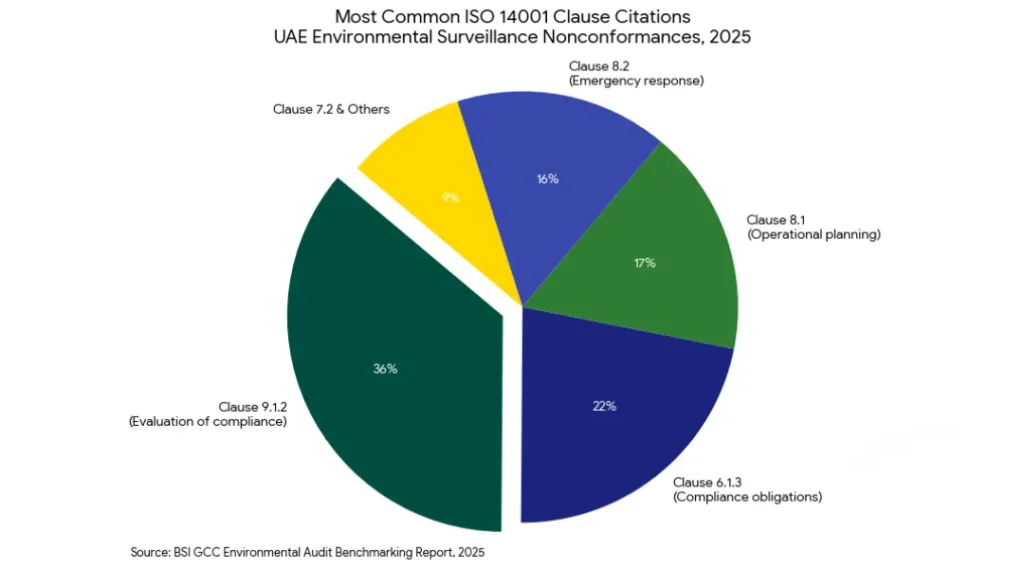
Clause 9.1.2 (evaluation of compliance) and Clause 6.1.3 (compliance obligations) together generate 58% of all major nonconformances in UAE ISO 14001 surveillance visits, followed by Clause 8.1 (operational planning and control) and Clause 8.2 (emergency preparedness and response) according to BSI GCC Environmental Audit Benchmarking Report (2025). Prioritize these four clauses in every UAE ISO 14001 internal environmental audit. Allocate the largest share of audit time to Clause 9.1.2 and conduct the legal compliance evaluation as the first substantive activity in every audit cycle, not the last.
Yes, a single competent environmental auditor can conduct a full-scope ISO 14001 internal environmental audit in a small or medium-sized UAE organization, provided they do not audit processes they are directly responsible for under the ISO 19011:2018 impartiality requirement. In practice, a full-scope ISO 14001 environmental audit for a mid-sized UAE construction or industrial facility typically requires 2 to 3 auditor days depending on site complexity and the number of significant environmental aspects in scope. For UAE organizations where the environmental manager is also the QMS manager, cross-auditing between functions or using M2Y Safety's external internal auditor service resolves the impartiality requirement while satisfying the Clause 9.2 obligation.
An IMS-trained internal auditor in the UAE can conduct ISO 14001, ISO 9001, and ISO 45001 audits within a single integrated audit event, using the shared High-Level Structure that all three standards share. Integrated auditing reduces total audit time by up to 35%, reduces operational disruption for UAE facility teams, and produces a single consolidated audit report that satisfies the Clause 9.2 requirements of all three standards simultaneously. In UAE construction and industrial contexts, where organizations typically hold all three certifications as conditions of major project contracts or government supplier registration, integrated IMS auditing is the most cost-effective approach. For the complete integrated auditing methodology, see our internal auditor training guide for UAE professionals.
Conclusion
A well-run ISO 14001 environmental audit in the UAE protects your certification status, your Dubai Municipality EHS registration, and your Abu Dhabi Environment Agency compliance position simultaneously. The process is not complicated. It requires a scope built around significant environmental aspects with UAE temperature and regulatory context factored into significance ratings, a legal compliance evaluation that is current on the date of the audit and references specific UAE federal and emirate-level obligations, operational control verification through site observation as well as document review, emergency preparedness testing through operator interviews rather than drill record review alone, and an audit closure that confirms corrective action ownership at the level where implementation authority actually exists.
Start with Clause 9.1.2 and your legal compliance register at your next audit cycle. Update the register before the audit session begins with a dated portal check. If you do not yet have a trained internal auditor running your ISO 14001 environmental program in the UAE, the M2Y Safety IMS Internal Auditor course qualifies you to conduct ISO 14001 environmental audits alongside ISO 9001 and ISO 45001 in a single 2-day program, delivered across Dubai, Abu Dhabi, and Ras Al-Khaimah.
Key Takeaways:
- Audit Clause 9.1.2 (evaluation of compliance) and Clause 6.1.3 (compliance obligations) first at every ISO 14001 internal environmental audit cycle. These two clauses generate 58% of all UAE ISO 14001 surveillance nonconformances, and both relate to legal compliance documentation that can be corrected administratively without operational change if caught before the certification body arrives (BSI GCC Environmental Audit Benchmarking Report, 2025).
- Update your legal compliance register with a dated portal check of Dubai Municipality and Abu Dhabi Environment Agency publications before every audit session. A 45-minute check prevents the most common single cause of UAE ISO 14001 surveillance failures, which is auditing against outdated regulatory obligations.
- Conduct structured operator interviews for every significant environmental emergency scenario in the audit scope. Drill records prove a drill happened. Operator interviews are the only evidence that tests whether your team can execute the emergency response procedure under actual emergency conditions in a UAE multi-language workplace.