Lifting Supervisor
When Ahmed received his first assignment as a lifting supervisor at a major oil and gas facility in Abu Dhabi, he quickly realized something crucial: the role demanded far more than just understanding cranes and hoists. Lives depended on his decisions. Millions of dirhams worth of equipment rested on his judgment. One miscalculation could halt an entire project.
Ahmed’s experience reflects what thousands of professionals across the UAE discover daily—becoming a competent lifting supervisor requires specialized knowledge, practical experience, and internationally recognized certification. Whether you’re looking to start your career in this high-demand field or seeking to advance your existing qualifications, understanding the lifting supervisor role is your first step toward success.
In this comprehensive guide, we’ll explore everything you need to know about becoming a lifting supervisor in the UAE, including certification pathways, job responsibilities, career opportunities, and how M2Y Safety Consultancy can help you achieve your professional goals.
What is a Lifting Supervisor?
A lifting supervisor is a certified professional responsible for planning, overseeing, and managing all lifting operations at construction sites, industrial facilities, oil and gas installations, and maritime operations. This critical role sits at the intersection of safety management, technical expertise, and operational leadership.
The lifting supervisor ensures that cranes, hoists, forklifts, and other lifting equipment operate safely and efficiently while protecting workers, assets, and project timelines. In the UAE’s booming construction and energy sectors, this position has become indispensable.
The Growing Demand in UAE
The United Arab Emirates continues experiencing unprecedented growth across multiple sectors:
- Construction boom: Mega-projects in Dubai and Abu Dhabi requiring complex lifting operations
- Oil and gas expansion: Offshore platforms and refinery maintenance demanding specialized lifting expertise
- Infrastructure development: Metro systems, airports, and seaports involving heavy lift operations
- Industrial manufacturing: Factory installations requiring precision lifting capabilities
According to recent industry data, the UAE construction sector alone is projected to reach $167 billion by 2027, with lifting operations representing a critical component of virtually every major project. This growth translates directly into sustained demand for qualified lifting supervisors.
Lifting Supervisor Responsibilities: What Does the Role Actually Involve?
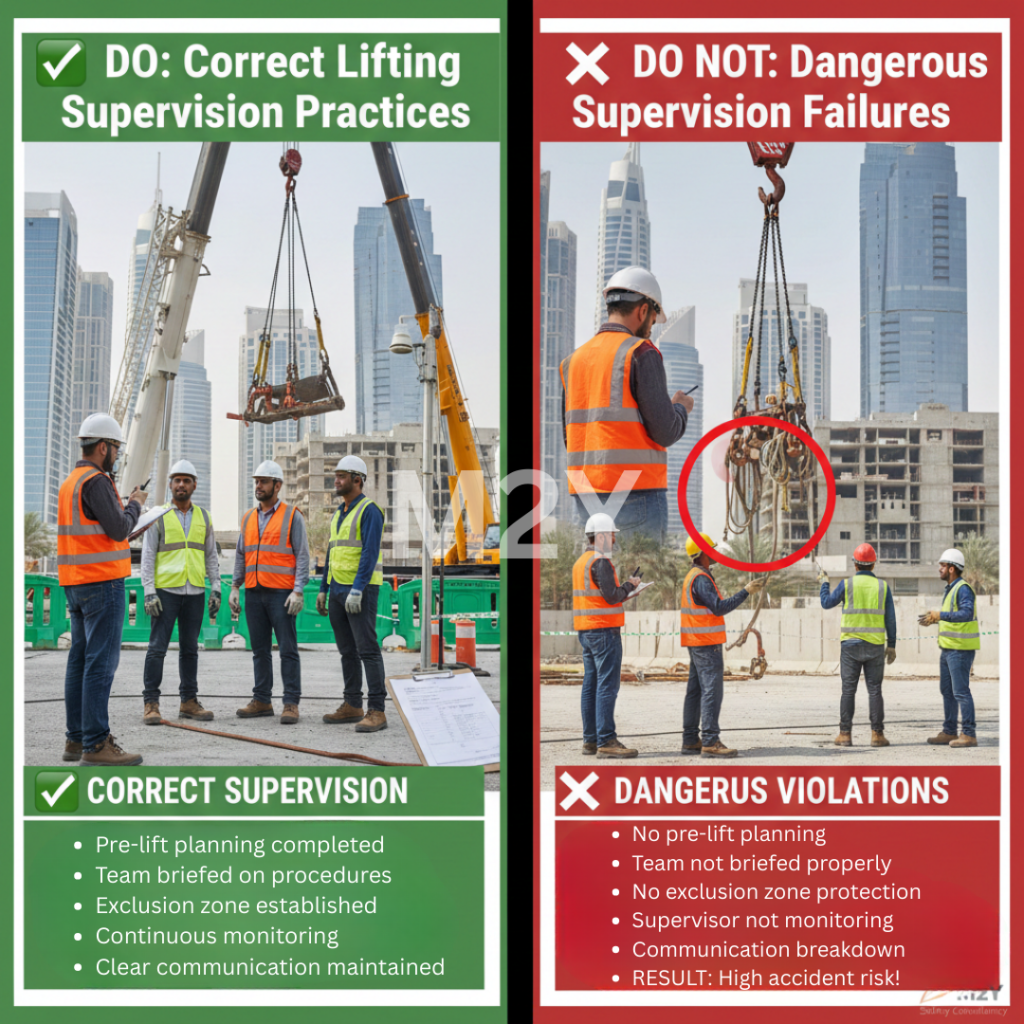
The lifting supervisor role encompasses far more than standing near a crane and giving hand signals. Here’s what the position genuinely entails:
Pre-Operational Planning
Risk Assessment and Method Statements:
- Conducting comprehensive site surveys before lifting operations
- Identifying potential hazards including overhead obstructions, ground conditions, and weather factors
- Developing detailed lifting plans and method statements
- Calculating load weights, center of gravity, and equipment requirements
Equipment Selection and Inspection:
- Choosing appropriate lifting equipment based on load specifications
- Verifying equipment certifications and inspection records
- Ensuring all rigging gear meets safety standards
- Confirming operator qualifications and competency
Operational Supervision
Direct Oversight:
- Supervising crane operators, riggers, and banksmen during lifts
- Ensuring compliance with approved lifting plans
- Monitoring environmental conditions (wind speed, visibility, temperature)
- Making real-time decisions to pause or modify operations based on changing conditions
Safety Management:
- Enforcing exclusion zones around lifting operations
- Verifying proper use of personal protective equipment (PPE)
- Coordinating with other trades and disciplines on multi-contractor sites
- Implementing emergency response procedures when incidents occur
Documentation and Compliance
Record Keeping:
- Maintaining detailed lifting operation logbooks
- Documenting pre-lift meetings and toolbox talks
- Recording equipment inspection results
- Preparing incident reports and near-miss documentation
Regulatory Compliance:
- Ensuring adherence to UAE Federal Law, OSHAD, and Dubai Municipality regulations
- Meeting international standards (LOLER, ASME, API)
- Coordinating with regulatory inspectors during audits
- Updating procedures to reflect regulatory changes
Team Leadership
Training and Development:
- Conducting toolbox talks and safety briefings
- Mentoring junior personnel and new team members
- Providing on-the-job coaching for riggers and operators
- Promoting a strong safety culture within lifting teams
Lifting Supervisor Course: Pathways to Certification
Professional certification isn’t optional—it’s mandatory for working as a lifting supervisor in the UAE. Several internationally recognized certification schemes are accepted across the Emirates.
ADNOC-Approved Lifting Supervisor Training
For professionals working in oil and gas sectors, ADNOC (Abu Dhabi National Oil Company) approval is essential. The ADNOC-approved lifting supervisor course covers:
| Training Module | Duration | Key Topics |
|---|---|---|
| Lifting Regulations & Standards | 1 day | UAE regulations, LOLER, ASME B30, API standards |
| Load Calculation & Planning | 1.5 days | Weight estimation, center of gravity, rigging design |
| Equipment Types & Selection | 1 day | Cranes, hoists, slings, shackles, spreader beams |
| Risk Assessment | 1 day | Hazard identification, risk matrices, method statements |
| Practical Assessments | 1.5 days | Live lifting scenarios, emergency procedures |
| Examination | 0.5 day | Written and practical assessments |
Total Duration: 5-6 days intensive training
LEEA (Lifting Equipment Engineers Association) Certification
LEEA offers globally recognized lifting supervisor qualifications highly valued in the UAE:
LEEA Appointed Person (Lifting Operations): Suitable for professionals planning and managing complex lifts, this comprehensive program covers advanced lifting engineering principles.
LEEA Lifting Supervisor: Focused specifically on the supervisory role, covering operational oversight and team management aspects.
OPITO-Approved Programs
For offshore oil and gas operations, OPITO (Offshore Petroleum Industry Training Organisation) certification may be required, particularly for:
- Offshore crane operations
- Marine lifting operations
- Platform construction and maintenance
Why Choose M2Y Safety Consultancy for Your Lifting Supervisor Training?
M2Y Safety Consultancy stands out as a premier provider of lifting supervisor training in the UAE for several compelling reasons:
✓ ADNOC-approved training programs recognized across UAE industries
✓ Experienced instructors with decades of field experience in oil & gas, construction, and industrial sectors
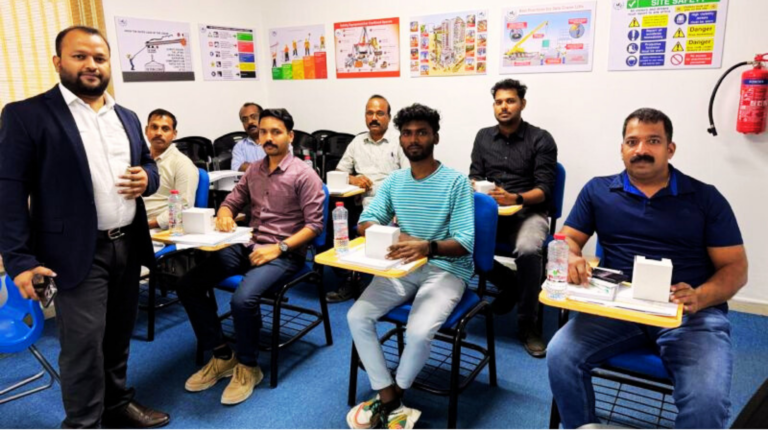
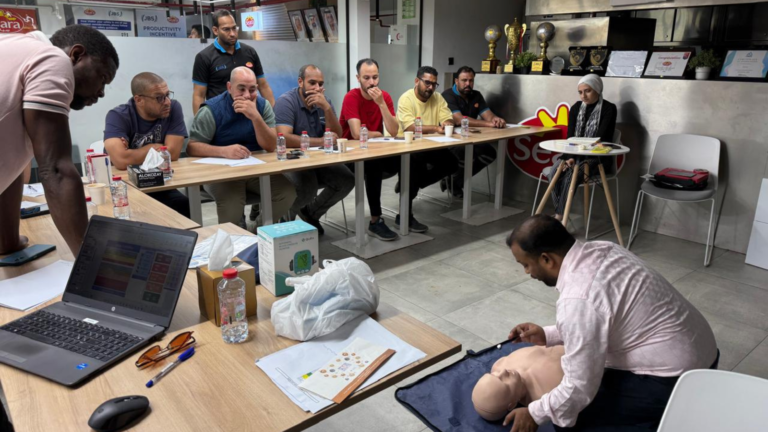
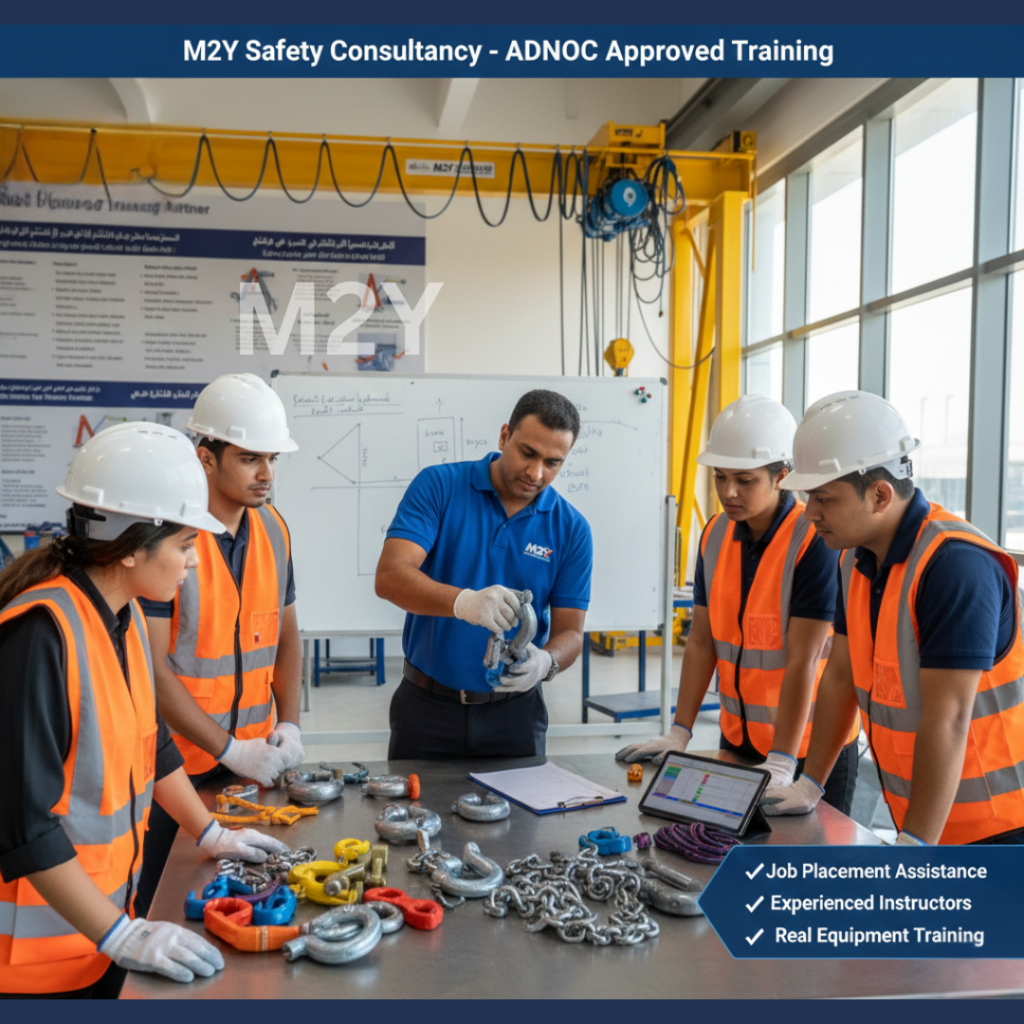
✓ Practical, hands-on training using real equipment and realistic scenarios
✓ Flexible scheduling including weekend and evening classes for working professionals
✓ Job placement assistance connecting graduates with UAE employers
✓ Competitive pricing with transparent fee structures and group discounts
✓ Multilingual instruction available in English, Arabic, and other languages
Our training facilities feature state-of-the-art equipment including mobile cranes, overhead cranes, rigging gear, and simulation technologies that prepare you for real-world challenges.
Visit M2Y Safety Consultancy to explore our complete training calendar and enroll in upcoming sessions.
Lifting Supervisor Jobs in UAE: Career Opportunities and Salary Expectations
The UAE job market for qualified lifting supervisors remains robust, with opportunities spanning multiple sectors.
Where Lifting Supervisors Work
Oil & Gas Sector:
- ADNOC facilities and contractor operations
- Offshore platforms and drilling rigs
- Refineries and petrochemical plants
- Pipeline construction projects
Construction Industry:
- High-rise building construction
- Infrastructure mega-projects
- Bridge and tunnel construction
- Specialized foundation works
Industrial Manufacturing:
- Factory installations and equipment rigging
- Heavy machinery positioning
- Plant maintenance and turnarounds
- Warehouse and logistics operations
Maritime Operations:
- Port and terminal facilities
- Shipyard operations
- Vessel cargo handling
- Offshore wind farm construction
Salary Expectations in UAE
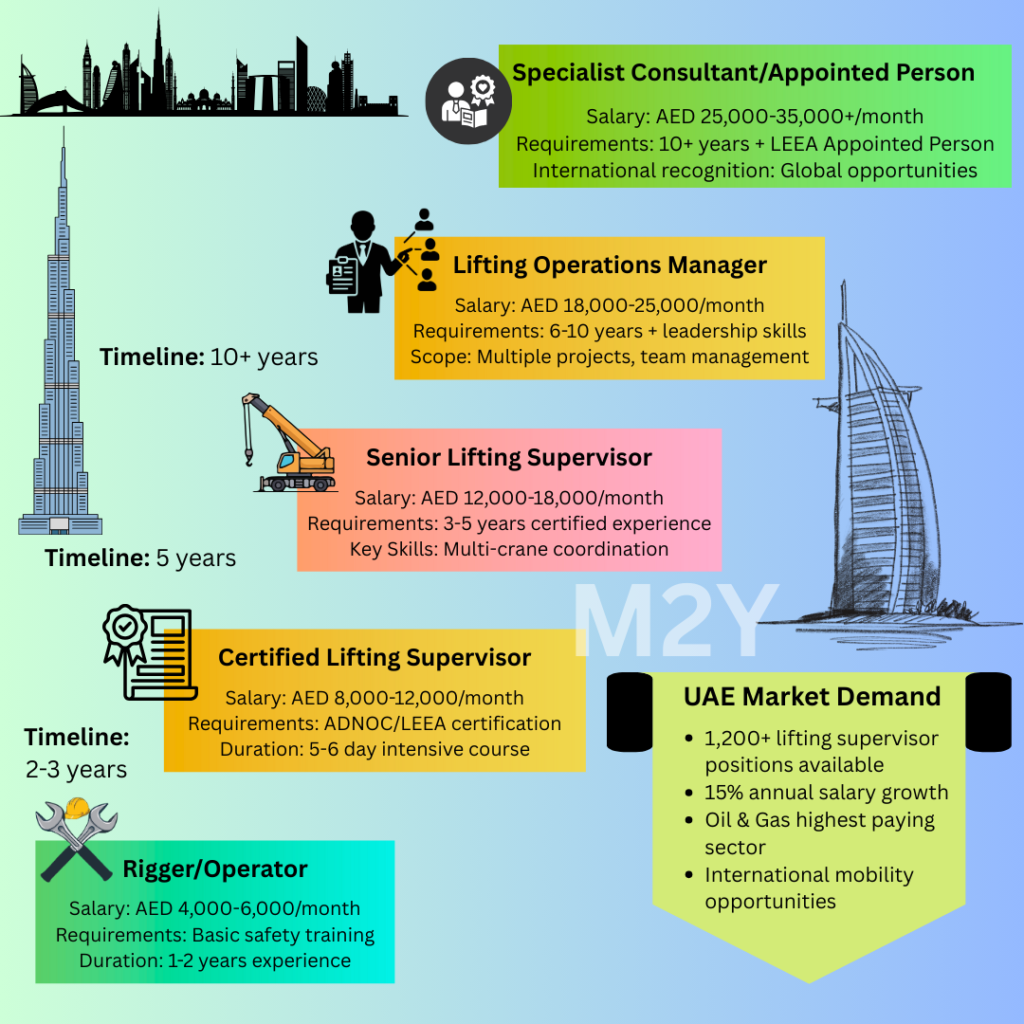
Lifting supervisor salaries in the UAE vary based on experience, certification level, and industry sector:
| Experience Level | Monthly Salary Range (AED) | Annual Package (AED) |
|---|---|---|
| Entry Level (0-2 years) | 5,000 – 8,000 | 60,000 – 96,000 |
| Mid-Level (3-5 years) | 8,000 – 12,000 | 96,000 – 144,000 |
| Senior Level (6-10 years) | 12,000 – 18,000 | 144,000 – 216,000 |
| Specialist/Lead (10+ years) | 18,000 – 25,000+ | 216,000 – 300,000+ |
Additional Benefits typically include:
- Housing allowance or company-provided accommodation
- Transportation allowance or company vehicle
- Annual flight tickets
- Medical insurance
- Performance bonuses
- Project completion incentives
Top Employers Hiring Lifting Supervisors in UAE
Leading companies actively recruiting qualified lifting supervisors include:
- ADNOC and subsidiaries (ADNOC Offshore, ADNOC Onshore, ADNOC Gas)
- International contractors (Petrofac, Tecnicas Reunidas, McDermott)
- Major construction firms (Arabtec, Al Futtaim Carillion, ALEC)
- Engineering consultancies (Bechtel, KBR, Fluor)
- Specialized rigging companies (Al Fattan Crane Services, Mammoet Middle East)
Essential Skills and Qualifications for Success
Beyond formal certification, successful lifting supervisors develop a comprehensive skill set:
Technical Competencies
- Engineering principles: Understanding of statics, dynamics, and structural loads
- Equipment knowledge: Detailed familiarity with crane types, capacities, and limitations
- Load calculations: Ability to perform complex weight and center-of-gravity calculations
- Rigging design: Expertise in selecting appropriate slings, shackles, and rigging configurations
Soft Skills
- Leadership: Managing diverse teams under pressure
- Communication: Clear instruction delivery in noisy, challenging environments
- Decision-making: Quick assessment and judgment in critical situations
- Problem-solving: Creative solutions to unexpected lifting challenges
- Cultural awareness: Working effectively in UAE’s multicultural workforce
Physical Requirements
The role demands certain physical capabilities:
- Ability to work in extreme weather conditions (UAE summer heat, offshore environments)
- Climbing stairs and ladders to inspect equipment and work areas
- Standing for extended periods during lifting operations
- Visual acuity to assess rigging and equipment from various distances
The Certification Journey: Step-by-Step Process
Ready to become a certified lifting supervisor? Here’s your roadmap:
Step 1: Assess Your Eligibility
Most lifting supervisor courses require:
- Minimum age of 21 years
- Secondary education certificate (high school diploma)
- Previous experience in construction or industrial operations (preferred but not always mandatory)
- Basic understanding of English and/or Arabic
- Valid medical fitness certificate
Step 2: Choose Your Training Provider
Select an accredited training center like M2Y Safety Consultancy that offers:
- Recognized certification (ADNOC, LEEA, OPITO)
- Qualified instructors with industry experience
- Adequate practical training facilities
- Good track record and student reviews
- Post-training support and job placement assistance
Step 3: Complete the Training Program
Commit fully to the 5-6 day intensive course:
- Attend all classroom sessions
- Participate actively in practical exercises
- Study course materials thoroughly
- Ask questions and seek clarification
- Network with fellow students and instructors
Step 4: Pass the Assessments
Certification requires passing both:
- Written examination: Testing theoretical knowledge of regulations, calculations, and procedures
- Practical assessment: Demonstrating competence in planning and supervising actual lifting operations
Step 5: Obtain Your Certification
Upon successful completion:
- Receive your official lifting supervisor certificate
- Register your certification with relevant authorities
- Update your CV and professional profiles
- Begin applying for positions or advance in your current role
Step 6: Maintain and Upgrade
Certifications typically require renewal every 3-5 years through:
- Refresher training courses
- Continuing professional development (CPD)
- Practical experience documentation
- Staying current with regulatory changes
Safety Culture: The Lifting Supervisor's Greatest Responsibility
Technical skills matter, but the best lifting supervisors excel at something more fundamental—creating and maintaining a strong safety culture.
Leading by Example
Your team watches everything you do. When you:
- Wear proper PPE consistently
- Never compromise on safety procedures
- Stop unsafe acts immediately and respectfully
- Acknowledge good safety practices publicly
…you establish the standard everyone else follows.
Empowering Your Team
Effective lifting supervisors:
- Encourage workers to speak up about concerns without fear of reprimand
- Implement near-miss reporting systems
- Recognize and reward safe behaviors
- Provide constructive feedback rather than blame after incidents
Learning from Experience
Every lifting operation offers lessons. Maintain a personal learning log documenting:
- Challenging lifts and how you overcame obstacles
- Near-misses and corrective actions taken
- New techniques or equipment learned
- Feedback received from team members
This reflective practice transforms good supervisors into exceptional ones.
Common Challenges and How to Overcome Them
Real-world lifting supervision presents recurring challenges. Here’s how experienced professionals address them:
Challenge 1: Time Pressure from Project Management
The Problem: Project managers pushing to complete lifts quickly, potentially compromising safety.
The Solution:
- Document realistic timelines during planning phases
- Educate management on consequences of rushing
- Stand firm on safety-critical delays
- Suggest efficiency improvements in planning rather than execution
Challenge 2: Inadequate Equipment or Resources
The Problem: Being asked to proceed with substandard equipment or insufficient rigging gear.
The Solution:
- Know regulatory requirements and cite them clearly
- Document equipment deficiencies formally
- Propose acceptable alternatives
- Exercise “stop work authority” when necessary
Challenge 3: Communication Barriers
The Problem: Multi-national crews with varying language proficiencies.
The Solution:
- Use standardized hand signals (crane signals)
- Implement picture-based communication boards
- Conduct bilingual safety briefings
- Ensure critical instructions are confirmed and understood
Challenge 4: Changing Weather Conditions
The Problem: UAE’s unpredictable weather—sudden sandstorms, high winds, extreme heat.
The Solution:
- Monitor weather forecasts continuously
- Establish clear wind speed limits (typically 20 mph for mobile cranes)
- Have contingency plans for weather delays
- Recognize early warning signs of deteriorating conditions
Advanced Career Progression: Beyond Lifting Supervisor
Certification as a lifting supervisor opens doors to numerous advancement opportunities:
Lifting Operations Manager
Overseeing multiple supervisors and coordinating complex multi-crane operations on large projects. Salary range: AED 20,000-35,000 monthly.
HSE Manager
Leveraging lifting expertise into broader health, safety, and environmental management roles. Requires additional HSE certifications.
Appointed Person (Lifting)
Senior role planning and approving complex or critical lifts, often requiring LEEA Appointed Person certification.
Training Instructor
Teaching the next generation of lifting professionals at organizations like M2Y Safety Consultancy.
Specialized Consultant
Providing expert advice on complex lifting challenges, equipment selection, or incident investigations. Daily rates can exceed AED 3,000 for experienced consultants.
Crane Operations Manager
Managing entire fleet operations including maintenance, operator training, and equipment procurement.
Global Opportunities: Taking Your Skills Worldwide
UAE lifting supervisor certification provides international mobility. Your qualifications are recognized in:
- Middle East: Saudi Arabia, Qatar, Kuwait, Oman
- Europe: UK, Norway, Netherlands (with appropriate visa and some additional certifications)
- Asia-Pacific: Singapore, Malaysia, Australia
- Africa: Various developing nations with growing construction sectors
- Americas: Canada, USA (with additional state/provincial requirements)
This global recognition makes lifting supervision one of the most portable careers in industrial safety.
Frequently Asked Questions (FAQs)
The core training course takes 5-6 days of intensive instruction. However, the complete journey from enrollment to certification typically spans 2-3 weeks when including pre-course requirements, examination scheduling, and certificate processing. Some providers like M2Y Safety Consultancy offer accelerated programs for experienced professionals. After training, you can begin applying for positions immediately while awaiting your physical certificate.
A crane operator physically controls the crane machinery, operating levers, pedals, and controls to execute lifts. A lifting supervisor plans, authorizes, and oversees entire lifting operations, managing crane operators, riggers, banksmen, and ensuring all safety procedures are followed. The supervisor role requires broader knowledge including regulations, load calculations, risk assessment, and team management. Many lifting supervisors have crane operator experience but have advanced to supervisory positions through additional training and certification.
Most reputable training providers, including M2Y Safety Consultancy, prefer candidates with 1-2 years of construction or industrial experience, though it's not always mandatory. Background as a rigger, banksman, or in related trades provides valuable context that helps students grasp concepts more quickly. However, motivated candidates without direct experience can succeed if they demonstrate strong mechanical aptitude, safety awareness, and commitment to learning. Some employers hire candidates with certification but limited experience into junior supervisor or trainee positions.
Most lifting supervisor certifications remain valid for 3-5 years, after which refresher training is required. During the certification period, professionals should maintain a logbook documenting lifting operations supervised, maintain current knowledge of regulation changes, and complete continuing professional development (CPD) activities. Some schemes require annual declarations of competency. Employers may also mandate additional training when introducing new equipment types or procedures. M2Y Safety Consultancy offers convenient refresher courses for recertification.
Yes, international certifications like LEEA and OPITO are widely recognized and accepted in the UAE, particularly in multinational companies and oil & gas operations. However, additional ADNOC approval may be required for certain projects, especially those involving ADNOC or its contractors. Some employers prefer candidates with both international certification and UAE-specific training covering local regulations. M2Y Safety Consultancy can advise on which certifications best suit your target employment sector and can provide supplementary training if needed.
Lifting supervisor salaries in UAE typically range from AED 8,000-18,000 monthly for mid-level professionals, with senior specialists earning AED 20,000-25,000+. Salaries are generally consistent across emirates, though Abu Dhabi's oil and gas sector sometimes offers slightly higher packages than Dubai's construction-focused market. Remote site positions (offshore platforms, remote facilities) often include hardship allowances adding 15-30% to base salary. Additional factors affecting compensation include certification level, years of experience, industry sector, employer size, and whether the role includes management responsibilities.
Take the Next Step in Your Career Today
The path to becoming a certified lifting supervisor in the UAE offers excellent career prospects, competitive compensation, and the satisfaction of ensuring worker safety in critical operations. Whether you’re starting fresh in the safety field or advancing from roles like rigger or operator, professional certification opens doors throughout the Emirates and beyond.
Ready to begin your journey?
Enroll with M2Y Safety Consultancy
M2Y Safety Consultancy provides comprehensive lifting supervisor training programs designed specifically for UAE workplace requirements:
✓ ADNOC-approved certification recognized across industries
✓ Expert instructors with real-world lifting operations experience
✓ Hands-on practical training with actual equipment and scenarios
✓ Flexible scheduling to accommodate working professionals
✓ Job placement support connecting you with UAE employers
✓ Competitive pricing with transparent fee structures
Don’t wait—the next course fills up quickly!
Visit https://m2ysafety.com/