COSHH
When Fatima, a facilities manager at a Dubai manufacturing plant, discovered that three of her workers had developed respiratory issues within the same month, she knew something was seriously wrong. The investigation revealed inadequate control measures for chemical vapors in the production area—a clear violation of hazardous substance regulations that could have been prevented with proper COSHH training and assessment.
Fatima’s experience isn’t unique. Across the UAE and globally, thousands of workers face daily exposure to hazardous substances that can cause anything from minor skin irritation to life-threatening diseases. The difference between safe operations and workplace disasters often comes down to one thing: proper understanding and implementation of COSHH principles.
Whether you’re a safety manager, employer, supervisor, or worker handling chemicals, cleaning products, dust, fumes, or biological agents, this comprehensive guide will help you understand what COSHH means, why it matters, and how to implement effective control measures in your workplace.
What is COSHH? Understanding the Basics
COSHH stands for Control of Substances Hazardous to Health. It’s a set of regulations originally established in the United Kingdom (1988, revised 2002) that provides a framework for controlling exposure to hazardous substances in the workplace.
While COSHH regulations originated in the UK, the principles have been adopted internationally and align closely with UAE occupational health and safety requirements under federal labor law and emirate-specific regulations like OSHAD (Abu Dhabi) and Dubai Municipality guidelines.
COSHH Full Form and Meaning
C – Control
O – Of
S – Substances
H – Hazardous
H – to Health
The meaning goes beyond the acronym. COSHH represents a systematic approach to:
- Identifying hazardous substances in your workplace
- Assessing the risks they pose to workers
- Implementing appropriate control measures
- Monitoring exposure levels and health effects
- Reviewing controls regularly to ensure continued effectiveness
Why COSHH Matters: The Real Impact of Hazardous Substances
The statistics paint a sobering picture. According to the UK Health and Safety Executive (HSE), hazardous substance exposure contributes to thousands of occupational illnesses annually, including:
- Occupational asthma – caused by inhaling dust, vapors, or fumes
- Dermatitis – skin conditions from direct contact with chemicals
- Occupational cancers – long-term exposure to carcinogens
- Respiratory diseases – from dust, silica, and chemical fumes
- Poisoning – acute exposure to toxic substances
In the UAE’s diverse industrial landscape—from oil and gas to construction, manufacturing, healthcare, and hospitality—workers encounter hazardous substances daily. Without proper controls, the consequences extend beyond individual health:
- Financial costs: Medical treatment, compensation claims, lost productivity
- Legal liability: Fines, work stoppages, criminal prosecution
- Reputational damage: Loss of contracts, difficulty recruiting workers
- Operational disruption: Project delays, equipment damage
What Substances Does COSHH Cover?
COSHH regulations apply to virtually any substance that can harm health, except for specific exclusions like asbestos, lead, and radioactive materials (which have separate regulations).
Common Hazardous Substances in UAE Workplaces
| Industry Sector | Typical Hazardous Substances | Health Risks |
|---|---|---|
| Construction | Cement dust, silica, solvents, paints, adhesives | Respiratory disease, skin conditions, poisoning |
| Oil & Gas | Crude oil, hydrogen sulfide (H₂S), benzene, drilling fluids | Cancer, poisoning, respiratory damage |
| Manufacturing | Metal dust, welding fumes, cleaning chemicals, lubricants | Metal fume fever, respiratory disease, skin burns |
| Healthcare | Disinfectants, sterilizing agents, laboratory chemicals, biological agents | Allergies, infections, chemical burns |
| Hospitality | Cleaning products, laundry chemicals, pest control substances | Skin irritation, respiratory problems, poisoning |
| Warehousing/Logistics | Diesel exhaust, battery acid, cleaning agents, refrigerants | Respiratory issues, chemical burns, poisoning |
Forms of Hazardous Substances
Hazardous substances exist in various physical states, each requiring different control approaches:
Solids:
- Dusts (wood, metal, stone, cement)
- Powders (chemicals, pharmaceuticals)
- Fibers (synthetic materials)
Liquids:
- Solvents and thinners
- Acids and alkalis
- Oils and fuels
- Cleaning products
Gases and Vapors:
- Welding fumes
- Chemical vapors
- Vehicle exhaust
- Natural gas and LPG
Biological Agents:
- Bacteria and viruses
- Mold and fungi
- Blood-borne pathogens
How Hazardous Substances Enter the Body
Understanding exposure routes is critical for implementing effective controls. Hazardous substances can enter the body through four main pathways:
1. Inhalation (Breathing)
The most common route of exposure. Workers breathe in:
- Dust particles
- Chemical vapors
- Fumes from hot processes
- Airborne biological agents
Example: Welders inhaling metal fumes, painters breathing solvent vapors, construction workers exposed to silica dust.
2. Skin/Eye Contact (Absorption)
Direct contact with substances causing:
- Chemical burns
- Dermatitis and rashes
- Absorption through skin into bloodstream
- Eye damage and blindness
Example: Mechanics getting oil on skin, cleaners splashing chemicals, laboratory workers handling corrosive materials.
3. Ingestion (Swallowing)
Less common but serious, occurring when:
- Workers eat/drink without washing contaminated hands
- Substances transfer from hands to mouth
- Food/drinks stored in contaminated areas
Example: Workers eating lunch with chemical-contaminated hands, drinking from containers in chemical storage areas.
4. Injection
Direct entry through skin breaks:
- Needlestick injuries (healthcare)
- High-pressure injection (spray painting, hydraulics)
- Cuts contaminated with hazardous materials
Example: Healthcare workers with needlestick exposures, mechanics injured by high-pressure hydraulic fluid.
The 8 Principles of COSHH: A Step-by-Step Framework
COSHH compliance isn’t complicated when you follow the systematic eight-step approach. Here’s how to implement it in your workplace:
Step 1: Identify Hazardous Substances
Action Required:
- Create an inventory of all substances used, stored, or generated in your workplace
- Obtain Safety Data Sheets (SDS) for all chemical products
- Identify substances created by work processes (welding fumes, dust, exhaust)
- Don’t forget waste products and by-products
Practical Example: A Dubai automotive workshop identified: brake cleaner, engine oil, paint thinners, battery acid, welding gases, metal grinding dust, and vehicle exhaust—each requiring specific controls.
Step 2: Assess the Risks
The COSHH Assessment Process:
A COSHH assessment evaluates:
- What hazardous substances are present
- Who might be exposed and how
- What harm could occur
- What control measures are needed
- Whether existing controls are adequate
Key Questions to Answer:
- What is the substance and its hazard classification?
- How much is used and how often?
- How many workers are potentially exposed?
- What exposure routes are possible?
- Are any workers particularly vulnerable (pregnant women, young workers, those with health conditions)?
- What control measures are currently in place?
- Are these controls working effectively?
Risk Assessment Matrix:
| Likelihood | Severity | Risk Level | Action Required |
|---|---|---|---|
| High | High | Critical | Stop work immediately, implement controls |
| High | Medium | High | Urgent action needed within days |
| Medium | High | High | Urgent action needed within days |
| Medium | Medium | Medium | Action needed within weeks |
| Low | Low | Low | Monitor and maintain controls |
Step 3: Prevent or Control Exposure
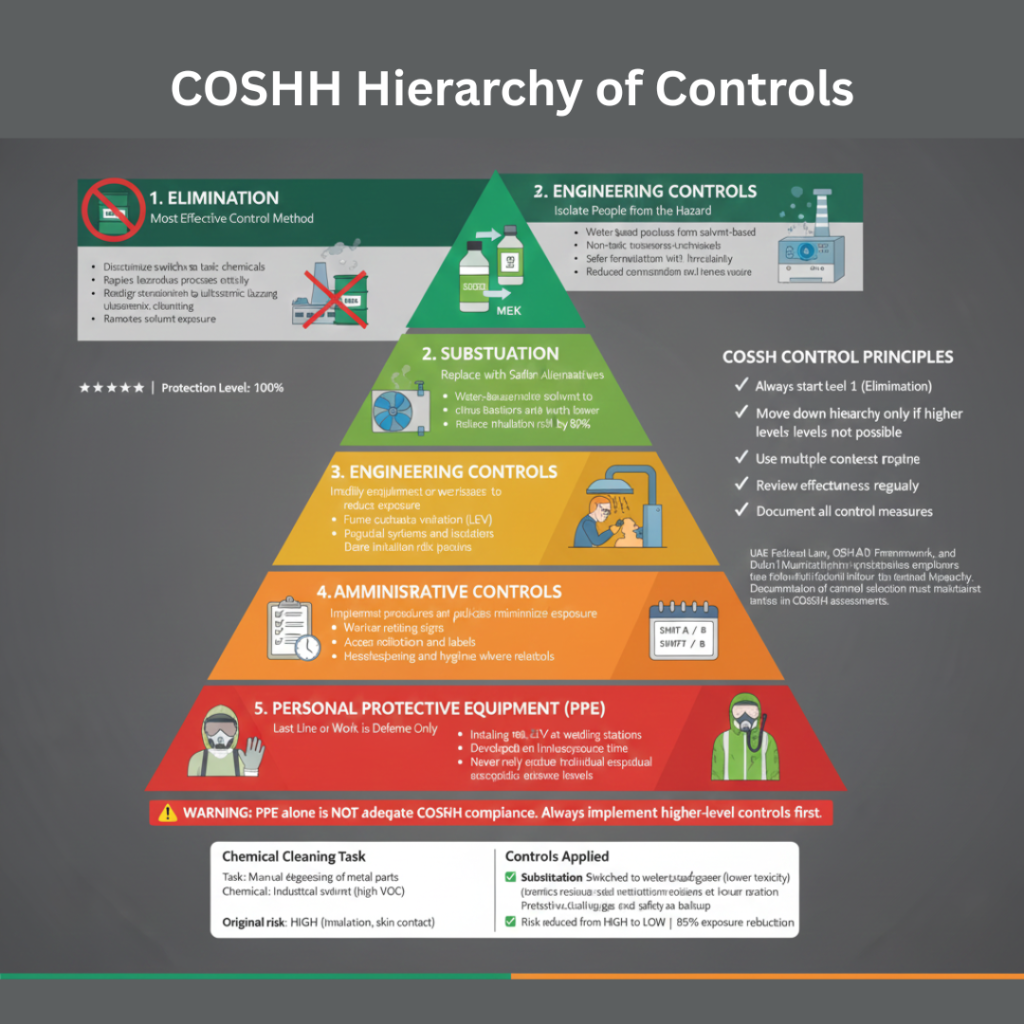
COSHH follows a hierarchy of control measures, prioritizing the most effective methods:
1. Elimination (Most Effective)
- Remove the hazardous substance entirely
- Example: Using water-based paints instead of solvent-based
2. Substitution
- Replace with less hazardous alternatives
- Example: Using non-toxic cleaning products instead of bleach-based cleaners
3. Engineering Controls
- Modify equipment or processes to reduce exposure
- Examples: Local exhaust ventilation (LEV), enclosed systems, automation
4. Administrative Controls
- Change work procedures to minimize exposure
- Examples: Rotation schedules, limiting access, work permits
5. Personal Protective Equipment (PPE) (Least Effective)
- Last line of defense when other controls insufficient
- Examples: Respirators, gloves, goggles, protective clothing
Critical Principle: Never rely solely on PPE. It should supplement, not replace, other control measures.
Step 4: Ensure Control Measures Are Used and Maintained
Implementation Requirements:
- Train workers on proper use of control equipment
- Establish maintenance schedules for ventilation systems
- Conduct regular inspections of LEV systems
- Keep records of maintenance and testing
- Ensure PPE is available, properly fitted, and replaced when needed
Real-World Challenge: At an Abu Dhabi manufacturing facility, expensive LEV systems were installed but rarely used because workers found them inconvenient. The solution? Management enforcement, worker education on health risks, and modifications making the systems easier to operate.
Step 5: Monitor Exposure
Exposure Monitoring Methods:
Environmental Monitoring:
- Air sampling to measure airborne contaminants
- Surface wipe tests for contamination
- Noise and vibration monitoring where relevant
Health Surveillance:
- Periodic medical examinations
- Lung function testing for those exposed to respiratory hazards
- Skin examinations for dermatitis risk
- Blood tests for certain chemical exposures
When is Monitoring Required?
- When risk assessment indicates significant exposure potential
- For work with substances requiring health surveillance by law
- After implementing new control measures to verify effectiveness
- When illness patterns suggest exposure problems
Step 6: Provide Information, Instruction, and Training
Training Must Cover:
- Hazards of substances workers handle
- Results of risk assessments
- Precautions and control measures
- Proper use and maintenance of controls
- Emergency procedures
- Safe storage and disposal
- Use and care of PPE
Training Frequency:
- During induction for new workers
- When introducing new substances or processes
- Annually as refresher training
- After incidents or near-misses
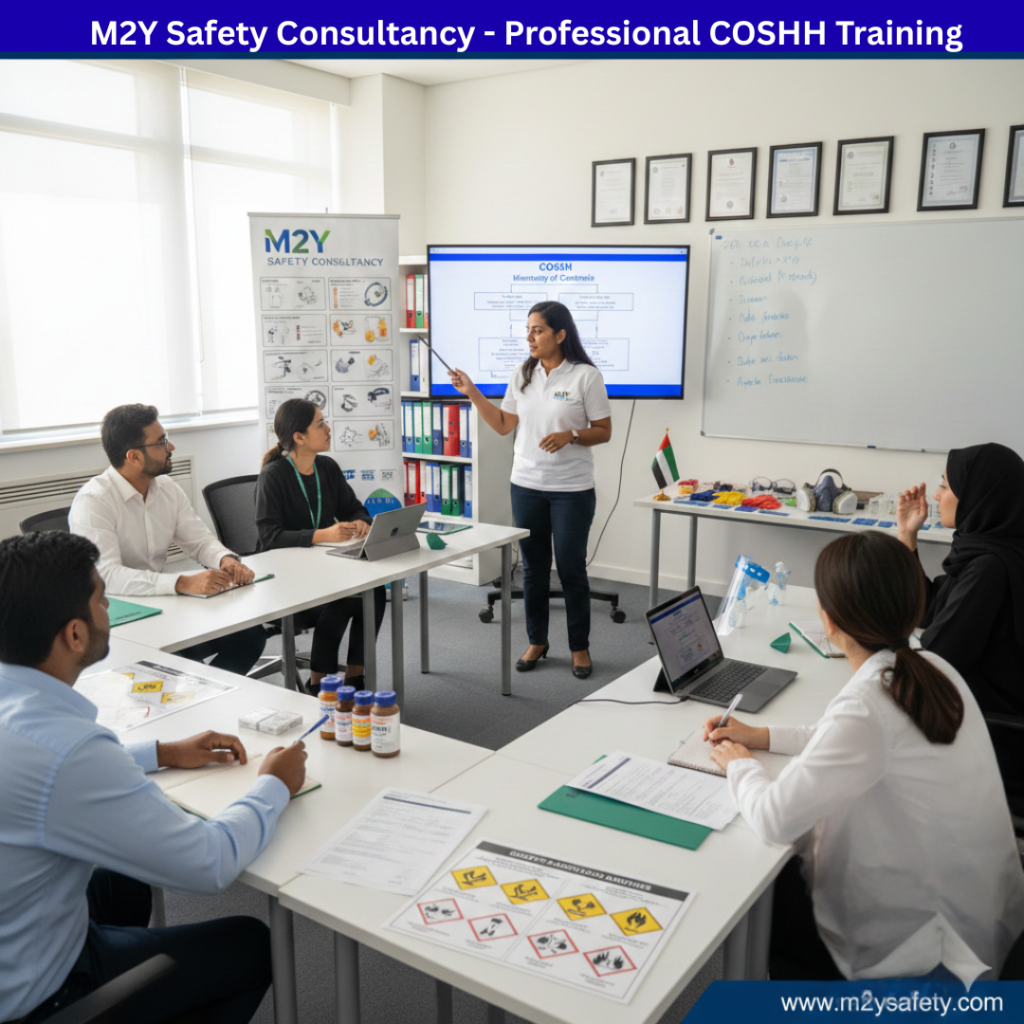
M2Y Safety Consultancy provides comprehensive COSHH training programs tailored to UAE workplace requirements. Our courses combine theoretical knowledge with practical, hands-on instruction ensuring workers understand not just what to do, but why it matters.
Step 7: Plan for Accidents, Incidents, and Emergencies
Emergency Preparedness Includes:
Spill Response:
- Spill kits readily available and workers trained in their use
- Clear spill response procedures posted
- Designated spill response team members
- Proper disposal arrangements for contaminated materials
First Aid:
- Trained first aiders available during all working hours
- Appropriate first aid facilities and supplies
- Emergency eyewash stations and safety showers where needed
- Clear protocols for chemical exposure incidents
Evacuation:
- Emergency exits clearly marked and kept clear
- Assembly points identified
- Evacuation drills conducted regularly
- Communication systems for alerting workers
Incident Reporting:
- Clear reporting procedures for all exposures
- Investigation protocols to identify root causes
- Corrective action tracking
- Learning and continuous improvement
Step 8: Review and Revise Assessments
COSHH assessments aren’t “one and done” documents—they require regular review and updates.
When to Review:
- At least annually as routine practice
- When new substances are introduced
- After changes to work processes or equipment
- Following accidents or near-miss incidents
- When new information about hazards becomes available
- When health surveillance reveals problems
- When workers report control measure failures
COSHH Training: Building Competence in Your Workforce
Effective COSHH implementation depends on worker competence. Everyone from senior management to frontline workers needs appropriate training for their role.
What Does COSHH Training Cover?
Foundation Level (All Workers):
- Basic hazard awareness
- Understanding warning labels and symbols
- Safe handling procedures
- Emergency response basics
- Proper PPE use
- When and how to report concerns
Supervisor/Manager Level:
- Conducting COSHH assessments
- Implementing control measures
- Monitoring compliance
- Investigating incidents
- Record keeping requirements
- Regulatory compliance
Specialist Level:
- Advanced risk assessment techniques
- Exposure monitoring and interpretation
- Occupational hygiene principles
- Designing engineering controls
- Health surveillance program management
COSHH Course Options with M2Y Safety Consultancy
M2Y Safety Consultancy offers flexible COSHH training programs designed for UAE workplaces:
1-Day COSHH Awareness Course
- Introduction to COSHH principles
- Identifying hazardous substances
- Basic control measures
- Emergency procedures
- Ideal for: General workers, supervisors
2-Day COSHH Assessment Course
- In-depth risk assessment methodology
- Control measure selection and implementation
- Documentation and record keeping
- Legal requirements and compliance
- Ideal for: Safety managers, HSE professionals
3-Day Advanced COSHH Course
- Occupational hygiene principles
- Exposure monitoring techniques
- Health surveillance programs
- Complex risk scenarios
- Ideal for: Senior HSE managers, consultants
Customized On-Site Training
- Tailored to your specific workplace hazards
- Conducted at your facility with your actual substances
- Flexible scheduling around operations
- Industry-specific examples and case studies
Visit M2Y Safety Consultancy to view our complete COSHH training calendar and enroll in upcoming courses.
COSHH Assessment: A Practical Guide
The COSHH assessment is your foundation for effective hazard control. Here’s how to conduct one properly:
COSHH Assessment Template Structure
Section 1: Basic Information
- Department/location
- Assessment date and assessor name
- Review date (typically annually)
Section 2: Substance Identification
- Product name and manufacturer
- Hazard classification (from SDS)
- Quantity stored and used
- Frequency of use
Section 3: Exposure Potential
- Work activities involving the substance
- Who might be exposed (number of workers, job roles)
- Exposure routes (inhalation, skin contact, etc.)
- Duration and frequency of exposure
Section 4: Current Control Measures
- Existing controls in place
- Condition and effectiveness of controls
- PPE provided and used
- Training and supervision arrangements
Section 5: Risk Evaluation
- Likelihood of exposure
- Severity of potential harm
- Overall risk level
Section 6: Additional Controls Required
- Actions needed to reduce risk
- Responsible person for each action
- Target completion dates
- Resources required
Section 7: Monitoring and Review
- Exposure monitoring requirements
- Health surveillance needs
- Review frequency and triggers
Common COSHH Assessment Mistakes to Avoid
❌ Mistake 1: Generic Assessments Copying template assessments without customizing to your specific workplace conditions and actual use patterns.
✅ Solution: Conduct workplace observations, interview workers who actually use the substances, and document your specific conditions.
❌ Mistake 2: Over-Reliance on PPE Listing gloves and masks as the primary control measure without considering higher-level controls.
✅ Solution: Always work through the hierarchy of controls systematically, implementing higher-level controls wherever possible.
❌ Mistake 3: Incomplete SDS Review Not thoroughly reading and understanding Safety Data Sheets for substances.
✅ Solution: Obtain current SDS for all substances, focusing on Sections 2 (Hazards), 7 (Handling), 8 (Exposure Controls), and 11 (Toxicology).
❌ Mistake 4: “Tick-Box” Exercise Treating assessments as paperwork requirements rather than tools for genuine risk reduction.
✅ Solution: Involve workers who use substances in the assessment process, implement findings practically, and verify effectiveness.
❌ Mistake 5: No Follow-Through Conducting assessments but failing to implement recommendations or monitor their effectiveness.
✅ Solution: Create action plans with clear responsibilities and deadlines, track completion, and verify controls work as intended.
COSHH in Different UAE Industries: Sector-Specific Guidance
Different industries face unique COSHH challenges. Here’s targeted guidance for major UAE sectors:
Construction Sector
Primary Hazards:
- Silica dust from cutting/grinding concrete and stone
- Cement dust causing chemical burns and dermatitis
- Solvent fumes from paints, adhesives, and coatings
- Asphalt fumes during road construction
- Diesel exhaust from equipment and generators
Critical Controls:
- Water suppression for dust-generating activities
- On-tool dust extraction for power tools
- Proper skin protection and barrier creams for cement work
- Adequate ventilation in enclosed spaces
- Rotation to limit individual exposure
Oil & Gas Industry
Primary Hazards:
- Hydrogen sulfide (H₂S) – deadly gas requiring specialized training
- Benzene and aromatic hydrocarbons – carcinogenic
- Crude oil and petroleum products
- Drilling muds and completion fluids
- Confined space atmospheres
Critical Controls:
- Continuous gas detection systems
- Strict permit-to-work systems
- Emergency escape breathing apparatus (SCBA)
- Enclosed systems to prevent vapor release
- Comprehensive H₂S training for all personnel
Healthcare Facilities
Primary Hazards:
- Disinfectants and sterilizing agents
- Anesthetic gases
- Cytotoxic drugs (chemotherapy)
- Laboratory chemicals
- Biological agents (pathogens)
Critical Controls:
- Closed drug preparation systems
- Biological safety cabinets
- Sharps disposal systems
- Vaccination programs
- Rigorous hand hygiene protocols
Manufacturing Operations
Primary Hazards:
- Metal working fluids and coolants
- Welding fumes (various metals)
- Industrial solvents and degreasers
- Dust from machining, grinding, polishing
- Adhesives and resins
Critical Controls:
- Local exhaust ventilation at source
- Enclosed processes where feasible
- Regular fluid testing and maintenance
- Skin surveillance programs
- Fume extraction for welding operations
Safety Data Sheets (SDS): Your Essential Information Source
The Safety Data Sheet is your first port of call for COSHH information. Understanding how to read and use SDS effectively is crucial.
The 16-Section SDS Structure
Section 1: Identification – Product name, supplier details, emergency contact
Section 2: Hazards – Classification, label elements, precautionary statements
Section 3: Composition – Chemical ingredients and concentrations
Section 4: First Aid – Emergency response for different exposure routes
Section 5: Fire-Fighting – Suitable extinguishing media and special hazards
Section 6: Accidental Release – Spill cleanup procedures and containment
Section 7: Handling & Storage – Safe use and storage requirements
Section 8: Exposure Controls/PPE – Exposure limits and protective equipment
Section 9: Physical/Chemical Properties – Appearance, odor, flammability, etc.
Section 10: Stability/Reactivity – Incompatibilities and hazardous reactions
Section 11: Toxicological Information – Health effects data
Section 12: Ecological Information – Environmental impacts
Section 13: Disposal – Waste disposal methods
Section 14: Transport – Classification for shipping
Section 15: Regulatory – Applicable regulations
Section 16: Other Information – Date prepared, revisions
How to Use SDS for COSHH Assessments
For Risk Assessment:
- Section 2 tells you what hazards exist
- Section 11 describes health effects
- Section 8 provides exposure limits
For Control Measures:
- Section 7 guides handling and storage
- Section 8 recommends PPE and engineering controls
- Section 4 informs emergency procedures
For Training:
- Sections 2, 4, 7, and 8 contain key worker information
- Use SDS content to develop safety briefings
- Keep SDS accessible to all workers using substances
Legal Requirements: COSHH Compliance in UAE Context
While COSHH regulations are UK-specific, UAE regulations impose similar requirements for controlling workplace hazards.
UAE Federal and Emirate-Level Requirements
UAE Federal Law No. 8 of 1980 (Labor Law):
- Article 91: Employers must take necessary precautions to protect workers from work-related hazards
- Requires provision of PPE and safe working conditions
- Mandates health surveillance for hazardous work
OSHAD System Framework (Abu Dhabi):
- Element 16: Hazardous Substances Control
- Requires hazard identification, risk assessment, and implementation of hierarchy of controls
- Mandates exposure monitoring and health surveillance where appropriate
- Requires maintenance of chemical inventories and SDS
Dubai Municipality Regulations:
- Specific requirements for construction, food service, and public health sectors
- Inspection and enforcement of chemical safety standards
- Registration requirements for hazardous substance use
Employer Responsibilities
Under UAE regulations, employers must:
- Identify all hazardous substances in the workplace
- Assess risks to workers’ health
- Implement appropriate control measures
- Provide information, instruction, and training
- Ensure control measures are properly used and maintained
- Monitor workers’ exposure where necessary
- Conduct health surveillance as required
- Keep records of assessments and monitoring
- Review and update assessments regularly
Worker Responsibilities
Workers also have duties:
- Use control measures properly (ventilation, safe procedures)
- Wear PPE correctly when provided
- Report defects in equipment or controls
- Report symptoms that may be work-related
- Follow safe systems of work
- Participate in health surveillance when required
Penalties for Non-Compliance
UAE authorities can impose:
- Financial penalties and fines
- Work stoppage orders
- License suspension or revocation
- Criminal prosecution in cases of serious harm
- Civil liability for worker compensation
Common COSHH Control Measures Explained
Understanding practical control measures helps you implement effective COSHH programs.
Local Exhaust Ventilation (LEV)
LEV systems capture contaminants at source before workers can breathe them.
Components:
- Hood: Positioned to capture fumes/dust at source
- Ductwork: Transports contaminants away
- Filter/Scrubber: Removes contaminants from air
- Fan: Provides airflow
- Discharge: Safe release of cleaned air
Effectiveness Factors:
- Hood design and positioning (closer = better)
- Adequate airflow rate (must overcome contaminant generation)
- Regular maintenance (filters, fan performance)
- Proper use by workers
Testing Requirements: LEV systems must be examined and tested at least every 14 months by competent persons.
Segregation and Containment
Isolating Hazardous Processes:
- Physical barriers between workers and hazards
- Remote operation of dangerous processes
- Automated systems reducing human exposure
- Designated hazardous work zones
Example: Paint spraying booths that contain overspray and fumes, protecting nearby workers while providing safe environment for spray painters.
Safe Working Procedures
Written procedures ensure consistency and safety:
Standard Operating Procedures (SOPs) Should Include:
- Step-by-step task instructions
- Required PPE and equipment
- Safety precautions and warnings
- Emergency procedures
- Proper waste disposal
- Cleaning and housekeeping
Permit-to-Work Systems: For high-risk activities requiring special authorization:
- Hot work (welding, cutting)
- Confined space entry
- Work with particularly hazardous substances
- Maintenance on systems containing chemicals
Personal Protective Equipment (PPE)
When other controls are insufficient, PPE provides essential protection.
Respiratory Protection:
- Disposable masks (FFP1, FFP2, FFP3): For dust and particles
- Half-mask respirators: For gases, vapors, and particulates
- Full-face respirators: Eye and face protection included
- Powered air-purifying respirators (PAPR): Filtered air blown into hood/mask
- Self-contained breathing apparatus (SCBA): Independent air supply for highest risk
Selection Factors:
- Type and concentration of contaminant
- Duration of exposure
- Work rate and physical demands
- Other PPE being worn
- Individual worker factors (facial features, medical conditions)
Critical Requirement: Face fit testing must be conducted for tight-fitting respirators to ensure proper seal.
Skin Protection:
- Chemical-resistant gloves: Selected for specific chemicals (no universal glove)
- Barrier creams: Supplement but don’t replace gloves
- Protective clothing: Coveralls, aprons, sleeves for splash protection
- Eye protection: Goggles (splash), face shields (impact + splash)
Occupational Health Surveillance
Health surveillance monitors workers for early signs of work-related illness.
When is Health Surveillance Required?
Mandatory Situations:
- Work with substances known to cause specific diseases
- Where valid detection techniques exist
- Where risk assessment identifies significant health risk
- Where health surveillance is likely to further protect workers
Common Substances Requiring Health Surveillance:
| Substance/Exposure | Surveillance Type | Frequency |
|---|---|---|
| Respiratory sensitizers (isocyanates, flour dust) | Respiratory questionnaire, possibly lung function | Annually or more often |
| Skin sensitizers (cement, epoxy resins) | Skin examination | 6-12 months |
| Asbestos | Chest X-ray or CT scan | Every 3 years |
| Lead | Blood lead testing | Every 6-12 months |
| Noise | Audiometry (hearing tests) | Every 2-3 years |
Health Surveillance Benefits
For Workers:
- Early detection of health effects
- Reassurance that work isn’t harming health
- Opportunity to discuss concerns with healthcare professionals
For Employers:
- Verification that controls are working
- Early warning of problems requiring additional controls
- Compliance with legal requirements
- Reduced long-term liability
For Safety Managers:
- Data to inform risk assessments
- Evidence for control measure effectiveness
- Identification of trends across workforce
Practical Tips for Effective COSHH Management
Drawing from years of experience working with UAE organizations, here are practical strategies that work:
Create a Chemical Register
Maintain a comprehensive database including:
- Product name and manufacturer
- Location(s) where used/stored
- Quantity on site
- SDS location (physical and digital)
- Hazard classification
- COSHH assessment reference
- Date SDS last updated
Digital Solutions: Use software or spreadsheets to make the register searchable and easily updatable.
Establish Clear Chemical Procurement Processes
Before Purchasing New Substances:
- Obtain SDS and review hazards
- Conduct or update COSHH assessment
- Ensure adequate controls available
- Provide worker training
- Update chemical register
Substitution Review: Always ask: “Do we need this substance, or is there a safer alternative?”
Label Everything Clearly
Container Labeling Requirements:
- Product name
- Hazard symbols and warnings
- Precautionary statements
- Storage requirements
- Expiry date (if applicable)
Never:
- Use unlabeled containers
- Decant into food/drink containers
- Remove or obscure original labels
Design Effective Storage
Chemical Storage Principles:
- Separate incompatible substances
- Store at appropriate temperatures
- Provide secondary containment (spill trays)
- Secure storage to prevent unauthorized access
- Adequate ventilation
- Clear labeling and organization
- Limited quantities (store minimum needed)
Maintain Strong Documentation
Essential COSHH Records:
- Chemical inventory and SDS
- COSHH assessments (keep for at least 5 years)
- Exposure monitoring results (keep for 40 years)
- Health surveillance records (keep for 40 years after last entry)
- Training records
- Equipment maintenance and testing
- Incident investigations
Why Long Retention? Some occupational diseases have latency periods of decades. Records may be needed years later to establish work-related causation.
Foster a Reporting Culture
Encourage Workers to Report:
- Near-miss incidents
- Control measure failures
- Health symptoms they suspect are work-related
- Suggestions for improvement
Response: When workers report concerns:
- Thank them for speaking up
- Investigate promptly
- Take action where needed
- Provide feedback on outcome
Frequently Asked Questions (FAQs)
COSHH stands for Control of Substances Hazardous to Health. While COSHH regulations are specific to the UK, the principles are internationally recognized and directly applicable to UAE workplaces under Federal Labor Law and emirate-specific regulations like OSHAD (Abu Dhabi) and Dubai Municipality requirements. The COSHH framework provides a systematic approach to identifying hazardous substances, assessing risks, implementing controls, and protecting worker health—obligations that UAE employers must fulfill regardless of the specific regulatory name. M2Y Safety Consultancy's COSHH training programs are specifically adapted for UAE regulatory context and workplace conditions.
Everyone in your organization requires some level of COSHH awareness appropriate to their role. General workers who handle or work near hazardous substances need basic awareness training covering safe handling, emergency procedures, and PPE use. Supervisors and managers require more comprehensive training in conducting risk assessments, implementing controls, and monitoring compliance. HSE professionals, safety managers, and those responsible for COSHH program management need advanced training covering occupational hygiene principles, exposure monitoring, and health surveillance. M2Y Safety Consultancy offers tiered training programs matching each competency level, ensuring everyone has the knowledge they need to work safely.
COSHH assessments should be reviewed at least annually as routine practice, but more frequent reviews are necessary when changes occur. Mandatory review triggers include: introducing new substances or processes, changing work methods or equipment, after accidents or near-misses involving hazardous substances, when health surveillance reveals problems, when exposure monitoring indicates inadequate controls, or when new information about substance hazards becomes available. Additionally, if your operations or substance inventory remain stable, annual reviews confirm that existing controls remain effective. Keep documentation showing when reviews occurred and any changes made. Failing to review assessments when circumstances change is a common compliance violation.
A COSHH assessment is a specific type of risk assessment focused exclusively on hazardous substances and their potential health effects. While a general risk assessment might identify "chemical storage" as a hazard, a COSHH assessment goes deeper: it identifies the specific substances, their hazard classifications, exposure routes, who might be affected and how, duration and frequency of exposure, and the specific control measures needed. COSHH assessments require detailed information from Safety Data Sheets and may involve exposure monitoring and health surveillance requirements that general risk assessments don't address. Think of COSHH assessments as specialized, detailed evaluations nested within your broader workplace risk management system.
No, PPE should never be the sole control measure under COSHH principles. The hierarchy of controls places PPE at the bottom as the least effective option because it requires perfect use every time, can fail or be worn incorrectly, only protects the individual wearing it, and doesn't reduce the overall hazard. COSHH requires employers to first eliminate or substitute hazardous substances where possible, then implement engineering controls (ventilation, enclosed systems), followed by administrative controls (safe procedures, training), and only use PPE as the final layer of protection when other controls are insufficient. Relying primarily on PPE represents a fundamental misunderstanding of COSHH principles and typically indicates inadequate risk control.
M2Y Safety Consultancy provides comprehensive COSHH training programs throughout the UAE, with courses available in Dubai, Abu Dhabi, and other emirates. Our training ranges from 1-day awareness courses for general workers to 3-day advanced programs for HSE professionals, all adapted specifically for UAE regulatory requirements and workplace conditions. We offer both scheduled public courses and customized on-site training tailored to your specific hazards and operations. Our experienced instructors bring decades of practical experience across oil & gas, construction, manufacturing, and other key UAE industries. All courses include practical assessments and provide certification upon successful completion. Visit https://m2ysafety.com/ to view our training calendar, detailed course descriptions, and enrollment information, or contact us directly to discuss your organization's specific training needs.
Take Control of Hazardous Substances in Your Workplace
Understanding and implementing COSHH principles isn’t just about regulatory compliance—it’s about protecting your most valuable asset: your people. Every worker deserves to return home healthy at the end of each shift, and effective hazardous substance control makes that possible.
Whether you’re a safety manager developing a comprehensive COSHH program, a supervisor conducting assessments, or a business owner ensuring compliance, the principles outlined in this guide provide your roadmap to success.
Your Next Steps
1. Conduct a Workplace Chemical Inventory Identify every hazardous substance in your facility. Don’t forget cleaning products, maintenance materials, and substances generated by your processes.
2. Obtain Current Safety Data Sheets Ensure you have up-to-date SDS for every substance. These documents are your primary information source for hazard identification and control selection.
3. Perform or Update COSHH Assessments Systematically assess risks for each substance using the eight-step COSHH framework outlined in this guide.
4. Implement Control Measures Work through the hierarchy of controls, prioritizing elimination, substitution, and engineering controls over PPE.
5. Invest in Training Ensure everyone in your organization has appropriate COSHH competence for their role.
Partner with M2Y Safety Consultancy
M2Y Safety Consultancy is your trusted partner for COSHH training and compliance support in the UAE. Our comprehensive services include:
✓ COSHH training courses at all levels (awareness, assessment, advanced)
✓ On-site consultancy for COSHH program development
✓ Risk assessment support customized to your operations
✓ Exposure monitoring and occupational hygiene services
✓ Health surveillance program design and implementation
✓ Regulatory compliance audits identifying gaps and solutions
✓ Industry-specific training for oil & gas, construction, manufacturing, healthcare
Why Choose M2Y Safety Consultancy?
- UAE-focused expertise: Deep understanding of local regulations and workplace conditions
- Experienced instructors: Practitioners with decades of hands-on HSE experience
- Practical approach: Real-world examples and actionable guidance, not just theory
- Flexible delivery: Public courses, on-site training, or customized programs
- Ongoing support: Post-training assistance and consultation available
- Proven results: Hundreds of organizations across UAE trust M2Y for their safety training
Enroll in COSHH Training Today
Don’t wait for an incident to prioritize hazardous substance control. Protect your workers, ensure compliance, and demonstrate your commitment to workplace safety.
Visit https://m2ysafety.com/