Confined Space
When Rajesh descended into the underground storage tank at a chemical facility in Dubai, he had no idea his life would change within seconds. The confined space entry permit was signed, the atmosphere had been tested that morning, and his team was waiting above. But 10 minutes into his inspection, Rajesh suddenly felt dizzy and disoriented. His supervisor, monitoring from above, immediately recognized the signs of oxygen deficiency and initiated emergency rescue procedures. Thanks to comprehensive confined space training from M2Y Safety Consultancy completed just months earlier, the rescue team extracted Rajesh within 4 minutes using proper retrieval equipment. Medical evaluation revealed oxygen levels in the tank had dropped to 16%—dangerously below the safe minimum of 19.5%.
Rajesh survived because his team did everything right: proper atmospheric testing, continuous monitoring, standby rescue personnel, and immediate emergency response. But confined space incidents don’t always end this way. Across the UAE, United States, India, and globally, confined spaces claim hundreds of lives annually—and tragically, over 60% of confined space fatalities involve would-be rescuers who enter without proper training or equipment.
Whether you’re a maintenance technician, industrial worker, safety manager, or emergency responder, understanding confined space hazards and proper entry procedures isn’t optional—it’s essential for survival. This comprehensive guide covers everything you need to know about confined space safety, from identifying hazards and atmospheric testing to certification requirements and emergency rescue protocols across UAE, India, US, and international standards.
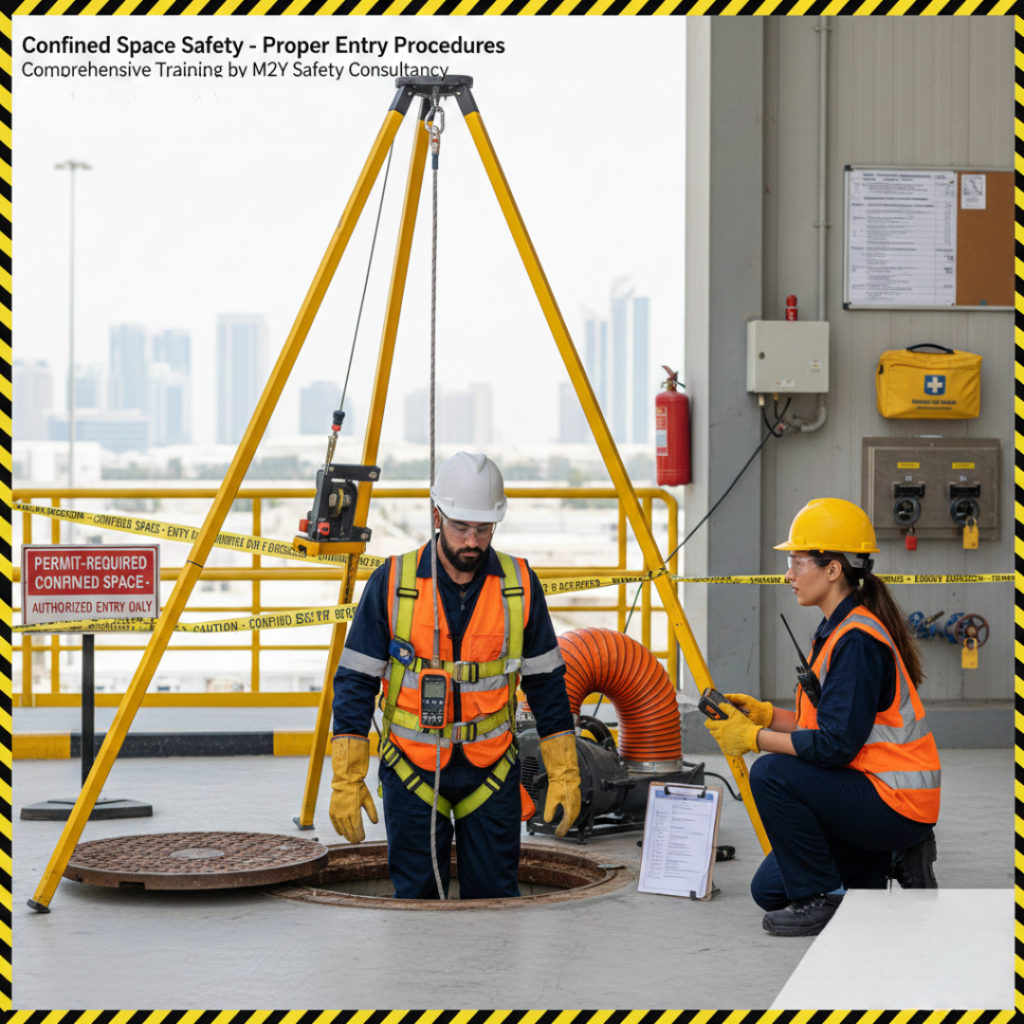
What is a Confined Space?
A confined space is any enclosed or partially enclosed area that meets specific criteria making it potentially hazardous for human entry. While definitions vary slightly by jurisdiction, most regulatory frameworks (OSHA, OSHAD, Indian Factories Act, ISO standards) define a confined space using three key characteristics:
The Three Defining Criteria
1. Limited or Restricted Means of Entry or Exit
- Not designed for continuous human occupancy
- Access points are small, awkward, or difficult to navigate
- Entry/exit could be hindered by the worker’s equipment or in emergency situations
- Examples: Manholes, hatches, small doors or openings
2. Not Designed for Continuous Human Occupancy
- Intended for storage, processing, or equipment housing—not for people to work in regularly
- Lacks adequate ventilation, lighting, or amenities for prolonged human presence
- May have configurations that complicate movement or communication
3. Presents or Has Potential to Present Hazards
- Atmospheric hazards (oxygen deficiency, toxic gases, flammable vapors)
- Physical hazards (engulfment, entrapment, temperature extremes)
- Configuration hazards (converging walls, sloped floors leading to suffocation)
Common Examples of Confined Spaces
Industrial and Manufacturing:
- Storage tanks (water, fuel, chemicals)
- Reactors and pressure vessels
- Mixing tanks and vats
- Boilers and furnaces (when shut down)
- Silos and hoppers
- Digesters and fermentation tanks
Oil & Gas Facilities (UAE, US, India):
- Crude oil storage tanks
- Process vessels and separators
- Pump stations and valve chambers
- Offshore platform void spaces
- Pipeline sections requiring internal access
- Drilling mud tanks
Utilities and Infrastructure:
- Sewers and manholes
- Underground electrical vaults
- Water treatment tanks and clarifiers
- Telecommunications pits
- Storm drainage systems
- Water and wastewater pipelines
Maritime and Transportation:
- Ship holds and cargo tanks
- Ballast tanks
- Fuel bunkers
- Double-bottom tanks
- Chain lockers
Construction and Maintenance:
- Trenches and excavations (deeper than 1.2m/4 feet)
- Culverts and drainage pipes
- Tunnels under construction
- Caissons and cofferdams
- Underground chambers
Agriculture:
- Grain bins and silos
- Livestock waste lagoons
- Fermentation silos
- Manure pits
- Grain elevators
Permit-Required vs Non-Permit Confined Spaces
Many regulations distinguish between two categories:
Non-Permit Confined Spaces:
- Meet confined space definition
- BUT do not contain or have potential for hazards
- Can be entered following standard safety procedures
- No special permit required
Permit-Required Confined Spaces (PRCS):
- Contain or have potential for serious hazards
- Require formal written permit before entry
- Demand comprehensive controls and monitoring
- Most confined spaces in industrial settings fall into this category
How Spaces Can Change Status:
- Non-permit space can become permit-required if conditions change
- Permit-required space can potentially be reclassified as non-permit after hazards are eliminated (not just controlled)
- Regular reassessment required
Geographic Regulatory Variations
United States (OSHA 1910.146):
- Comprehensive permit-required confined space standard
- Specific requirements for construction (1926.1200 series)
- Emphasis on atmospheric testing and continuous monitoring
- Mandatory rescue provisions
UAE (Federal Law & OSHAD Framework):
- OSHAD (Abu Dhabi) Element 17: Confined Space Entry
- Dubai Municipality regulations for construction sites
- ADNOC-specific requirements for oil & gas facilities
- Aligned with international best practices (ISO 14122, BS standards)
India (Factories Act 1948 & IS Standards):
- Section 36: Precautions against dangerous fumes
- IS 7969 (Part I & II): Code of practice for confined space entry
- State-level factory rules supplementing central regulations
- Increasing enforcement and compliance requirements
International Standards:
- ISO 14122: Safety of machinery – Permanent means of access
- BS 7671: Electrical installations in hazardous areas
- ANSI Z117.1: Safety requirements for confined spaces
- AS/NZS 2865: Australian/New Zealand confined space standard
Confined Space Hazards: Understanding the Dangers
Confined spaces present multiple simultaneous hazards, often creating conditions where one hazard triggers or worsens another.
1. Atmospheric Hazards (Most Common and Deadly)
Oxygen Deficiency (Hypoxia)
Normal Atmospheric Oxygen: 20.9% at sea level
Safe Confined Space Oxygen Level: 19.5% – 23.5%
Why Oxygen Levels Drop:
- Displacement by other gases: Nitrogen, argon, carbon dioxide displacing oxygen
- Consumption through chemical reactions: Rusting metal, decomposing organic matter, bacterial action
- Absorption by materials: Fresh concrete, coatings, sealants absorbing oxygen
- Combustion: Previous hot work consuming oxygen
- Biological processes: Fermentation, decay, bacterial activity
Effects of Oxygen Deficiency:
| Oxygen Level | Effects on Humans | Time to Symptoms |
|---|---|---|
| 19.5% – 23.5% | Safe range for confined space entry | N/A – Normal function |
| 15-19% | Impaired judgment, rapid breathing, accelerated heartbeat | Minutes |
| 12-15% | Dizziness, headache, fatigue, poor coordination, rapid fatigue | 1-2 minutes |
| 10-12% | Nausea, vomiting, inability to perform vigorous movement, unconsciousness | 30-60 seconds |
| 6-10% | Collapse, convulsions, cessation of breathing | Seconds |
| Below 6% | Death within minutes, possible immediate collapse | Immediate |
Critical Point: Symptoms often go unrecognized by the victim due to impaired judgment—one of the first effects of oxygen deficiency. Workers may not realize they’re in danger until it’s too late.
Oxygen Enrichment (Hyperoxia)
Danger Level: Above 23.5% oxygen
Causes:
- Leaking oxygen supply lines
- Improper “ventilation” using pure oxygen
- Welding or cutting oxygen system leaks
Hazards:
- Greatly increased fire and explosion risk
- Materials that don’t normally burn become highly flammable
- Clothing, hair, skin can ignite easily
- Combustion rates dramatically accelerated
Example Incident: A worker using pure oxygen to “ventilate” a tank. When he struck a lighter, his clothing ignited instantaneously, causing severe burns. NEVER use pure oxygen for ventilation.
Toxic Gases and Vapors
Common Toxic Contaminants:
Hydrogen Sulfide (H₂S) – “Sour Gas”:
- Colorless gas with rotten egg smell at low concentrations
- Smell disappears at dangerous levels (olfactory fatigue)
- Heavier than air (accumulates at bottom of spaces)
- Common in: Oil & gas facilities, sewers, manure pits, paper mills
- Exposure limits:
- Permissible Exposure Limit (PEL): 10 ppm (8-hour average)
- IDLH (Immediately Dangerous to Life or Health): 100 ppm
- Fatality possible: 500-1000 ppm causes immediate collapse, death within minutes
Carbon Monoxide (CO):
- Colorless, odorless, tasteless gas
- Produced by incomplete combustion
- Binds to hemoglobin 200x more readily than oxygen
- Common sources: Gasoline engines, propane heaters, combustion processes
- Exposure limits:
- PEL: 50 ppm (8-hour average)
- IDLH: 1,200 ppm
- Symptoms: Headache, dizziness, nausea, confusion, loss of consciousness
Carbon Dioxide (CO₂):
- Colorless, odorless gas
- Heavier than air (1.5x density of air)
- Displaces oxygen and acts as asphyxiant
- Also toxic at high concentrations
- Common sources: Fermentation, decomposition, dry ice sublimation, combustion
- Exposure limits:
- PEL: 5,000 ppm (0.5%) 8-hour average
- Dangerous: Above 40,000 ppm (4%)
- Fatal: Above 100,000 ppm (10%)
Methane (CH₄):
- Colorless, odorless, flammable gas
- Lighter than air (accumulates at top of spaces)
- Common in: Sewers, landfills, oil/gas facilities, coal mines
- Acts as simple asphyxiant (displaces oxygen)
- Explosion hazard: Flammable range 5-15% (Lower Explosive Limit to Upper Explosive Limit)
Chemical Vapors:
- Solvents (benzene, toluene, xylene)
- Cleaning agents
- Petroleum products
- Industrial chemicals
- Pesticides and fumigants
Flammable and Combustible Atmospheres
Danger: Explosive atmosphere requiring only ignition source to cause blast/fire
Flammability Concepts:
- Lower Explosive Limit (LEL): Minimum concentration that will burn (e.g., 5% for methane)
- Upper Explosive Limit (UEL): Maximum concentration that will burn (e.g., 15% for methane)
- Flammable Range: Between LEL and UEL
- Safe Level: Below 10% of LEL (most regulations require below 10% LEL before entry)
Sources of Flammable Atmospheres:
- Residual petroleum products in tanks
- Solvent vapors from cleaning or coating
- Methane from decomposition
- Propane or natural gas leaks
- Combustible dusts (grain, metal, chemical)
Ignition Sources:
- Static electricity
- Sparks from tools or equipment
- Hot work (welding, cutting, grinding)
- Electrical equipment
- Smoking materials
- Hot surfaces
2. Physical Hazards
Engulfment
Definition: Burial or immersion in flowable material (liquids, solids) causing suffocation, crushing, or drowning
Common Engulfment Materials:
- Grain, sand, gravel, coal, flour, sugar (free-flowing solids)
- Water, sewage, chemicals (liquids)
- Foam, snow, foam insulation
Characteristics of Engulfing Materials:
- May appear solid but become fluid when disturbed
- Create suction effect when person sinks
- Compress chest preventing breathing
- Fill nose, mouth, lungs causing suffocation
Example: Grain bin entry—grain appears solid but worker “sinks” as grain flows like quicksand. Rescue extremely difficult once engulfed.
Temperature Extremes
Heat Stress:
- Confined spaces often lack air circulation
- High ambient temperatures (critical concern in UAE, India summers)
- Radiant heat from nearby hot processes
- Wearing PPE increases heat stress risk
- Effects: Heat exhaustion, heat stroke, death
Cold Stress:
- Refrigerated spaces, cryogenic equipment
- Cold water immersion
- Wind chill from ventilation in cold climates
- Effects: Hypothermia, frostbite, reduced dexterity
Noise
- Amplification in confined spaces
- Equipment noise (pumps, fans, generators)
- Impairs communication critical for safety
- Hearing damage with prolonged exposure
- Masks warning signals
Physical Configuration Hazards
Inwardly Converging Walls:
- Walls that taper inward (silos, hoppers)
- Can trap and asphyxiate workers
Sloped Floors:
- Lead workers toward sumps or drains
- Risk of sliding into liquid or engulfing material
Internal Obstructions:
- Agitators, mixers, baffles
- Create blind spots and entrapment hazards
- Complicate movement and rescue
3. Mechanical and Electrical Hazards
Unexpected Equipment Startup:
- Agitators, mixers, augers, conveyors
- Pumps and compressors
- Can cause crushing, amputation, death
- Critical control: Lockout/Tagout (LOTO) procedures mandatory
Electrical Hazards:
- Increased shock risk in confined spaces (metal construction, moisture)
- Damaged electrical cords or equipment
- Inadequate grounding
- Water or chemical contact with electrical systems
Stored Energy:
- Pressurized systems
- Hydraulic/pneumatic systems
- Springs, flywheels
- Elevated components that could fall
4. Biological Hazards
Pathogens and Microorganisms:
- Sewage and wastewater (bacteria, viruses, parasites)
- Animal waste lagoons (E. coli, salmonella, leptospirosis)
- Decomposing organic matter
- Diseases: Hepatitis, tetanus, leptospirosis, histoplasmosis (from bird/bat droppings)
Insects and Animals:
- Snakes, spiders, scorpions (particularly UAE, India, US rural areas)
- Rats and rodents (disease vectors)
- Stinging insects (wasps, hornets)
- Aggressive behavior in confined spaces
5. Visibility and Communication Hazards
Poor Visibility:
- Inadequate lighting
- Dust, mist, vapor obscuring vision
- Tight spaces limiting line-of-sight
- Makes hazard recognition difficult
- Complicates rescue
Communication Difficulties:
- Noise levels
- Distance from entry point
- Physical barriers blocking signals
- Radio interference from metal structures
- Language barriers (diverse workforce in UAE, global operations)
Confined Space Entry: Procedures and Requirements
Safe confined space entry requires systematic planning, preparation, and execution following established protocols.
Pre-Entry Procedures
Step 1: Identify and Classify the Space
- Determine if space meets confined space definition
- Classify as permit-required or non-permit
- Document classification and basis
- Reassess if conditions or use change
Step 2: Conduct Comprehensive Risk Assessment
Identify Hazards:
- Review space history and previous contents
- Check design drawings and specifications
- Identify connected systems and processes
- Consider work to be performed
- Assess atmospheric, physical, and other hazards
Evaluate Risks:
- Likelihood of exposure
- Severity of potential consequences
- Number of workers affected
- Duration and frequency of entry
Determine Control Measures:
- Apply hierarchy of controls
- Elimination: Can entry be avoided? (inspection cameras, remote sensors)
- Engineering controls: Ventilation, isolation, atmospheric monitoring
- Administrative controls: Permits, procedures, training, time limits
- PPE: Respiratory protection, protective clothing, fall protection
Step 3: Isolate and Lockout
Isolation Methods:
- Blanking/blinding: Insert solid plate in pipeline flanges (most reliable)
- Double block and bleed: Close two valves with drain between (drain must be open and confirmed flowing)
- Disconnect pipes/ducts: Physical separation from connected systems
- Single block (least preferred): One closed valve with lock—only acceptable if no other hazards present
Energy Isolation (LOTO):
- Electrical energy: Disconnect switches, circuit breakers locked open
- Mechanical energy: Brakes applied, blocks preventing movement
- Hydraulic/pneumatic: Valves closed and locked, pressure relieved
- Thermal energy: Allow cooling, isolate steam/hot water lines
- Potential energy: Lower suspended loads, block against movement
Verify Isolation:
- Attempt to start equipment (should not operate)
- Verify valves are locked and cannot be operated
- Confirm zero energy state
- Document isolation verification
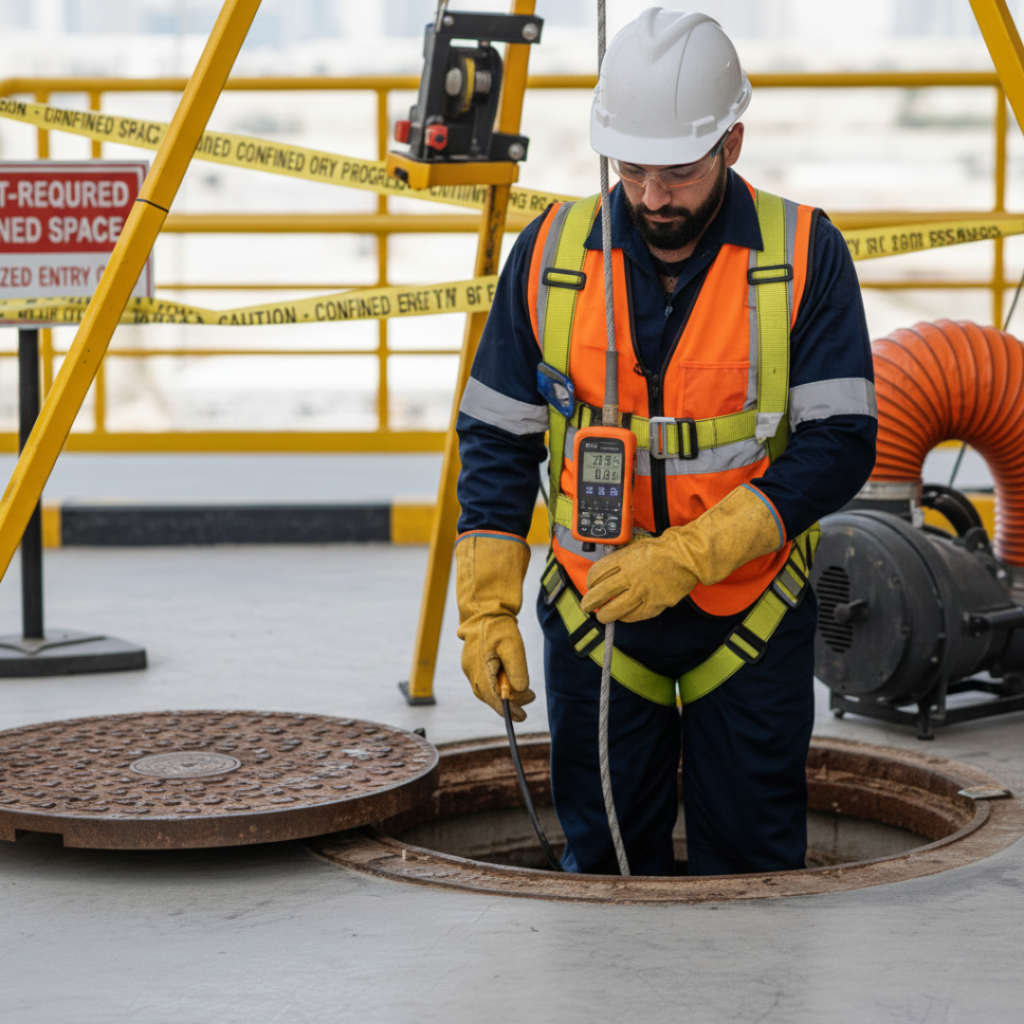
Step 4: Atmospheric Testing
Testing Protocol:
- Must be performed by trained, authorized personnel
- Calibrated instruments required (before each use)
- Test from outside space initially (probe inserted through opening)
- Test multiple locations and levels (gases stratify by density)
- Test in sequence: Oxygen → Flammability → Toxicity
Testing Sequence and Acceptable Levels:
| Parameter | Acceptable Range | Action if Outside Range |
|---|---|---|
| Oxygen | 19.5% – 23.5% | Ventilate, retest, identify source |
| Flammability | Below 10% of LEL | Ventilate, eliminate sources, retest |
| Hydrogen Sulfide (H₂S) | Below 10 ppm | Ventilate, retest, source control |
| Carbon Monoxide (CO) | Below 35 ppm | Ventilate, retest, eliminate sources |
| Other toxics | Below 50% of PEL | Specific to substance, ventilate |
Continuous Monitoring:
- Install continuous atmospheric monitors
- Alarm set points configured
- Entrant carries personal monitor
- Attendant monitors readings continuously
- Automatic evacuation if readings exceed safe limits
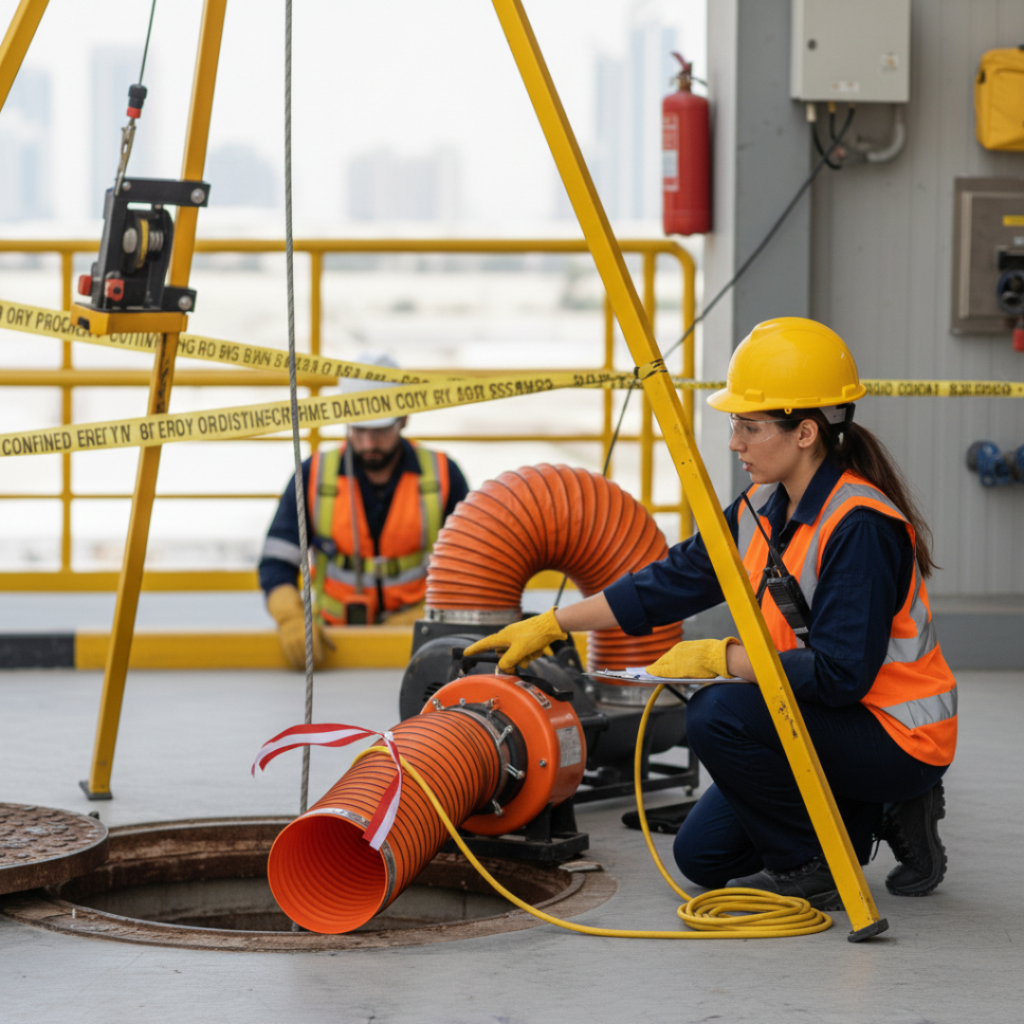
Step 5: Ventilation
Purpose:
- Remove atmospheric contaminants
- Provide breathable air
- Maintain acceptable atmosphere during work
Ventilation Methods:
Natural Ventilation:
- Open multiple hatches/vents creating airflow
- Only acceptable if demonstrably effective
- Rarely sufficient for permit-required spaces
Mechanical Ventilation:
- Forced air (positive pressure): Blow fresh air into space
- Advantages: Creates positive pressure preventing contaminants entering, ensures air supply
- Setup: Position blower outside, duct extends into space but not touching bottom
- Exhaust (negative pressure): Extract contaminated air from space
- Advantages: Removes contaminants at source
- Risk: Creates negative pressure potentially drawing contaminants from surroundings
- Setup: Exhaust point at lowest point for heavier-than-air gases, highest for lighter gases
Ventilation Duration:
- Minimum: Sufficient to purge volume of space 3-5 times
- Continue during entry (continuous ventilation required)
- Calculate air changes: (CFM of fan ÷ volume of space in ft³) × 60 = air changes per hour
- Retest atmosphere after ventilation, before entry
Ventilation Cautions:
- Never use pure oxygen (fire/explosion hazard)
- Position exhaust discharge away from work areas
- Ensure adequate makeup air for exhaust systems
- Prevent recirculation of contaminated air
Step 6: Permit Preparation and Authorization
Confined Space Entry Permit Contents:
- Space identification and location
- Purpose of entry and work to be performed
- Date and authorized duration
- Authorized entrants, attendants, entry supervisor (names and signatures)
- Hazards identified
- Isolation measures completed (with verification)
- Atmospheric testing results (initial and continuous)
- Ventilation specifications
- Communication procedures
- Equipment required (PPE, monitoring, rescue)
- Rescue services available
- Emergency contacts
- Special procedures or restrictions
- Cancellation conditions
Permit Validation:
- Entry supervisor reviews all conditions
- Verifies controls are in place and effective
- Confirms all personnel understand duties
- Signs permit authorizing entry
- Posts permit at entry point for duration
- Cancels permit when conditions change or work complete
Entry Procedures
Roles and Responsibilities
Entry Supervisor:
- Overall responsibility for safe entry
- Verifies all permit conditions met
- Authorizes entry and cancels permit
- Ensures rescue services available
- Terminates entry if unsafe conditions develop
- May serve as attendant if qualified
Authorized Entrants:
- Enter the confined space to perform work
- Understand hazards and control measures
- Use required PPE and equipment properly
- Maintain communication with attendant
- Exit space immediately upon:
- Alarm activation
- Attendant order
- Recognizing danger signs or symptoms
- Perceiving prohibited condition
Attendants (Hole Watch):
- Remain outside space at entry point
- Continuously monitor entrants
- Count entrants (track who is inside)
- Maintain communication
- Monitor atmospheric readings
- Order evacuation if unsafe conditions
- Summon rescue if needed
- NEVER enter space to perform rescue (unless properly trained and equipped as rescue team member)
- Prevent unauthorized entry
Rescue Team:
- Trained and equipped for confined space rescue
- Standing by or on-call (response time critical)
- Conduct practice rescues periodically
- Understand specific space configuration
- Equipment maintained and readily available
Communication Systems
Methods:
- Direct visual contact: Preferred when possible
- Voice communication: Through opening, amplified as needed
- Radio: Two-way communication, check before entry
- Signal line (tug line): Physical rope with predetermined signals (backup method)
- Continuous video: Camera monitoring entrants
Communication Frequency:
- Attendant checks entrants at least every few minutes
- Entrants acknowledge and report status
- Any communication failure requires immediate investigation
- Loss of communication = emergency response initiated
Entry Equipment
Personal Protective Equipment:
- Full-body harness with retrieval line (unless retrieval creates greater hazard)
- Respiratory protection (if required by atmosphere):
- Air-purifying respirators (only if oxygen adequate and contaminants identified)
- Supplied-air respirators (airline from outside source)
- Self-contained breathing apparatus (SCBA) (for IDLH atmospheres or unknown conditions)
- Protective clothing (chemical-resistant, heat-resistant as needed)
- Hard hat with chin strap
- Safety glasses or face shield
- Gloves (chemical-resistant, cut-resistant as appropriate)
- Safety boots (non-sparking in flammable atmospheres)
Monitoring Equipment:
- Personal atmospheric monitors (worn by entrant)
- Continuous area monitors (fixed in space)
- Calibrated and bump-tested before use
- Alarm set points configured
Retrieval Equipment:
- Tripod or davit arm (mechanical advantage for retrieval)
- Winch or retrieval system (manual or powered)
- Full-body harness (never waist belt)
- Retrieval line attached to dorsal D-ring
- Quick-connect devices
Lighting:
- Intrinsically safe or explosion-proof (in flammable atmospheres)
- Adequate illumination for work and egress
- Backup lighting available
Communication Equipment:
- Two-way radios (intrinsically safe if required)
- Signal lines
- Communication boards (for complex instructions)
Ventilation Equipment:
- Blowers, fans, ducts
- Operating throughout entry
Other Equipment:
- Barriers and signs preventing unauthorized entry
- Fire extinguishers
- First aid equipment
- Decontamination supplies (if needed)
During Entry Operations
Continuous Monitoring:
- Atmospheric conditions monitored constantly
- Regular communication between entrant and attendant
- Observation for signs of distress
- Work rate controlled to prevent overexertion
- Hot work carefully controlled (cutting, welding, grinding)
Maintaining Safe Conditions:
- Continuous ventilation
- Periodic re-testing of atmosphere (especially after breaks)
- Vigilance for changing conditions
- Prompt response to any concerns
Time Limits:
- Consider: Temperature, physical demands, PPE burden, atmospheric conditions
- Rotate entrants to prevent fatigue
- Mandatory rest breaks outside space
- Heat stress management (critical in UAE, India, US summers)
Emergency Response and Rescue
Emergency Scenarios:
- Atmospheric conditions deteriorate
- Entrant becomes unconscious or incapacitated
- Equipment failure
- Injury or medical emergency
- Fire or explosion
- Structural failure
Immediate Actions:
- Attendant activates alarm/emergency notification
- All entrants evacuate (if able)
- Attendant attempts non-entry rescue (retrieval system) if applicable
- Emergency services contacted immediately
- Entry supervisor notified
- Rescue team dispatched
Non-Entry Rescue:
- Preferred method (safest for rescuers)
- Uses retrieval equipment to extract victim from outside
- Requires proper harness and retrieval line setup
- Regular practice ensures proficiency
- May not be possible in all space configurations
Entry Rescue:
- Only by trained, equipped rescue team
- Proper respiratory protection (SCBA, supplied-air)
- Additional attendants for rescue team members
- Communication systems
- Backup rescuers
- Medical support standing by
Critical Rule: Untrained personnel must NEVER enter for rescue—over 60% of confined space fatalities are would-be rescuers who become victims.
Confined Space Entry Training: Building Competence
Comprehensive training is the foundation of confined space safety and is legally required in most jurisdictions.
Training Requirements by Role
All Personnel (General Awareness):
- What confined spaces are
- Why they are dangerous
- Company policy on confined space entry
- How to recognize confined spaces
- Prohibition on unauthorized entry
Authorized Entrants:
- Recognize hazards in specific spaces
- Use required PPE and equipment
- Communicate effectively with attendants
- Recognize warning signs and symptoms
- Understand duties and limitations
- Know when and how to exit
- Alert attendant to problems
Attendants:
- Understand hazards and effects on entrants
- Maintain accurate count of entrants
- Remain at entry point (never leave)
- Maintain communication with entrants
- Order evacuation when required
- Summon rescue services
- Prevent unauthorized entry
- Understand attendant may NOT enter for rescue
Entry Supervisors:
- Understand hazards including information on mode, signs, symptoms, consequences
- Verify permit conditions (isolation, testing, ventilation, equipment)
- Terminate entry when conditions warrant
- Ensure rescue services available
- Remove unauthorized individuals
Rescue Team Members:
- Entry rescue techniques
- Use of rescue equipment (SCBA, retrieval systems, victim packaging)
- First aid and CPR
- Space-specific rescue challenges
- Practice rescues (at least annually, preferably quarterly)
Confined Space Entry Training Course Structure
Standard Training Duration: 1-2 days (8-16 hours) depending on depth and regulatory requirements
M2Y Safety Consultancy Comprehensive Course:
Module 1: Introduction and Regulations (2 hours)
- Confined space statistics and incident case studies
- Regulatory requirements:
- OSHA 1910.146 (US)
- OSHAD Framework Element 17 (UAE)
- Indian Factories Act Section 36 and IS 7969 (India)
- International standards (ISO, BS, ANSI)
- Employer and employee responsibilities
- Consequences of non-compliance
Module 2: Confined Space Identification and Classification (2 hours)
- Defining characteristics
- Examples across industries
- Permit-required vs non-permit determination
- Hazard assessment methodology
- Site-specific space review (if on-site training)
Module 3: Atmospheric Hazards (3 hours)
- Oxygen deficiency and enrichment
- Toxic gases and vapors (H₂S, CO, CO₂, methane, solvents)
- Flammable and combustible atmospheres (LEL, UEL)
- Physiological effects
- Atmospheric testing instruments:
- Direct-reading multi-gas monitors
- Single-gas detectors
- Sampling procedures
- Calibration and bump testing
- Interpretation of readings
Module 4: Physical and Other Hazards (1.5 hours)
- Engulfment hazards
- Temperature extremes
- Mechanical and electrical hazards
- Configuration hazards
- Noise, visibility, communication issues
Module 5: Isolation, Lockout/Tagout (1.5 hours)
- Energy isolation principles
- Blanking, disconnection, double block and bleed
- Lockout/Tagout procedures
- Verification of isolation
- Documentation requirements
Module 6: Ventilation (1.5 hours)
- Natural vs mechanical ventilation
- Forced air vs exhaust systems
- Calculating air changes
- Ventilation duration and continuity
- Setup and positioning
Module 7: Permit System and Entry Procedures (2 hours)
- Permit components and completion
- Roles and responsibilities (entrant, attendant, supervisor)
- Authorization process
- Communication systems
- Entry equipment selection and use
- Maintaining safe conditions during entry
Module 8: Emergency Response and Rescue (2 hours)
- Emergency scenarios
- Non-entry rescue methods and equipment
- Entry rescue procedures and limitations
- The “would-be rescuer” problem
- Emergency notification and coordination
- First aid considerations (suspension trauma)
Module 9: Practical Exercises (3-4 hours)
- Atmospheric testing instrument operation (hands-on)
- Confined space entry simulation
- Donning and using PPE (harnesses, respiratory protection)
- Communication practice
- Non-entry rescue demonstration and practice
- Permit completion exercise
- Case study analysis
Assessment:
- Written examination (multiple choice and short answer)
- Practical skills assessment (instrument use, permit completion, hazard identification)
- Pass mark: 70-80% (varies by program)
- Certificate issued upon successful completion
Certificate Validity: Typically 2-3 years, varies by jurisdiction and employer requirements
Global Training Standards and Certification
United States:
- OSHA 1910.146 requires training for all roles
- No federal certification, but many states and employers require competency demonstration
- Third-party certification programs available (ASSE, BCSP)
United Arab Emirates:
- ADNOC-approved confined space training mandatory for oil & gas operations
- OSHAD compliance required for Abu Dhabi operations
- Dubai Municipality enforces training requirements on construction sites
- Increasing standardization across emirates
India:
- Factories Act requires competent person authorization
- IS 7969 standard provides training framework
- State factory inspectorates enforce requirements
- Growing emphasis on formal certification programs
International Recognition:
- ISO standards provide framework
- Many multinational companies require standardized training across global operations
- M2Y Safety Consultancy provides globally-recognized training meeting multiple regulatory frameworks
Refresher Training
When Required:
- At regular intervals (annually or as specified)
- When employee demonstrates inadequate knowledge or skills
- When workplace conditions change
- After incidents or near-misses
- When procedures or equipment change
Refresher Content:
- Review of key concepts
- Updates on regulations or procedures
- Discussion of recent incidents (lessons learned)
- Re-testing of critical skills
- Renewal of certification
Why Choose M2Y Safety Consultancy
M2Y Safety Consultancy Advantages:
✓ Globally recognized training meeting OSHA, OSHAD, IS, and international standards
✓ Experienced instructors with decades of industrial safety experience across UAE, India, US, and global operations
✓ Practical, hands-on training with atmospheric testing equipment, rescue systems, and PPE
✓ Multi-regulatory expertise – single training meeting multiple jurisdictional requirements
✓ Flexible delivery – classroom, on-site, or customized for specific industries
✓ Small class sizes ensuring competency development
✓ Current content reflecting latest best practices and regulatory changes
✓ Post-training support assisting with program implementation
✓ Multilingual instruction available (English, Arabic, Hindi, others)
Training Locations:
- UAE: Dubai, Abu Dhabi, and other emirates
- India: Multiple cities (on-site training available)
- US: On-site training for US operations
- Global: Customized training programs worldwide
Visit M2Y Safety Consultancy to view confined space training schedules and enroll today.
Confined Space Safety Best Practices
Program Elements
Written Confined Space Program:
- Policy statement and objectives
- Space inventory and classification
- Entry procedures for each space type
- Equipment specifications
- Training requirements
- Contractor management
- Rescue arrangements
- Record-keeping
- Program review and improvement
Space Inventory and Evaluation:
- Comprehensive list of all confined spaces
- Classification (permit-required vs non-permit)
- Hazard assessment for each
- Required controls documented
- Regular reassessment (at least annually)
Contractor Management:
- Inform contractors of confined spaces and hazards
- Coordinate entry operations
- Debrief contractors on entry experience
- Verify contractor training and competence
Rescue Services:
- On-site rescue team: Trained company employees (preferred for rapid response)
- Off-site rescue services: Fire department, private rescue (verify capability for confined spaces specifically)
- Practice rescues at least annually
- Response time assessment
- Equipment maintenance and availability
Common Mistakes to Avoid
1. “We’ve Always Done It This Way” Complacency
- Previous successful entries don’t guarantee future safety
- Conditions change over time
- Hazards may develop without warning
- Every entry requires full procedures
2. Inadequate Atmospheric Testing
- Testing from outside only (must test where entrant will be)
- Single-location testing (must test multiple levels and areas)
- Testing only once (conditions change—continuous monitoring required)
- Using uncalibrated instruments
- Wrong testing sequence (always: oxygen, flammability, toxicity)
3. Improper Ventilation
- Insufficient duration (must ventilate adequately before entry)
- Discontinuing ventilation during entry
- Using pure oxygen (creates extreme fire/explosion hazard)
- Poor positioning (not reaching all areas of space)
4. Incomplete Isolation
- Relying on single valves (inadequate—use double block and bleed minimum)
- Not verifying isolation (must confirm zero energy/flow)
- Overlooking energy sources (electrical, mechanical, hydraulic, potential)
- Inadequate lockout/tagout
5. Rescue Planning Failures
- No rescue plan in place
- Untrained personnel designated as rescuers
- Rescue equipment unavailable or not maintained
- No practice rescues conducted
- Assuming fire department can perform rescue (many cannot without specialized training/equipment)
6. Training Shortfalls
- One-time training without refreshers
- Generic training not addressing specific site hazards
- No competency verification
- Inadequate documentation
7. Permit Shortcuts
- Skipping permit process (“quick” entries)
- Incomplete permit information
- Insufficient authorization
- Not canceling permits when conditions change
8. Communication Breakdowns
- No designated attendant
- Inadequate communication systems
- Attendant leaves post
- Language barriers not addressed (multinational workforce)
Industry-Specific Considerations
Oil & Gas (UAE, US, India):
- Hydrocarbon vapors and H₂S primary concerns
- Offshore platforms present additional challenges (access, weather, medical evacuation)
- Hot climates (UAE, India) increase heat stress risk
- ADNOC and operator-specific requirements
Utilities (Wastewater, Water Treatment):
- Biological hazards (pathogens)
- Hydrogen sulfide generation
- Methane accumulation
- Variable atmospheric conditions
Manufacturing:
- Residual process chemicals
- Stored energy in equipment
- Physical configuration hazards (agitators, conveyors)
- Frequent short-duration entries
Construction:
- Trenches and excavations (engulfment, collapse)
- Constantly changing conditions
- Transient workforce (varying training levels)
- Multiple contractors on site
Maritime:
- Ship tanks and holds (oxygen deficiency, toxic residues)
- Access difficulties (vertical ladders, small openings)
- Limited rescue resources at sea
- International regulatory variations
Agriculture:
- Grain bins (engulfment)
- Manure pits (H₂S, methane)
- Silos (oxygen deficiency from fermentation)
- Rural locations complicating rescue
Frequently Asked Questions (FAQs)
The safe oxygen level for confined space entry is 19.5% to 23.5% by volume, according to OSHA, OSHAD, and most international standards. Normal atmospheric oxygen at sea level is approximately 20.9%. Oxygen levels below 19.5% create hypoxic conditions with progressively severe effects: at 15-19% workers experience impaired judgment and rapid breathing; at 12-15% dizziness, poor coordination, and rapid fatigue occur; at 10-12% unconsciousness happens within minutes; below 6% death can occur within seconds. The danger is that hypoxia impairs judgment before physical symptoms appear—victims often don't recognize they're in danger until it's too late. Conversely, oxygen levels above 23.5% (oxygen enrichment) dramatically increase fire and explosion risk, as materials that don't normally burn become highly flammable. This is why atmospheric testing with calibrated instruments is mandatory before every confined space entry, and continuous monitoring is required throughout the entry. Never use pure oxygen to "ventilate" a confined space—this creates extreme explosion hazards. The 19.5-23.5% range ensures workers can breathe normally while maintaining safe fire/explosion margins.
The most lethal confined space hazards are atmospheric hazards, which account for over 60% of confined space fatalities. Specifically:
(1) Oxygen deficiency (hypoxia) caused by displacement (nitrogen, carbon dioxide), consumption (rusting, decomposition), or absorption (concrete, coatings)—workers lose consciousness within seconds to minutes, often without warning signs;
(2) Hydrogen sulfide (H₂S) in sewers, oil/gas facilities, and agricultural settings—this "sour gas" causes immediate collapse and death at concentrations above 500 ppm, and its characteristic rotten egg smell disappears at dangerous levels (olfactory fatigue);
(3) Carbon monoxide (CO) from combustion sources—colorless and odorless, it binds to hemoglobin preventing oxygen transport;
(4) Flammable atmospheres that explode when ignition sources are introduced. Additional significant hazards include
(5) Engulfment in grain, sand, or liquids causing suffocation or drowning;
(6) Physical configuration hazards like converging walls or sloped floors; and
(7) Mechanical hazards from unexpected equipment startup. A tragic aspect of confined space incidents is that over 60% of fatalities involve would-be rescuers who enter without proper training or equipment and become victims themselves.
This is why comprehensive confined space entry training covering atmospheric testing, proper isolation, continuous monitoring, and emergency rescue procedures is absolutely critical—M2Y Safety Consultancy provides this training meeting OSHA, OSHAD, and international standards across UAE, India, US, and globally.
Confined space entry training is highly specialized and focuses exclusively on the unique hazards, procedures, and rescue techniques specific to confined spaces—it goes far beyond general workplace safety training. The training covers: atmospheric hazards and testing (oxygen levels, toxic gases, flammability), proper use of atmospheric monitoring equipment, isolation and lockout/tagout procedures specific to confined spaces, ventilation requirements and calculations, permit-to-work systems, emergency rescue procedures, and role-specific responsibilities (entrant, attendant, entry supervisor). Who needs this training varies by role:
(1) Authorized Entrants - anyone who physically enters permit-required confined spaces must complete comprehensive training on hazard recognition, equipment use, communication, and emergency response;
(2) Attendants (hole watch) - personnel stationed outside the space monitoring entrants require training on hazard recognition, communication, emergency procedures, and understanding they must NOT enter for rescue;
(3) Entry Supervisors - those who authorize entries need training on hazard assessment, permit validation, and overall entry coordination;
(4) Rescue Team Members - specialized training in confined space rescue techniques, equipment, and regular practice rescues. This is required by regulations (OSHA 1910.146 in US, OSHAD Element 17 in UAE, Indian Factories Act Section 36, international standards) and by any employer whose operations involve confined space entry. Training must be refreshed regularly (typically every 2-3 years) and whenever conditions, procedures, or equipment change.
M2Y Safety Consultancy provides role-specific confined space training meeting regulatory requirements across UAE, India, US, and internationally, with practical hands-on components and competency verification.
The distinction between permit-required and non-permit confined spaces is based on hazard presence. All confined spaces share three characteristics:
(1) limited entry/exit,
(2) not designed for continuous occupancy, and
(3) large enough for a person to enter.
However, Permit-Required Confined Spaces (PRCS) additionally contain or have potential for serious hazards including: atmospheric hazards (oxygen deficiency below 19.5%, toxic gases, flammable vapors above 10% LEL), engulfment potential (liquids, solids), physical configuration that could trap or asphyxiate (converging walls, sloped floors), or other recognized serious safety/health hazards. PRCS require formal written permits before entry, comprehensive atmospheric testing, continuous monitoring, isolation/lockout, ventilation, rescue provisions, trained personnel (entrant, attendant, supervisor), and specific equipment.
Non-permit confined spaces meet the basic definition but do not contain or have potential for hazards—these can be entered following standard safety procedures without formal permits. However, spaces can change classification: a non-permit space becomes permit-required if hazardous conditions develop; conversely, a permit-required space can potentially be reclassified as non-permit only after hazards are permanently eliminated (not just controlled—controlling hazards doesn't change the classification). Most industrial confined spaces are permit-required due to potential for atmospheric hazards even if not always present. Classification must be reassessed regularly and whenever conditions change. The permit requirement ensures systematic evaluation and control of hazards before every entry—this process has proven essential for preventing confined space fatalities.
If atmospheric testing reveals unsafe levels (oxygen outside 19.5-23.5%, flammable gases above 10% of LEL, toxic gases above permissible limits), you must NEVER enter the space regardless of schedule pressure or previous safe entries. Instead, follow this systematic approach:
(1) Immediately cease all entry preparations and ensure everyone stays out;
(2) Implement or increase ventilation using mechanical forced-air or exhaust systems (never use pure oxygen—extreme fire hazard), ventilating for sufficient duration to purge the space volume 3-5 times;
(3) Re-test the atmosphere after adequate ventilation period—test multiple locations and levels since gases stratify by density;
(4) If readings are now acceptable, implement continuous ventilation and continuous atmospheric monitoring throughout entry, with alarm set points configured and personal monitors worn by entrants;
(5) If readings remain unacceptable, identify and address the source—this may require: enhanced ventilation (larger/additional blowers, better positioning), elimination of contamination sources (cleaning residues, removing decomposing materials), allowing more time for off-gassing or chemical reactions to complete, or implementing engineering controls (permanent ventilation systems);
(6) Consider whether entry can be avoided entirely through alternative methods (remote cameras, extended tools, redesign);
(7) If entry remains necessary despite persistent hazards, respiratory protection appropriate to the contaminants may be required (supplied-air respirators or SCBA for IDLH conditions), but this significantly increases complexity, training requirements, and rescue difficulty;
(8) Document all testing results, ventilation measures, and decisions made. Remember: schedule pressure never justifies unsafe entry—atmospheric conditions that are unacceptable today won't become acceptable through wishful thinking or risk-taking.
M2Y Safety Consultancy training emphasizes this decision-making process and provides hands-on experience with atmospheric testing equipment across UAE, India, US, and international operations.