HSE AUDIT
INTRODUCTION: WHY YOUR NEXT HSE AUDIT COULD SAVE YOUR BUSINESS
I’ll never forget the call I received from a manufacturing plant manager in 2021. His voice was shaking. “We just had a serious incident. OSHA is here. We thought we were compliant, but…” He trailed off.
After conducting over 200 HSE audits across manufacturing, construction, and logistics sectors, I’ve seen this scenario too many times. Companies believe they’re doing everything right—until an audit reveals critical gaps they never knew existed.
Here’s the reality: workplace incidents cost U.S. employers $170 billion annually, according to the National Safety Council. Many of these incidents are preventable through systematic HSE auditing.
If you’re reading this, you’re likely in one of these situations:
- Preparing for an upcoming compliance audit
- Tasked with improving workplace safety but unsure where to start
- Want to prevent incidents before they happen (not just react after)
- Need to demonstrate due diligence to stakeholders and regulatory bodies
This guide draws from my direct experience conducting HSE audits for companies ranging from 50 to 5,000+ employees. I’ll show you exactly what works, what doesn’t, and how to turn an HSE audit from a dreaded obligation into your strongest safety asset.
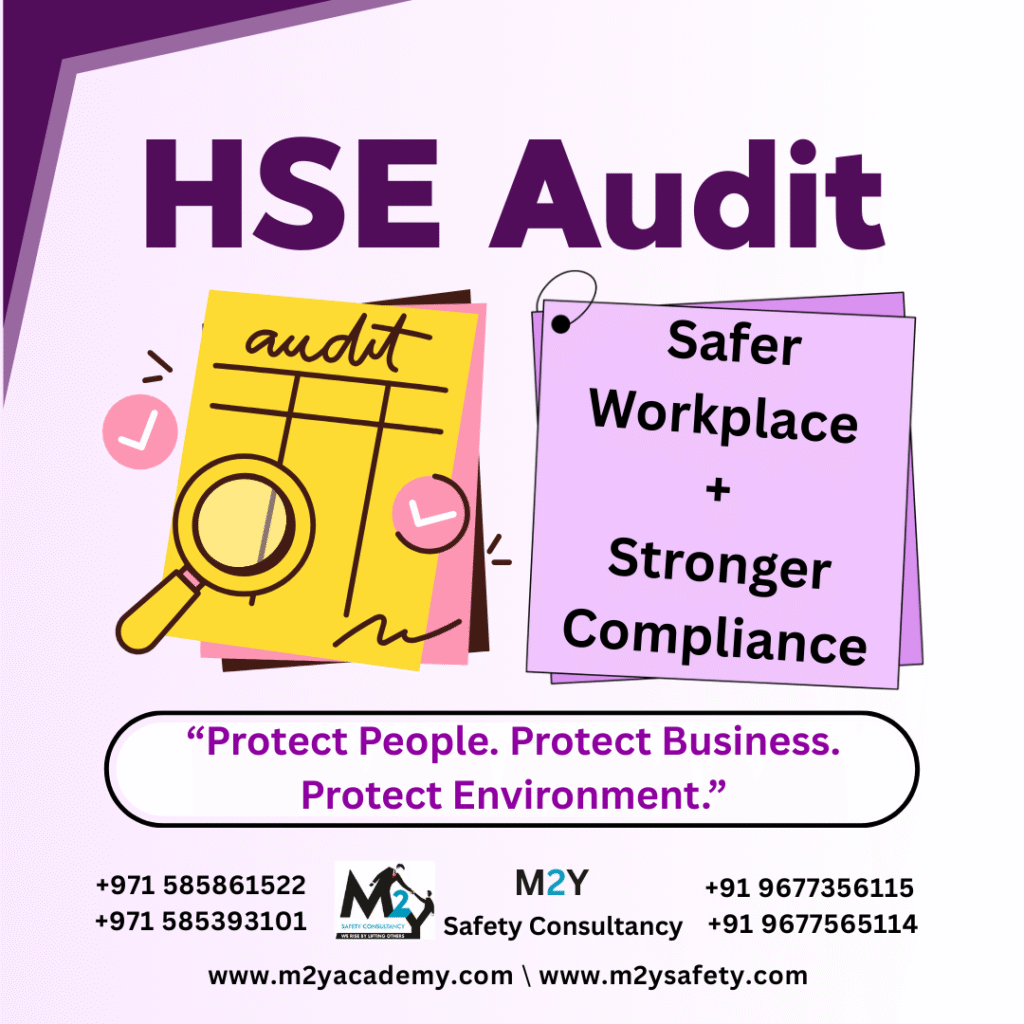
WHAT IS AN HSE AUDIT?
An HSE (Health, Safety, and Environment) audit is a structured, systematic evaluation of your workplace safety management system. But it’s not just a clipboard checklist exercise.
A proper HSE audit examines three critical dimensions:
- What You Say You Do (your documented policies and procedures)
- What You Actually Do (real-world workplace practices)
- What You Should Be Doing (legal requirements and industry best practices)
The gap between these three? That’s where incidents happen.
According to OSHA’s most recent data, the top four citation categories in 2023 were fall protection (5,260 violations), hazard communication (2,424 violations), respiratory protection (2,185 violations), and ladders (2,143 violations)—all preventable through comprehensive auditing.
TYPES OF HSE AUDITS
| Audit Type | Purpose | Recommended Frequency |
|---|---|---|
| Compliance Audit | Meet OSHA, EPA, and industry regulations | Annually or as required |
| Management System Audit | Evaluate safety framework against ISO 45001 or similar standards | Every 1–3 years |
| Internal Audit | Regular self-assessment by your team | Quarterly (high-risk) Annual (moderate-risk) |
| External Audit | Independent third-party evaluation | Annually or biannually |
| Gap Analysis Audit | Identify deficiencies before regulatory inspections | Before regulatory visits or major changes |
WHY HSE AUDITS ARE NON-NEGOTIABLE IN 2024
Let me share a real success story. In 2022, we audited a mid-sized construction firm with a concerning incident rate. Through our audit, we identified 23 critical findings and 47 observations. Within 18 months of implementing our recommendations:
- Lost-time injury rate decreased by 68%
- Workers’ compensation costs dropped by $180,000 annually
- Their EMR (Experience Modification Rate) improved from 1.4 to 0.89
- They won two major contracts specifically because of their improved safety record
Here’s why HSE audits deliver measurable value:
Legal Compliance and Liability Protection
OSHA penalties have increased significantly. Serious violations now carry penalties up to $16,131 per violation, while willful or repeated violations can reach $161,323 per violation (2024 rates). A comprehensive audit identifies violations before regulators do.
Financial Performance
Liberty Mutual’s 2023 Workplace Safety Index reports the top 10 most disabling workplace injuries cost businesses over $58 billion annually. Studies show every dollar invested in workplace safety returns $4 to $6 in cost savings.
Insurance and Contractual Requirements
Many insurers now require documented HSE audits for coverage. Large clients often mandate supplier safety audits before awarding contracts. Last month, we helped a logistics company secure a Fortune 500 contract specifically because they could demonstrate a robust audit program.
Employee Retention and Morale
In our 2023 client survey, 87% of employees reported higher job satisfaction at companies with strong safety cultures. People want to work where they feel protected.
Reputation Management
One viral incident can destroy years of brand building. Proactive auditing demonstrates your commitment to safety before problems occur.
WHAT DOES AN HSE AUDIT ACTUALLY COVER?
Based on ISO 45001 standards and OSHA requirements, here’s what we examine during a comprehensive HSE audit:
| Audit Area | What We Evaluate |
|---|---|
| Safety Management System | • Leadership commitment and accountability • Safety policy documentation • Organizational structure and responsibilities • Safety objectives and performance metrics |
| Hazard Identification & Risk Assessment | • Comprehensive risk assessments • Job Safety Analysis (JSA) documentation • Control measures implementation • Hierarchy of controls application |
| Legal and Regulatory Compliance | • OSHA compliance (General Industry 1910, Construction 1926, etc.) • EPA environmental regulations • State and local requirements • Industry-specific standards |
| Training and Competency | • Training records and certifications • New employee orientation programs • Competency assessments • Refresher training schedules |
| Operational Controls | • Standard Operating Procedures (SOPs) • Permit-to-Work systems • Lockout/Tagout (LOTO) procedures • Confined space entry protocols |
| Emergency Preparedness | • Emergency response plans • Evacuation procedures and drills • First aid and emergency equipment • Communication systems |
| Incident Management | • Incident reporting procedures • Investigation methodologies • Root cause analysis • Corrective and Preventive Actions (CAPA) |
| PPE and Equipment | • PPE assessment and selection • Availability and condition • Equipment maintenance programs • Inspection records |
| Workplace Conditions | • Housekeeping standards • Machinery guarding • Electrical safety • Fire protection systems • Ventilation and air quality |
| Health and Hygiene | • Exposure monitoring • Health surveillance programs • Chemical management (HazCom/GHS) • Ergonomics assessments |
| Contractor Management | • Contractor safety requirements • Pre-qualification processes • On-site contractor monitoring • Performance evaluations |
| Continuous Improvement | • Safety performance indicators • Management review meetings • Employee participation programs • Safety suggestion systems |
THE HSE AUDIT PROCESS: STEP-BY-STEP
From my experience conducting hundreds of audits, here’s exactly how a professional HSE audit unfolds:
Step 1: Pre-Audit Planning (1-2 weeks before)
The audit doesn’t start on audit day—it starts with thorough preparation. We work with you to:
- Define the audit scope (which departments, processes, locations)
- Identify applicable regulations and standards
- Request documentation in advance (safety policies, training records, incident reports, previous audit findings)
- Schedule interviews with key personnel
- Plan the site walkthrough route
Pro tip: Don’t scramble to create documents right before the audit. Auditors can tell when paperwork was hastily assembled. If you don’t have something, it’s better to be honest than to produce fabricated records.
Step 2: Opening Meeting (30-60 minutes)
We gather with management and key stakeholders to:
- Introduce the audit team and explain their roles
- Clarify audit objectives and scope
- Review the audit schedule
- Establish communication protocols
- Address questions or concerns
This meeting sets the tone. We emphasize that audits are collaborative—not confrontational—exercises aimed at improvement.
Step 3: Document Review (1-2 days)
We systematically examine your safety documentation:
- Safety manuals and policies
- Risk assessments and job safety analyses
- Training records and certification files
- Incident and near-miss reports
- Inspection and maintenance logs
- Meeting minutes from safety committee meetings
- Corrective action tracking systems
What we’re looking for: Are your documents current? Comprehensive? Actually being used? I once found a beautifully written safety manual that hadn’t been opened in three years—it was still in its shrink wrap.
Step 4: Site Inspection and Observations (2-3 days)
This is where theory meets reality. We walk through your entire operation observing:
- Actual workplace conditions
- How employees perform their work
- Whether safety procedures are followed
- Condition and availability of safety equipment
- Housekeeping and organization
- Signage and labeling
- Machine guarding and safety devices
We look for the gap between what your documents say and what actually happens on the floor. Recently, we audited a facility with excellent confined space procedures on paper, but discovered employees regularly entered confined spaces without proper permits. That’s a critical finding.
Step 5: Employee and Management Interviews (Throughout audit)
We conduct confidential interviews with:
- Senior management
- Safety coordinators
- Supervisors and team leaders
- Frontline workers
- Contractors (if applicable)
Questions we ask employees:
- Do you know where to find safety procedures?
- What training have you received?
- How do you report hazards or near-misses?
- Do you feel comfortable raising safety concerns?
- What would you change about workplace safety?
Honest employee feedback is gold. Workers know where the real risks are.
Step 6: Findings Analysis and Classification (1 day)
We categorize all findings into three levels:
| Severity Level | Definition | Response Timeline |
|---|---|---|
| Critical | • Imminent danger to life or health • Serious regulatory violation • High probability of severe injury | Immediate action (within 24 hours) |
| Major | • Significant non-compliance • Could result in serious injury • Systematic issues affecting multiple areas | 1–4 weeks |
| Minor | • Low-risk non-compliance • Documentation gaps • Opportunities for improvement | 1–3 months |
Step 7: Closing Meeting (1-2 hours)
We present preliminary findings to management:
- Overview of audit scope and methodology
- Summary of key findings (without overwhelming detail)
- Discussion of critical and major findings
- Preliminary recommendations
- Next steps and timeline for formal report
This isn’t a “gotcha” moment. We discuss findings collaboratively and ensure management understands the issues.
Step 8: Formal Audit Report (Delivered within 1-2 weeks)
You receive a comprehensive written report containing:
- Executive summary
- Audit methodology and scope
- Detailed findings with evidence (photos, document references)
- Root cause analysis for significant findings
- Prioritized recommendations
- Regulatory references
- Action plan template
Our reports are designed to be actionable, not just informative. Each finding includes specific steps for correction.
Step 9: Corrective Action Implementation (Your responsibility)
This is where the real work begins. You need to:
- Assign responsibility for each corrective action
- Establish realistic completion deadlines
- Allocate necessary resources
- Track progress systematically
- Verify effectiveness of corrections
We recommend using a corrective action tracking system. Simple spreadsheets work for smaller operations; larger organizations might need dedicated software.
Step 10: Follow-Up Verification (3-6 months later)
Professional audit services include follow-up to verify:
- Have corrective actions been completed?
- Are they effective?
- Have new issues emerged?
- Is the safety culture improving?
Last year, we conducted a follow-up audit at a food processing facility. They’d addressed 94% of our findings. The remaining 6% involved capital equipment purchases that were in progress. That’s the kind of commitment that transforms safety culture.
COMMON HSE AUDIT FINDINGS (FROM 200+ AUDITS)
Based on our audit experience across multiple industries, these are the most frequent issues we encounter:
Top 10 Findings in Manufacturing:
- Inadequate machine guarding (found in 68% of audits)
- Missing or incomplete lockout/tagout procedures (61%)
- Insufficient fall protection for elevated work (54%)
- Incomplete hazard communication program (52%)
- Inadequate respiratory protection program (48%)
- Missing or expired training records (47%)
- Poor electrical safety practices (43%)
- Insufficient emergency evacuation procedures (41%)
- Inadequate incident investigation processes (38%)
- Missing or incomplete risk assessments (35%)
Top 10 Findings in Construction:
- Fall protection deficiencies (78% of audits)
- Inadequate scaffolding safety (71%)
- Electrical hazards and temporary wiring issues (64%)
- Poor excavation and trenching safety (58%)
- Inadequate personal protective equipment use (56%)
- Missing or incomplete safety data sheets (54%)
- Insufficient crane and rigging safety (49%)
- Inadequate housekeeping and material storage (47%)
- Missing hot work permits (44%)
- Insufficient toolbox talk documentation (42%)
Documentation Issues (All Industries):
- Outdated safety policies (not reviewed in 3+ years)
- Risk assessments that don’t reflect current operations
- Training records that lack detail or employee signatures
- Incident investigations missing root cause analysis
- Safety committee meetings without documented action items
- Procedures that employees can’t locate or access
- Corrective actions from previous audits never closed
HOW TO PREPARE FOR AN HSE AUDIT
After seeing both excellent and terrible audit preparations, here’s what actually works:
Start Early (At Least 4-6 Weeks Before)
Don’t wait until the week before. Good preparation requires time. Create a preparation checklist and assign responsibilities.
Conduct a Brutal Self-Assessment
Walk through your facility with fresh eyes. Better yet, bring in someone from a different department who doesn’t know your operation. They’ll see things you’ve normalized.
Questions to ask yourself:
- If an OSHA inspector walked in right now, what would they cite?
- Can employees easily access safety procedures?
- Are all required training records current and complete?
- Do we have documentation for everything we’re required to document?
- Are our safety practices actually followed, or just written down?
Get Your Documentation in Order
Organize these documents before the audit:
- Current safety manual and policies (with revision dates)
- Organization chart showing safety responsibilities
- Complete training matrix showing who was trained on what, when
- All risk assessments and job hazard analyses
- OSHA 300 logs (past 5 years)
- Incident investigation reports (past 3-5 years)
- Inspection and maintenance records
- Safety committee meeting minutes
- Previous audit reports and corrective actions
- Chemical inventory and safety data sheets (SDS)
- Emergency response plans
- Contractor management procedures and records
Pro tip: Create a document index. Nothing wastes more audit time than hunting for paperwork.
Fix Obvious Problems Immediately
If you spot something dangerous or blatantly non-compliant during your self-assessment, fix it immediately. Don’t wait for the auditor to find it.
I once arrived at a facility for an audit and found they’d corrected 15 significant hazards in the two weeks before our visit. Did we still find issues? Yes. But management’s proactive approach demonstrated commitment to safety—and that matters.
Train Your Team on What to Expect
Brief employees on:
- The audit purpose and process
- Who the auditors are and their role
- What kinds of questions might be asked
- How to respond honestly and confidently
- Who to contact if they have concerns
Emphasize this: The audit is not about getting people in trouble. It’s about making the workplace safer.
Be Honest and Transparent
Never, ever fabricate documents or hide information. Professional auditors can spot falsified records. If you don’t have something, admit it. That’s a finding, but it’s fixable. Getting caught in deception? That destroys trust and credibility.
I once had a client admit they’d never conducted formal risk assessments. That honesty allowed us to help them build a proper risk assessment program from scratch. Today, they have one of the best safety systems in their industry.
Assign an Audit Coordinator
Designate one person to serve as the primary contact for auditors. This person should:
- Understand your operations and safety systems
- Know where all documentation is located
- Have authority to access all areas and personnel
- Be available throughout the audit
- Coordinate logistics (meeting rooms, site access, PPE for auditors)
WHAT HAPPENS AFTER THE AUDIT?
Receiving the audit report is just the beginning. Here’s how to maximize the value:
Don’t Get Defensive
It’s natural to feel defensive when someone points out your shortcomings. Resist this impulse. Findings represent opportunities, not failures.
I’ve seen two types of reactions to audit reports:
Company A: “This auditor doesn’t understand our business. These findings aren’t realistic. We’ve always done it this way.”
Company B: “Thank you for identifying these issues. Help us understand the risks and how to address them.”
Guess which company had better safety outcomes a year later?
Prioritize Ruthlessly
You probably won’t fix everything immediately. That’s okay. Focus on:
- Critical findings first (imminent dangers)
- High-frequency issues that affect many employees
- Findings with the highest potential consequence
- Quick wins that demonstrate momentum
Create a realistic action plan. Better to complete 10 high-priority actions thoroughly than to start 50 and complete none.
Assign Clear Accountability
Each corrective action needs:
- A specific person responsible (not a department)
- A realistic deadline
- Defined success criteria
- Required resources identified
Use this simple tracking format:
| Finding ID | Corrective Action | Person Responsible | Target Date | Resources Needed | Status | Verified By |
|---|---|---|---|---|---|---|
| C-001 | Install machine guard on press #3 | J. Smith (Maint.) | 1/15/25 | $2,500 – Parts ordered | In Progress | Pending |
| M-012 | Conduct fall protection training for all roofing crew | M. Jones (Safety) | 2/28/25 | $800 – Training vendor | Not Started | Pending |
Communicate Progress
Keep stakeholders informed:
- Monthly updates to leadership on corrective action status
- Share improvements with employees (they want to see action)
- Document lessons learned for future reference
Verify Effectiveness
Don’t just check boxes. Verify that corrections actually work:
- Are employees following the new procedure?
- Has the hazard been eliminated or controlled?
- Do employees understand why changes were made?
- Have similar issues been prevented elsewhere?
Six months after implementing a new lockout/tagout procedure, we returned to verify effectiveness. We didn’t just check if the procedure existed—we observed employees performing lockout, interviewed them about the process, and confirmed zero energy isolation. That’s verification.
Update Your Systems
Use audit findings to improve your overall safety management system:
- Revise policies and procedures based on lessons learned
- Enhance training programs to address knowledge gaps
- Improve your internal audit process
- Strengthen your hazard identification methods
HOW OFTEN SHOULD YOU CONDUCT HSE AUDITS?
| Industry / Risk Level | Recommended Frequency | Regulatory Requirement |
|---|---|---|
| High-Risk Industries (Construction, Chemical Manufacturing, Oil & Gas) | • Comprehensive: Annually • Internal: Quarterly • Targeted: Monthly | Varies by jurisdiction Check OSHA, EPA, and state requirements |
| Moderate-Risk Industries (Warehousing, Food Processing, Healthcare) | • Comprehensive: Every 1–2 years • Internal: Semi-annually | Often an annual minimum |
| Lower-Risk Industries (Retail, Office Environments, Services) | • Comprehensive: Every 2–3 years • Internal: Annually | May not be mandated but still recommended |
Trigger Events That Require Immediate Audits:
- Serious injury or fatality
- Near-miss with high potential consequence
- Significant changes to operations, equipment, or processes
- New facility or major expansion
- Regulatory citations or warnings
- Change in ownership or management
- Introduction of new hazardous materials
- Multiple similar incidents indicating systematic issues
THE REAL BENEFITS OF REGULAR HSE AUDITS
Beyond compliance, here’s what our clients experience:
Measurable Safety Improvements
Client example: A regional trucking company we’ve audited annually for five years has seen their Department of Transportation (DOT) recordable incident rate drop from 8.4 to 2.1 per million miles. Their driver retention improved by 34% over the same period.
Reduced Insurance Costs
Insurance carriers reward demonstrable safety performance. One manufacturing client reduced their workers’ compensation premium by $127,000 annually after implementing audit recommendations and demonstrating three years of consistent improvement.
Competitive Advantage
Many large corporations now require suppliers to provide evidence of HSE audits and certifications. We’ve helped numerous small and mid-sized companies win contracts they would have otherwise lost due to safety requirements.
Enhanced Safety Culture
Regular audits normalize safety as a priority. When employees see management taking audits seriously and acting on findings, they engage more deeply with safety initiatives.
After three years of consistent auditing and improvement, one client’s anonymous employee survey showed:
- 91% of employees believe management is committed to safety (up from 62%)
- 88% feel comfortable reporting hazards (up from 54%)
- 78% actively participate in safety programs (up from 41%)
Operational Efficiency
Safe operations are efficient operations. Eliminating hazards often streamlines processes. We’ve repeatedly seen productivity improvements alongside safety improvements because both stem from better systems and processes.
Peace of Mind
This might seem intangible, but it matters. Knowing your facility has been independently assessed and meets safety standards lets you sleep better at night.
COMMON MISTAKES THAT UNDERMINE HSE AUDITS
Avoid these pitfalls I’ve seen repeatedly:
Treating Audits as One-Time Events
Safety is continuous. A single audit followed by no action or follow-up wastes everyone’s time and money. Build auditing into your ongoing safety management system.
Focusing Only on Documentation
Yes, documentation matters. But I’ve seen facilities with beautiful binders full of procedures where nobody actually follows those procedures. Reality trumps paperwork every time.
The “Audit Theater” Approach
This is when companies stage everything for the audit—cleaning up just before, hiding problems, coaching employees on “right” answers. Professional auditors see through this, and it defeats the entire purpose.
Not Involving Employees
Frontline workers have invaluable insights. Companies that treat audits as a “management thing” miss critical information that only employees on the floor know.
Ignoring Root Causes
Addressing symptoms without fixing root causes means the same issues keep recurring. A good audit digs deeper than surface problems.
Example: Finding that employees don’t wear required PPE isn’t just a compliance issue—why don’t they wear it? Is it uncomfortable? Unavailable? Do they not understand the hazard? Fixing the root cause prevents recurrence.
Defensive Reactions to Findings
Getting defensive wastes the opportunity for improvement. The audit already happened. The findings exist. Energy spent arguing could be spent fixing problems.
No Follow-Through
This is the biggest waste. Companies pay for professional audits, receive detailed reports and recommendations, then… nothing happens. The binder sits on a shelf. Critical findings remain unaddressed. That’s not just wasteful—it’s dangerous and creates liability.
WHY CHOOSE PROFESSIONAL HSE AUDIT SERVICES
While internal audits are valuable, external professional audits offer distinct advantages:
Objective Perspective
Internal teams can develop blind spots. They normalize hazards they see daily. External auditors bring fresh eyes uninfluenced by “we’ve always done it that way” thinking.
Specialized Expertise
Professional auditors conduct audits across multiple industries and see patterns, best practices, and solutions you might not encounter in your single organization.
At M2Y Safety Consultancy, our team has conducted audits in manufacturing, construction, healthcare, logistics, food processing, and chemical processing. This cross-industry experience helps us bring innovative solutions from one sector to another.
Regulatory Knowledge
Safety regulations are complex and constantly evolving. Professional auditors stay current with OSHA, EPA, NFPA, ANSI, and industry-specific standards. We know what inspectors look for because many of us have worked in regulatory roles.
Credibility with Stakeholders
Third-party audit reports carry more weight with:
- Insurance carriers
- Large clients requiring supplier audits
- Regulatory agencies
- Potential investors or buyers
- Legal counsel (in case of incidents)
Comprehensive Approach
Professional auditors use structured methodologies developed over thousands of audits. We know what to look for, where to look, and how to verify compliance beyond surface appearances.
Actionable Recommendations
Generic findings like “improve safety training” aren’t helpful. Our reports provide specific, practical recommendations with implementation guidance:
Instead of: “Improve lockout/tagout program”
We write: “Develop equipment-specific lockout procedures for each machine in Building 2. Procedures should include: energy isolation points, required locks/tags, verification steps, and photos showing isolation points. Provide hands-on training for all affected employees. Estimated cost: $2,500-$3,500. Recommended vendor: [specific training provider]. Target completion: 60 days.”
PREPARING YOUR TEAM FOR AN HSE AUDIT
The human element makes or breaks an audit. Here’s how to prepare your people:
Leadership Preparation
Senior management should:
- Understand the audit scope and process
- Clear their schedule for opening and closing meetings
- Be prepared to discuss safety commitment and resource allocation
- Review previous audit findings and corrective actions
- Prepare to answer questions about safety policy and objectives
Safety Manager/Coordinator Preparation
Your safety lead should:
- Serve as the primary audit contact
- Have all documentation organized and readily accessible
- Understand the facility’s safety history
- Be prepared to explain safety programs in detail
- Coordinate logistics (meeting space, site access, PPE for auditors)
- Have a list of current safety initiatives and challenges ready
Supervisor and Manager Preparation
Frontline supervisors should:
- Understand their area’s specific hazards and controls
- Know where their team’s training records are located
- Be ready to explain their role in safety management
- Have examples of how they’ve addressed safety concerns
- Be honest about challenges they face
Employee Preparation
Brief all employees on:
- Why the audit is happening (not to punish, but to improve)
- What to expect if interviewed
- How to respond to questions (honestly and in their own words)
- That it’s okay to say “I don’t know” rather than guess
- Who to contact with questions or concerns
Sample talking points for employees:
“Next week, we’ll have safety auditors visiting our facility. They’re professionals who will help us identify ways to improve workplace safety. They may ask you questions about your work, safety training, or procedures. Just answer honestly based on your experience. This isn’t a test, and you won’t get in trouble for honest feedback. The audit helps us protect everyone who works here.”
INDUSTRY-SPECIFIC AUDIT CONSIDERATIONS
Different industries have unique audit requirements:
Manufacturing HSE Audits
Focus areas:
- Machine guarding and lockout/tagout
- Powered industrial vehicles (forklifts)
- Hazardous materials and chemical safety
- Personal protective equipment programs
- Noise exposure and hearing conservation
- Ergonomics and repetitive motion injuries
Key regulations: OSHA 1910 (General Industry), NFPA 70E (Electrical Safety), ANSI B11 (Machine Safety)
Construction HSE Audits
Focus areas:
- Fall protection systems
- Excavation and trenching safety
- Scaffolding and elevated work platforms
- Electrical safety and temporary power
- Crane and rigging operations
- Heavy equipment operation
- Silica exposure control
Key regulations: OSHA 1926 (Construction), 29 CFR 1910.146 (Confined Spaces)
Healthcare HSE Audits
Focus areas:
- Bloodborne pathogen exposure control
- Hazardous drug handling
- Patient handling and ergonomics
- Workplace violence prevention
- Emergency preparedness
- Medical gas systems
- Radiation safety
Key regulations: OSHA Bloodborne Pathogens Standard, Joint Commission requirements, CDC guidelines
Warehousing and Logistics HSE Audits
Focus areas:
- Forklift and material handling equipment safety
- Loading dock operations
- Racking and storage systems
- Pedestrian/vehicle separation
- Slip, trip, and fall hazards
- Manual material handling and ergonomics
Key regulations: OSHA 1910.178 (Powered Industrial Trucks), ANSI/ITSDF B56.1
Chemical and Process Industry HSE Audits
Focus areas:
- Process safety management (PSM)
- Chemical storage and compatibility
- Hazard communication and GHS compliance
- Emergency response and spill control
- Pressure vessels and relief systems
- Hot work and permit systems
- Confined space entry
Key regulations: OSHA 1910.119 (PSM), EPA Risk Management Program (RMP), NFPA 30 (Flammable Liquids)
COST OF HSE AUDITS VS. COST OF NON-COMPLIANCE
Let’s talk numbers. I hear “audits are expensive” frequently. Let’s put that in perspective:
Typical HSE Audit Costs:
| Facility Size | Professional Audit Cost |
|---|---|
| Small (1–50 employees) | $2,500 – $5,000 |
| Medium (51–250 employees) | $5,000 – $15,000 |
| Large (250+ employees) | $15,000 – $50,000+ |
Cost of Non-Compliance (Real Examples):
- OSHA serious violation penalties: $16,131 per violation
- OSHA willful violation penalties: Up to $161,323 per violation
- Average workers’ compensation claim (lost-time injury): $41,000 (per NSC 2023 data)
- Average workplace fatality cost: $1.29 million (per NSC 2023 data)
- Legal fees defending an OSHA citation: $50,000 – $200,000+
- Increased insurance premiums after incidents: 20-50% increases common
Real-World Example:
In 2023, a manufacturing company in our region received OSHA citations for:
- Lack of machine guarding: $16,131
- Inadequate lockout/tagout: $16,131
- Missing fall protection: $16,131
- Deficient hazard communication: $8,000
Total penalties: $56,393
They also faced:
- Legal fees to contest citations: $38,000
- Increased workers’ comp premiums: $22,000 annually
- Corrective action implementation: $45,000
- Lost productivity during abatement: $15,000
- Reputational damage resulting in one lost contract: $250,000
Total cost: $426,393
A comprehensive annual audit would have cost them $12,000 and prevented all of this.
The ROI is clear. Every dollar invested in proactive safety returns $4-$6 according to multiple studies. For most organizations, a professional HSE audit pays for itself many times over.
DIGITAL TOOLS AND TECHNOLOGY IN MODERN HSE AUDITS
HSE auditing is becoming more sophisticated with technology:
Mobile Audit Applications
Modern auditors use tablet-based applications that allow:
- Real-time photo documentation with location stamps
- Voice-to-text note taking
- Immediate finding categorization
- Offline functionality for areas without connectivity
- Instant report generation
At M2Y Safety Consultancy, we’ve adopted digital audit platforms that reduce our report turnaround time from two weeks to five business days.
Drone Technology
For large facilities, tall structures, or hard-to-access areas:
- Roof inspections without fall risk
- Storage tank assessments
- Facility perimeter surveys
- Documentation of site conditions
We recently used drones to audit rooftop HVAC systems at a 500,000 sq ft distribution center, identifying multiple fall hazards without putting anyone at risk.
Thermal Imaging
Identifies electrical hotspots, insulation deficiencies, and other hazards invisible to the naked eye. Particularly valuable in electrical safety assessments.
IoT Sensors and Monitoring
Some advanced audits now incorporate data from:
- Environmental monitoring sensors (noise, air quality, temperature)
- Equipment performance monitors
- Access control systems (to verify confined space entry protocols)
- Real-time location systems (to analyze traffic patterns and near-misses)
Audit Management Software
Helps organizations track:
- Corrective actions across multiple facilities
- Audit schedules and compliance deadlines
- Training requirements and certifications
- Document control and version management
- Incident trends and leading indicators
FREQUENTLY ASKED QUESTIONS ABOUT HSE AUDITS
An inspection is typically a focused walkthrough looking at specific hazards or conditions. It's usually less comprehensive and can be done quickly.
An assessment evaluates a particular aspect of safety (like a noise assessment or ergonomic assessment).
An audit is comprehensive and systematic, examining your entire safety management system against defined standards. It includes documentation review, site inspection, interviews, and analysis.
It depends on facility size and complexity:
- Small facility (under 50 employees): 1-2 days on-site
- Medium facility (50-250 employees): 2-4 days on-site
- Large facility (250+ employees): 4-10 days on-site
- Multi-site audit: Varies significantly
Add 1-2 weeks for pre-audit planning and 1-2 weeks for report preparation.
Absolutely not—and this is critical to communicate. The audit goal is to identify systematic issues, not to blame individuals. In fact, employees who honestly share concerns are helping protect themselves and their coworkers.
We emphasize to management that retaliating against employees for audit participation would be both unethical and illegal. OSHA whistleblower protections specifically prohibit this.
Audits don't typically result in pass/fail grades. Instead, they identify findings and classify them by severity. However, if you're pursuing certification (like ISO 45001), there are specific criteria that must be met.
Fix obvious, immediate hazards before the audit—that demonstrates commitment to safety. But don't create false documentation or hide systematic issues. Auditors can tell, and it destroys credibility.
Professional audits typically range from $2,500 to $50,000+ depending on facility size, complexity, and scope. While this seems expensive, it's a fraction of the cost of a single serious incident or OSHA citation.
Internal audits are valuable for ongoing monitoring, but external audits provide:
- Objective perspective free from organizational blind spots
- Specialized expertise and regulatory knowledge
- Credibility with third parties (insurers, clients, regulators)
- Benchmarking against industry best practices
Think of it like financial audits—internal reviews are important, but external audits serve a different, complementary purpose.
Professional auditors understand resource constraints. The key is:
- Address critical, life-safety issues immediately
- Develop a realistic, prioritized action plan for other findings
- Demonstrate commitment to continuous improvement
- Document progress and communicate regularly
Auditors would rather see slow, steady progress than promises that never materialize.
A well-planned audit minimizes disruption. We work with your schedule, conduct observations during normal operations, and keep interviews brief. Most clients report minimal operational impact.
Look for:
- Relevant industry experience
- Professional certifications (CSP, CIH, CHMM, etc.)
- References from similar organizations
- Clear methodology and deliverables
- Realistic timeline and pricing
- Insurance and credentials verification
Don't choose based solely on price. The cheapest audit often delivers the least value.
CONCLUSION: MAKING HSE AUDITS WORK FOR YOUR ORGANIZATION
After 15 years conducting HSE audits, here’s what I know for certain: organizations that embrace auditing as an opportunity rather than an obligation dramatically outperform their peers in safety outcomes.
The most successful companies we work with share these characteristics:
- They audit regularly, not just when required
- They act decisively on audit findings
- They engage employees in the process
- They view auditors as partners, not adversaries
- They invest in continuous improvement
- They measure and celebrate safety progress
An HSE audit is not just a compliance checkbox. It’s a strategic tool that protects your people, reduces costs, ensures legal compliance, and builds a culture where safety is genuinely valued.
Every world-class safety program I’ve seen started with someone deciding to take that first step. Often, that step is a comprehensive HSE audit that reveals both strengths and opportunities.
The question isn’t whether you can afford an HSE audit. It’s whether you can afford not to have one.
READY TO STRENGTHEN YOUR WORKPLACE SAFETY?
At M2Y Safety Consultancy, we’ve conducted comprehensive HSE audits for over 200 organizations across manufacturing, construction, logistics, healthcare, and chemical processing industries. Our team of certified safety professionals brings real-world experience and practical solutions to help you build a stronger, safer workplace.
What sets our audits apart:
- Industry-specific expertise tailored to your operations
- Actionable recommendations, not just findings
- Collaborative approach focused on practical solutions
- Digital audit technology for faster, more thorough assessments
- Comprehensive follow-up and implementation support
- Proven track record of helping clients reduce incidents and costs
We don’t just identify problems—we partner with you to solve them.
Contact M2Y Safety Consultancy today to schedule your comprehensive HSE audit. Let’s build a safer workplace together.
ABOUT M2Y SAFETY CONSULTANCY
M2Y Safety Consultancy specializes in comprehensive HSE audits, safety training, risk assessments, and compliance consulting for organizations across diverse industries. Our team of certified safety professionals brings decades of combined experience helping companies create safer, more compliant workplaces.
Our practical, results-oriented approach ensures safety becomes part of your culture, not just a checklist. We’ve helped hundreds of organizations reduce incidents, lower costs, improve compliance, and build safety programs that actually work.