ISO 14001
If you’re reading this, chances are you’re dealing with mounting pressure to prove your organization’s environmental commitment. Maybe you’re facing stricter regulations, concerned stakeholders asking tough questions, or simply want to reduce your environmental footprint while cutting costs. You’re not alone—and more importantly, you’re in the right place.
As environmental consultants who’ve guided dozens of organizations through ISO 14001 certification in the UAE and beyond, we’ve seen firsthand how this standard transforms businesses. Not just on paper, but in real operational improvements that matter to your bottom line and the planet.
Let’s cut through the jargon and explore what ISO 14001 really means for your business.
Table of Contents
ToggleWhat is ISO 14001?
ISO 14001 is the internationally recognized standard for Environmental Management Systems (EMS). Think of it as a structured framework that helps your organization minimize its environmental impact while maximizing efficiency and compliance.
The current version—ISO 14001:2015—was updated to align with other management system standards, making integration with ISO 9001 (Quality) and ISO 45001 (Safety) much smoother. This isn’t just a certificate to hang on your wall. It’s a systematic approach to managing environmental responsibilities that become part of your organization’s DNA.
Here’s what makes it powerful: ISO 14001 doesn’t dictate specific environmental performance levels. Instead, it provides the structure for you to set your own objectives based on your unique circumstances, then continuously improve. One manufacturing client we worked with reduced their water consumption by 34% in the first year—not because the standard required it, but because the system helped them identify and act on opportunities they’d previously missed.
Why ISO 14001 Matters Now More Than Ever
The business landscape has shifted dramatically. Environmental performance isn’t optional anymore—it’s expected.
Regulatory compliance is tightening globally. In the UAE, environmental regulations have evolved significantly, with stricter enforcement from authorities like the Environment Agency – Abu Dhabi (EAD) and Dubai Municipality. Non-compliance isn’t just about fines; it can halt operations entirely.
But here’s the interesting part: organizations pursuing ISO 14001 Course certification often discover financial benefits that far outweigh the implementation costs. We’re talking about:
- Reduced energy consumption (typically 10-30% savings)
- Lower waste disposal costs
- Decreased raw material usage through better resource management
- Fewer environmental incidents and associated costs
- Improved operational efficiency
One construction company in Dubai we consulted for was initially skeptical. Within 18 months of certification, they’d reduced their diesel consumption by 22% and cut waste management costs by AED 180,000 annually. The CFO became the standard’s biggest advocate.
The Core Structure of ISO 14001:2015
The ISO 14001 standard follows the high-level structure (HLS) common to modern ISO standards. This makes sense when you see how the pieces fit together:
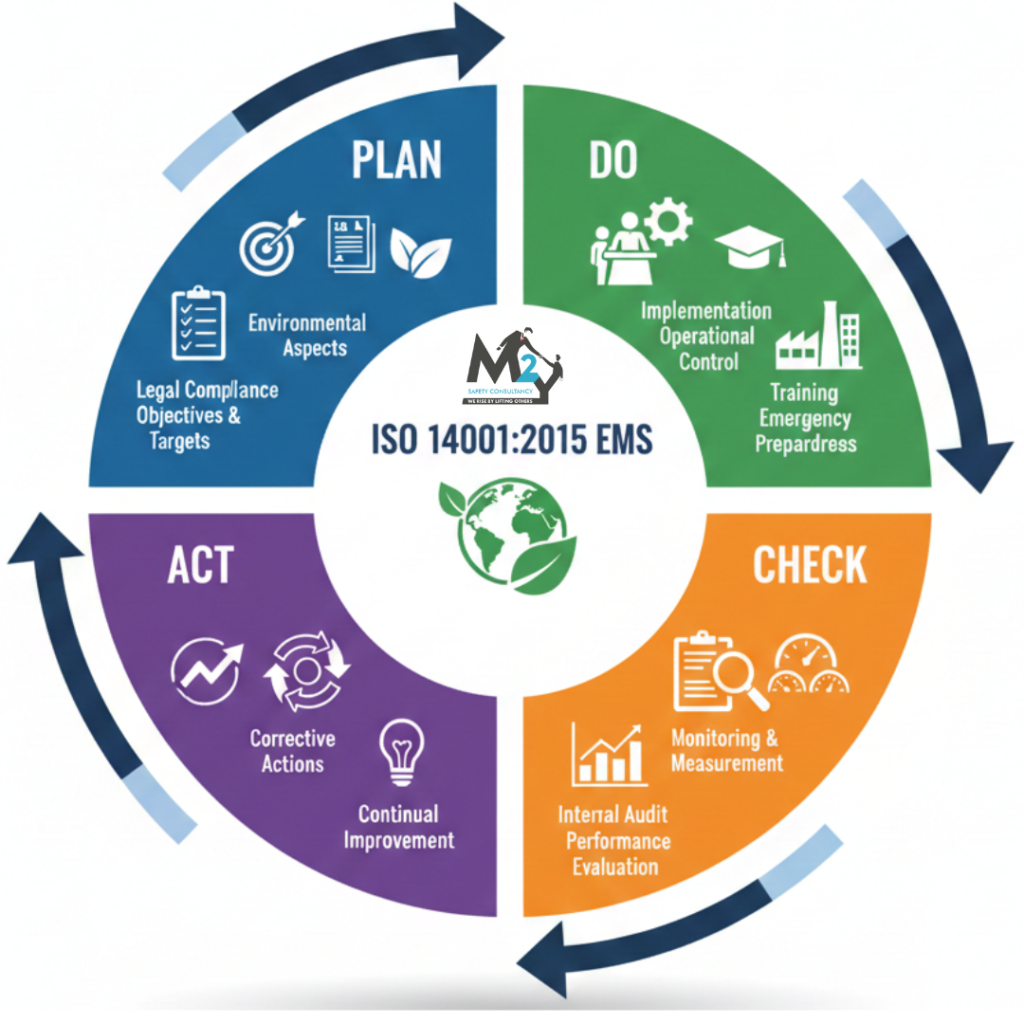
Plan-Do-Check-Act Cycle
At its heart, ISO 14001 uses the PDCA cycle—a continuous improvement loop that keeps your EMS evolving:
Plan → Identify environmental aspects, set objectives, establish processes
Do → Implement the planned processes
Check → Monitor and measure processes against policy and objectives
Act → Take actions to continually improve
The Seven Key Clauses
While the standard contains ten clauses total, clauses 4-10 form the operational framework:
| Clause | Focus Area | What It Means for You |
|---|---|---|
| 4 | Context of the Organization | Understanding your business environment and stakeholder needs |
| 5 | Leadership | Top management commitment and environmental policy |
| 6 | Planning | Risk-based thinking, identifying environmental aspects and impacts |
| 7 | Support | Resources, competence, awareness, communication |
| 8 | Operation | Operational planning, emergency preparedness |
| 9 | Performance Evaluation | Monitoring, measurement, internal audits |
| 10 | Improvement | Corrective action, continual improvement |
The beauty of this structure? It’s flexible enough to work for a three-person trading company or a thousand-employee industrial facility.
Understanding Environmental Aspects and Impacts
This is where theory meets reality. An environmental aspect is any element of your activities, products, or services that can interact with the environment. The impact is the actual change to the environment, whether adverse or beneficial.
Let’s make this concrete with examples from clients we’ve worked with:
Manufacturing Facility:
- Aspect: Cooling water discharge
- Impact: Potential thermal pollution of receiving water body
- Control: Temperature monitoring, cooling towers, discharge permits
Office Building:
- Aspect: Paper consumption
- Impact: Resource depletion, waste generation
- Control: Digitalization initiatives, recycling program, sustainable procurement
Logistics Company:
- Aspect: Fleet fuel consumption
- Impact: Greenhouse gas emissions, air quality degradation
- Control: Route optimization, driver training, fleet modernization
You need to identify ALL significant aspects across normal operations, abnormal conditions (like startups and shutdowns), and reasonably foreseeable emergencies. Yes, it sounds exhaustive—because it is. But this comprehensive approach is what makes the system effective.
The Certification Journey: What to Really Expect
Let’s be honest about what ISO 14001 certification in UAE actually involves. We’ve seen companies rush through this and regret it, and we’ve seen others nail it by understanding the real timeline and commitment required.
Implementation Timeline
Month 1-2: Gap Analysis & Planning
├─ Initial assessment of current practices
├─ Stakeholder identification
└─ Resource allocation
Month 2-4: System Development
├─ Environmental aspects identification
├─ Legal requirements register
├─ Documentation development
└─ Procedure creation
Month 4-6: Implementation & Training
├─ Staff awareness programs
├─ Operational control implementation
└─ Emergency response procedures
Month 6-7: Internal Audits
├─ System verification
└─ Corrective actions
Month 8: Management Review & Pre-assessment
├─ Final system check
└─ Readiness assessment
Month 9: Certification Audit (Stage 1 & 2)
├─ Stage 1: Documentation review
└─ Stage 2: Implementation verification
Realistic timeline: 9-12 months for most organizations. Could you do it faster? Sure. Should you? Probably not. Rushing leads to superficial implementation that doesn’t stick.
Choosing Your Certification Body
Not all certification bodies are equal. In the UAE, you’ll want an accredited body recognized by entities like ESMA (Emirates Authority for Standardization & Metrology) or internationally accredited organizations.
Consider:
- Industry experience and understanding
- Auditor competence and language capabilities
- Certification turnaround time
- Ongoing support and communication
- Cost (but don’t make this your only criterion)
We typically recommend bodies that have worked in your specific sector. An auditor who understands hospitality operations will ask more relevant questions than one whose experience is purely industrial.
Common Challenges (And How to Overcome Them)
After working with countless organizations, we see the same stumbling blocks repeatedly. Here’s what to watch for:
Challenge 1: “It’s just a paperwork exercise”
This mindset kills EMS effectiveness immediately. Yes, documentation is required, but it should reflect what you actually do. We worked with a facilities management company that had beautiful procedures nobody followed. After rebuilding their system around actual workflows, adoption skyrocketed.
Solution: Involve the people doing the work in developing procedures. If a process document doesn’t make sense to the operator, it’s wrong.
Challenge 2: Lack of top management engagement
ISO 14001:2015 explicitly requires leadership commitment—and auditors can spot fake enthusiasm instantly. When senior management treats this as “the EHS manager’s project,” the whole organization follows suit.
Solution: Demonstrate ROI early. Identify quick wins that save money or reduce risk. Nothing gets management attention like tangible results.
Challenge 3: Identifying legal requirements
UAE environmental legislation spans federal, emirate, and free zone levels. It’s complex and constantly evolving.
Solution: Establish a robust legal register process. Subscribe to legal update services. Better yet, work with consultants who monitor regulatory changes as part of their core business (like us at M2Y Safety Consultancy—shameless plug, but it’s genuinely important).
Challenge 4: Maintaining momentum post-certification
We’ve seen companies celebrate certification, then watch their EMS gather dust. The standard requires continual improvement, and surveillance audits will check.
Solution: Set meaningful environmental objectives tied to business goals. Review performance monthly. Keep environmental topics on management meeting agendas.
Real Benefits: Beyond the Certificate
Let’s talk about what ISO 14001 actually delivers when properly implemented:
For Your Business
- Risk management: Identify environmental risks before they become expensive problems
- Competitive advantage: Many tenders require ISO 14001; some prefer it
- Legal compliance: Structured approach to meeting obligations
- Stakeholder confidence: Investors, customers, and communities increasingly demand environmental accountability
- Integration opportunities: Easier to implement other management systems
For Your Operations
- Resource efficiency: Systematic identification of waste and inefficiency
- Cost savings: Energy, water, materials, waste disposal
- Process improvement: Encourages questioning “why we do it this way”
- Employee engagement: Staff appreciate working for environmentally responsible employers
For the Environment
Let’s not forget the actual point: reducing environmental harm. The aggregate impact of thousands of certified organizations making incremental improvements is genuinely significant. Your contribution matters.
ISO 14001 in the UAE Context
The UAE presents unique environmental challenges and opportunities that influence how you’ll implement the ISO 14001 standard here:
Climate considerations: Extreme temperatures drive massive energy consumption for cooling. Your EMS should prioritize energy efficiency.
Water scarcity: Water conservation isn’t just good practice—it’s critical. Monitoring consumption and exploring reuse opportunities should be central to your approach.
Regulatory environment: Federal Law No. 24 of 1999 for the Protection and Development of the Environment provides the overarching framework, but each emirate adds specific requirements. Dubai has different standards than Abu Dhabi, which differ from Sharjah.
Industry focus: If you’re in oil and gas, construction, hospitality, or logistics—the UAE’s dominant sectors—there are sector-specific environmental considerations your EMS must address.
The good news? The UAE government actively supports environmental initiatives. Many free zones offer incentives for certified companies, and federal procurement increasingly favors organizations with robust environmental credentials.
Getting Started: Your Action Plan
Ready to begin your ISO 14001 journey? Here’s your practical roadmap:
Step 1: Secure Leadership Commitment
Schedule a presentation for top management. Focus on business benefits, not just compliance. Get budget and resource allocation confirmed.
Step 2: Conduct a Gap Analysis
Where are you now versus where you need to be? This informs your implementation plan and timeline.
Step 3: Build Your Team
Appoint an EMS Manager or team. Consider whether you need external support (hint: most organizations benefit from experienced guidance, at least initially).
Step 4: Develop Your Environmental Policy
This is your public commitment. Make it meaningful, specific to your context, and approved by top management.
Step 5: Identify Aspects and Impacts
Walk through your operations systematically. Document everything that interacts with the environment.
Step 6: Establish Legal and Other Requirements
Build your legal register. This is time-consuming but absolutely critical.
Step 7: Set Objectives and Targets
What will you improve? By how much? By when? Make objectives SMART (Specific, Measurable, Achievable, Relevant, Time-bound).
Step 8: Implement Operational Controls
Put procedures in place to manage significant aspects and meet legal requirements.
Step 9: Train Your People
Everyone should understand the EMS, their role, and the significance of their activities.
Step 10: Monitor, Audit, Review
Check that your system works. Find gaps. Fix them. Repeat.
Is ISO 14001 Right for Your Organization?
Honest answer: it depends. ISO 14001 works brilliantly for organizations that:
- Have significant environmental aspects to manage
- Face pressure from customers, regulators, or stakeholders regarding environmental performance
- Want to systematically reduce operational costs through resource efficiency
- Operate in environmentally sensitive contexts
- Have commitment from leadership to actually implement change
It’s less valuable for organizations that:
- View it purely as a marketing tool
- Won’t allocate sufficient resources
- Expect certification to magically solve problems without process changes
- Are only pursuing it because a customer demanded it (without understanding why)
That said, virtually every organization has environmental impacts worth managing better. The question is whether the structured ISO 14001 approach aligns with your organizational maturity and readiness for change.
Moving Forward: Your Next Steps
Environmental management isn’t getting any less important. Climate change, resource scarcity, and stakeholder expectations will only intensify. The organizations thriving tomorrow are building robust environmental management capabilities today.
ISO 14001 provides a proven framework to do exactly that. It’s not perfect—no standard is—but it’s battle-tested across hundreds of thousands of organizations worldwide.
At M2Y Safety Consultancy, we’ve walked countless organizations through this journey. We understand the UAE regulatory landscape, the practical realities of implementation, and how to build systems that actually work (not just look good on paper).
Whether you’re just exploring the possibility of certification or actively preparing for your audit, the key is to start. Begin with that gap analysis. Get leadership on board. Take the first step.
Need help getting started with ISO 14001 certification in UAE? Our team specializes in practical, results-focused environmental management system implementation. We don’t just help you get certified—we help you build systems that improve performance, reduce costs, and stand up to the scrutiny of both auditors and stakeholders.
Contact M2Y Safety Consultancy today for a no-obligation discussion about your environmental management needs. Let’s build something that makes a real difference.